Les sites web qui hébergent du contenu tiers pour profiter de leur autorité dans Google (appelés “parasites seo”) sont dans la ligne de mire de la firme de Mountain View. Une nouvelle politique qui bouleverse les stratégies SEO établies. Moz a défini 5 niveaux de risque afin d’évaluer la vulnérabilité des sites face à ce changement majeur !
Ce qu’il faut retenir :
- Au cours de l’année, Google a lancé une série d’actions manuelles ciblées contre les sites exploitant abusivement leur réputation via du contenu tiers, particulièrement dans les secteurs des coupons et des jeux d’argent.
- Les grandes marques utilisant des sous-domaines pour héberger du contenu affilié sont les plus à risque.
- La distinction entre actions manuelles et algorithmes reste floue, suggérant une possible évolution vers une détection automatisée.
En mars 2024, Google annonçait la mise en place d’une nouvelle politique anti-spam visant spécifiquement « l’abus de réputation des sites », une pratique consistant à publier des pages tierces dans le but d’exploiter les signaux de classement d’un site hôte réputé, aussi appelé “parasite SEO”. Cette annonce s’est concrétisée par une série d’actions pénalisantes qui ont frappé de plein fouet certains grands noms du web.
Une succession d’actions pénalisantes pour le parasitage
La première vague de sanctions est tombée en mai 2024, ciblant particulièrement les sites proposant des coupons de réduction et les contenus liés aux jeux d’argent aux États-Unis. Des sous-domaines comme coupons.usatoday.com ou coupons.cnn.com ont ainsi vu leur visibilité s’effondrer dans les résultats de recherche.
La situation s’est complexifiée en octobre 2024 avec une deuxième salve de pénalités touchant d’autres grandes marques. Google a alors précisé qu’il ne s’agissait pas d’actions liées à l’abus de réputation, mais plutôt de systèmes détectant si une section d’un site différait radicalement de son focus principal. Cette déclaration a semé le trouble, suggérant une composante algorithmique aux pénalités.
Enfin, une troisième vague de sanctions manuelles est survenue en novembre 2024, pendant la mise à jour majeure du cœur de l’algorithme, amplifiant les effets des pénalités d’octobre.
Une échelle de risque SEO à 5 niveaux
Face à cette situation complexe, une échelle de risque inspirée du système DEFCON a été développée par MOZ afin d’évaluer la vulnérabilité des sites face à la nouvelle politique de Google.
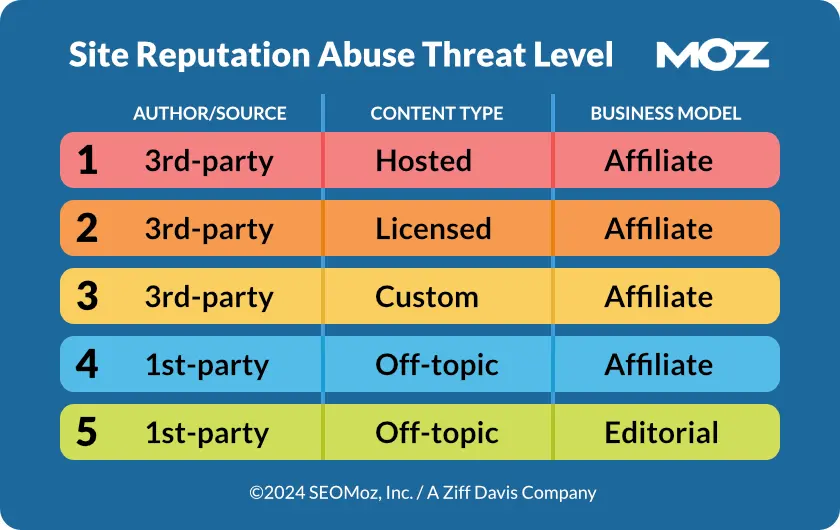
Version du tableau en français :
| Source de l’info | Type de contenu | Modèle éco. | Exemple |
|---|---|---|---|
| Rédigé par un tiers | Simplement hébergé | Affiliation | Sous-domaine de codes promos d’un média généraliste |
| Rédigé par un tiers | Sous licence / loué | Affiliation | Répertoire de conseils d’investissement sur un média généraliste |
| Rédigé par un tiers | Contenu personnalisé | Affiliation | Rubrique de vente de tondeuses, rédigée par un tiers, sur un site de déco |
| Rédigé par vous | Hors sujet | Affiliation | Rubrique de voyance sur votre site de rachat de crédit |
| Rédigé par vous | Hors sujet | Editorial | Blog Jardin dédié à la vente de liens de votre site d’info généraliste |
Niveau 1 – Sous-domaines dédiés
Ce niveau représente la menace la plus élevée et concerne principalement les sites qui hébergent du contenu tiers sur des sous-domaines ou sous-dossiers. Ces contenus sont généralement fortement monétisés et créés dans le but explicite de profiter de la réputation du site principal pour améliorer leur classement SEO.
Les exemples les plus flagrants sont les grands médias américains comme USA Today, CNN, Business Insider ou CNET, qui ont vu leurs sections de coupons (hébergées sur des sous-domaines comme coupons.usatoday.com) perdre presque toute leur visibilité dans les résultats de recherche.
Étant lui-même registrar de noms de domaine, Google peut facilement détecter ces pratiques via les enregistrements CNAME. La détection est d’autant plus simple que ces contenus sont souvent massivement distribués et présentent des schémas facilement identifiables.
Niveau 2 – Contenu tiers sous licence
Cette catégorie, bien que techniquement différente du niveau 1, présente un risque presque tout aussi élevé. Elle englobe les sites qui obtiennent du contenu sous licence auprès de tiers, mais l’hébergent et le diffusent eux-mêmes sur leur infrastructure. Des sections comme forbes.com/advisor, marketwatch.com/guides, cnn.com/cnn-underscored ou wsj.com/buyside en sont des exemples représentatifs.
Ces contenus, même s’ils sont personnalisés avec la charte graphique et le logo du site hôte, restent fondamentalement du contenu dupliqué distribué à plusieurs partenaires. La personnalisation superficielle ne suffit pas à masquer la nature standardisée du contenu sous-jacent. Les sites concernés ont subi des pertes majeures de visibilité lors des dernières mises à jour de Google.
Niveau 3 – Contenu tiers personnalisé
Ce niveau marque l’entrée dans une zone grise où l’évaluation du risque devient plus complexe. Il concerne les sites qui commandent du contenu sur mesure à des tiers. Bien que Google reconnaisse la légitimité des « colonnes, articles d’opinion et autres travaux de nature éditoriale », le moteur de recherche reste vigilant quant au contenu manifestement créé pour exploiter des opportunités SEO sans lien avec l’audience naturelle du site.
Un exemple cité par Google est celui d’un site de critiques cinématographiques qui publierait du contenu optimisé pour cibler les « meilleurs services de rédaction d’essais ». Même si ce contenu est unique et créé spécifiquement pour le site, son intention purement SEO et son décalage avec la thématique principale du site le rendent suspect aux yeux de Google.
Niveau 4 – Contenu hors sujet produit en interne
La notion de contenu « hors sujet » introduite par Google soulève de nombreuses questions. Ce niveau concerne les sites qui produisent en interne du contenu original, mais clairement orienté vers la monétisation via l’affiliation, sur des thématiques éloignées de leur cœur de métier. Par exemple, un site d’actualités sportives locales publiant des articles sur les meilleures cartes de crédit avec cashback transgresse l’esprit des nouvelles règles, même si le contenu est original.
Google fait une distinction entre les liens d’affiliation isolés dans du contenu éditorial (acceptables s’ils sont correctement déclarés) et les modèles agressifs d’affiliation où le contenu est créé uniquement pour générer des commissions. Notons que les sites de jeux vidéo publiant des guides sur les cartes cadeaux avec du contenu sponsorisé semblent pour l’instant moins à risque, selon les directives actuelles de Google.
Niveau 5 – Contenu éditorial occasionnellement hors sujet
Le niveau de risque le plus faible concerne les sites qui produisent occasionnellement du contenu éditorial s’écartant de leur thématique principale. Google a clairement indiqué que ce type de contenu ne pose pas de problème tant qu’il s’agit d’un véritable travail éditorial original. Cependant, le moteur de recherche met en garde contre les tentatives de contournement consistant à simplement étiqueter du contenu tiers comme « Revue éditoriale ».
Selon Google, « aucune implication éditoriale ne peut modifier la nature fondamentalement tierce du contenu ou le caractère déloyal et exploiteur de la tentative de profiter des signaux de classement du site hôte ». Cette précision souligne l’importance de l’authenticité du travail éditorial plutôt que des étiquettes superficielles.
L’affiliation dans le viseur de Google ?
Bien que Google affirme ne pas cibler spécifiquement le contenu affilié, la majorité des sites pénalisés exploitaient ce modèle économique (appelés par le passé Made For Adsense ou “MFA“). La recommandation officielle d’indiquer explicitement les liens d’affiliation ne résout pas le problème fondamental : l’utilisation de marques autoritaires pour propulser du contenu tiers dans les résultats de recherche sur des mots-clés compétitifs.
Pour les sites opérant aux niveaux de risque 1 et 2, le danger est imminent. Ceux au niveau 3 devraient sérieusement réfléchir à leur stratégie pour les mois à venir, sans nécessairement supprimer tout leur contenu. La probable intégration de ces critères dans l’algorithme suggère qu’une approche prudente et réfléchie est désormais nécessaire en matière de contenu tiers et d’affiliation.
L’article “Parasite SEO : évaluez le risque pour votre site !” a été publié sur le site Abondance.