Le TrustFlow (TF) est un indicateur développé par Majestic qui mesure la qualité d’un site en fonction des backlinks qu’il reçoit. Cet indicateur est souvent utilisé pour évaluer si un site est intéressant pour un backlink, en particulier sur les plateformes de vente de liens. Pour certains, gonfler artificiellement leur TF permet de mieux se positionner sur ces plateformes ou de vendre davantage de liens en misant sur une évaluation superficielle des acheteurs. Mais comment cela fonctionne-t-il, et quelles sont les pratiques associées à la manipulation du TrustFlow ?
Faire grimper son TrustFlow de manière classique
Le TrustFlow peut être augmenté relativement facilement en utilisant des liens provenant de pages d’accueil ou des redirections 301 issues de domaines expirés. Voici une démonstration concrète issue d’une vidéo de Jérôme Pasquelin, qui montre comment passer d’un domaine vierge à un site avec les métriques suivantes :
- TF : 32 pour le domaine racine,
- TF : 53 pour la page d’accueil.
Stratégies utilisées
- Liens depuis des pages d’accueil :
- Un lien depuis une page avec un TF de 40.
- Un lien depuis une page avec un TF de 30.
- Un lien depuis une page avec un TF de 39.
- Redirections 301 depuis des domaines expirés :
- Une redirection 301 d’un domaine avec 10 RD, un TF de 21 (root domain) et un TF de 33 depuis la page d’accueil.
- Une redirection 301 d’un domaine avec un TF de 25 (root domain) et un TF de 40 depuis la page d’accueil.
- Canonical links :
- Une redirection canonical depuis un site ayant un TF de 19 (root domain) et un TF de 30 depuis la page d’accueil.
Points clés à retenir
- Les liens depuis des pages d’accueil ont un impact significatif sur le TF. La page d’accueil ayant souvent un TF plus élevé que le domaine racine, ces liens sont précieux pour booster rapidement les métriques.
- Les redirections 301 ont un effet similaire : elles transfèrent du TrustFlow à la cible.
- Les liens sitewide (présents sur toutes les pages d’un site) et les canonical ont également un impact positif sur le TF.
- Plus un site a de backlinks et de domaines référents, moins le TF bouge rapidement sous l’effet de ces actions.
- Même les pages non indexées peuvent avoir de belles métriques.
Ces manipulations influencent aussi le Citation Flow (CF), même si c’est dans une moindre mesure. Le CF, comparable au PageRank historique de Google (avant 2012), mesure davantage la quantité de liens et leur jus que leur qualité.
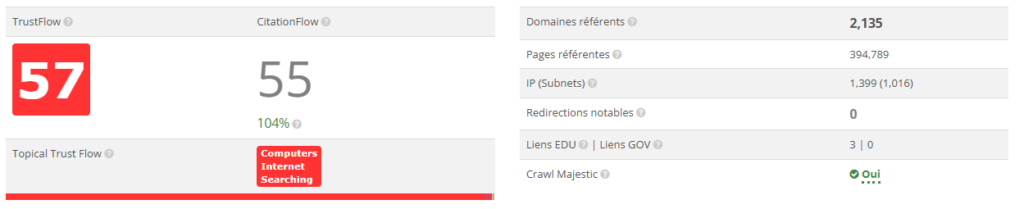
Exemple de TrustFlow et de CitationFlow visibles sur SEObserver (qui récupèrent les métriques de Majestic) :
Manipulations frauduleuses du TrustFlow
Ces pratiques, bien que calculées, s’inscrivent dans le fonctionnement normal de Majestic. Elles ne constituent pas de la triche à proprement parler. Mais existe-t-il des moyens plus douteux de manipuler le TrustFlow ? Malheureusement, oui. Voici deux exemples basés sur le cloaking, une technique visant à présenter un contenu différent à Majestic et à Google.
Méthode 1 : Faire croire à un site énorme
Dans le passé, certains ont exploité l’idée que chaque nouvelle page créée sur un site apporte un petit boost de PageRank. En créant des centaines de milliers de pages artificielles, ils augmentaient le PageRank global du site, et donc son TF.
Stratégie
Ces pages n’étaient accessibles qu’au robot de Majestic (via cloaking), tandis que Google ne pouvait pas les voir (car la méthode est dangereuse, voire suicidaire). Ainsi, Majestic considérait ces pages comme légitimes et augmentait les métriques du site.
Limitations actuelles
Aujourd’hui, cette méthode est normalement devenue obsolète. Majestic a introduit un indicateur “is_spam” qui détecte les sites ressemblant à des fermes à liens ou créant des pages artificielles en masse. Ces pratiques sont donc beaucoup moins efficaces en 2025. Et c’est une bonne nouvelle pour notre crédibilité..
Méthode 2 : Simuler des backlinks non visibles par Google
Cette méthode repose également sur le cloaking, mais cible cette fois la création de backlinks.
Stratégie
En ajoutant des liens home page ou sitewide sur plusieurs sites appartenant au même réseau, et en les rendant visibles uniquement pour le robot de Majestic (maj12), le TF augmente artificiellement. Google, ne voyant pas ces liens, ne peut pas identifier le réseau de sites pour cette manipulation.
Risques
Cette méthode existe depuis 15 ans et, bien que cette technique fonctionne encore pour certains, elle expose le réseau de l’utilisateur à des concurrents qui pourraient détecter et signaler ces pratiques frauduleuses.
S’appuyer uniquement sur le TrustFlow pour acheter des liens est risqué. Ce type d’indicateur peut être manipulé, que ce soit par des méthodes acceptables ou frauduleuses. Avant d’acheter des liens, analysez plusieurs éléments :
- La qualité des backlinks.
- Les ancres des liens.
- Les mots-clés positionnés du site.
- La structure et la pertinence du site.
- La légalité du site (mentions légales et sujets traités).
Finalement, si manipuler le TrustFlow peut sembler tentant, plaire à Google sur le long terme exige une stratégie plus authentique et durable. Le vrai travail consiste à créer un site de qualité qui répond aux attentes des utilisateurs, et non à courir après des métriques manipulables. Et demain, visons un monde où les plateformes de vente de liens n’auront plus à souffrir de ces indicateurs tiers manipulés.
L’article “Manipulation du TrustFlow : optimisation ou triche ?” a été publié sur le site Abondance.