Backlinks are among those signals that Google has never stopped listening to. And despite the constant changes to the algorithm, link building remains a pillar of SEO. But then, how much does it really cost to buy a backlink?
In an SEO strategy, inbound links play a central role. They tell Google that other sites “trust” yours, which boosts its credibility in the search engine's eyes. It's simple on paper, except that in practice, not all backlinks are equal. Neither in quality nor in price.
Behind the “netlinking” label, you find a jungle of platforms, marketplaces and direct sellers, each with its own calculation methods. The cost of a backlink varies according to dozens of factors: site authority, estimated traffic, language, topic, country, type of link offered, exposure options, intermediary fees… In short, it's impossible to produce a single price that would apply to everyone.
But to make things clearer, Link Finder, an analytics and price-comparison tool for buying backlinks, conducted a large-scale study: more than 400,000 sites analyzed, spread across 30 netlinking marketplaces in France and internationally. The goal? Understand how prices are set, identify glaring differences between countries, and point out the real factors that influence rates. In this article, we get into the meat of it: backlink prices, geographic variations, SEO metric biases, estimation techniques, pitfalls to avoid. We examined everything with a fine-tooth comb. With one guiding thread: to help you buy smarter, without being fooled by an inflated Domain Rating (DR) or an unfounded price.
Key takeaways:
- The median price of a backlink in France is the lowest in Europe (€87).
- An expensive backlink is not necessarily more effective.
- SEO metrics like DR or traffic can be manipulated.
- A site that ranks for real keywords is often better than a site with a high score.
- A good backlink is judged by relevance, not by the label.
How much does a backlink cost in France?
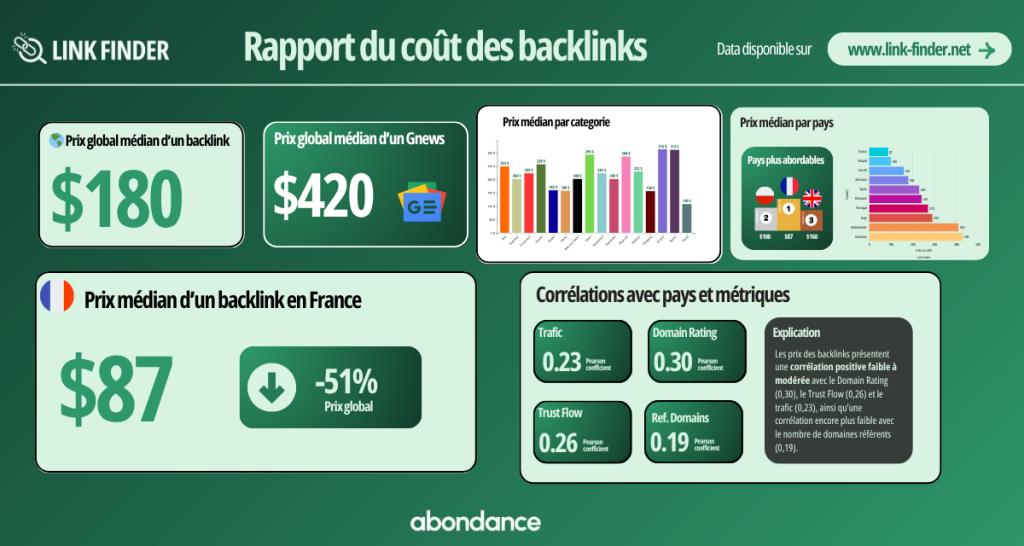
€87. This is the median rate observed for a backlink in France according to the Link Finder study. It's also the lowest price among all countries analyzed. For comparison, the global median is around €180. In other words, buying a link in France costs half as much as the international average.
Within the French ecosystem itself, there are significant disparities. Some publishers push prices down, often at the expense of quality. Others bet on more demanding sites, integrated into recognized media or with high SEO trust.
This is particularly the case for sites listed on Google News, often called “Gnews”. These outlets are sometimes considered SEO “gems”, rightly or wrongly. Their presence in the news feed can push prices up to several hundred euros per link, well beyond the French median.
In other words: the French market is cheap, until it isn't anymore. It all depends on where you buy, and from whom.
Specifics of the link-building market in France
If the backlink prices in France are so low, it's mainly a matter of supply. There is a large number of sellers on the local market: independent publishers, SEO agencies, specialized platforms… The network is dense, catalogs are well stocked, and tools to buy links are widely democratized.
Buying backlinks there has become common practice, almost institutionalized. No need to negotiate case by case or spend hours on relationship-building, everything is industrialized, a click away.
This abundance naturally pushes prices down. When hundreds of sites offer links on similar topics, competition plays out as much on metrics as on the listed price. And since platforms often take a cut, publishers have to adjust their prices to stay visible.
For a French consultant or agency, this dynamic is rather favorable. It makes it possible to obtain backlinks at a lower cost, provided you know how to choose them. Because even if the supply is large, quality, however, varies greatly.
How much does a backlink cost abroad?
If you find the French market expensive, wait until you take a look at the prices charged by our neighbors.
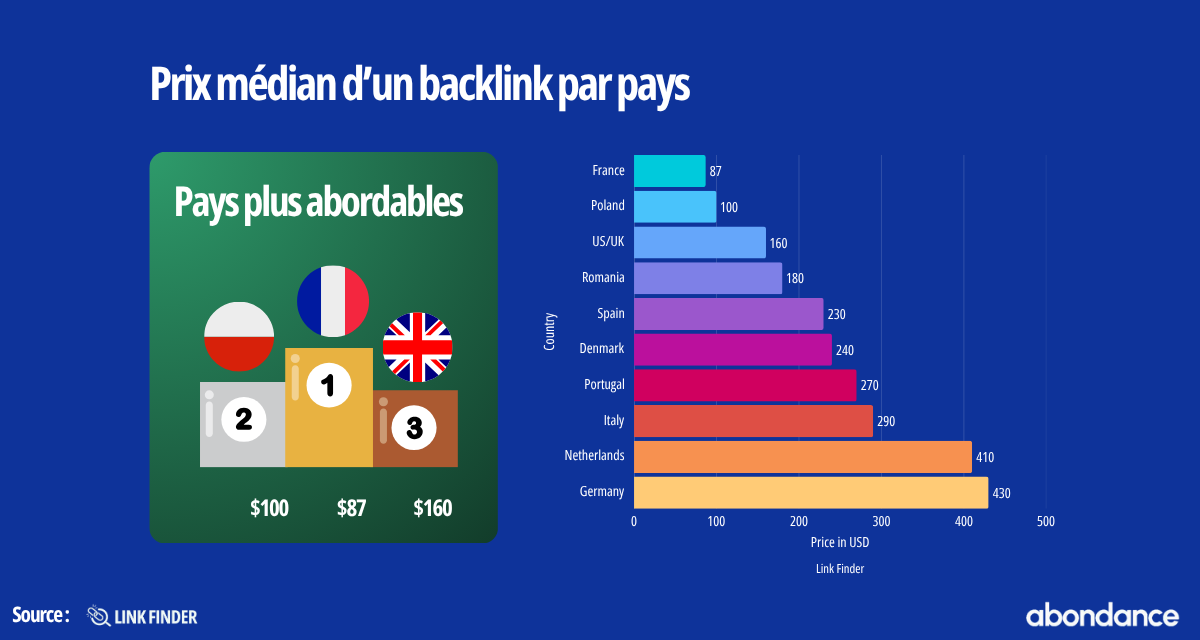
Link Finder's study makes it very concrete to compare the prices charged in different countries. And the variation is striking: from €87 in France to more than €400 in the Netherlands and Germany. Yes, you read that right, a link costs on average nearly five times more expensive in some of our European neighbors.
Here are some reference points to situate the cost of a backlink elsewhere:
- France : €87
- Poland : €100
- US/UK : €160
- Romania : €180
- Spain : €230
- Denmark : €240
- Portugal : €270
- Italy : €290
- Netherlands : €410
- Germany : €430
The gap is striking. The United States and the United Kingdom remain relatively affordable given their economic weight, with a median around €160, close to the global average.
On the other hand, the German-speaking markets (Germany, the Netherlands) are literally off the charts. There, the median price exceeds €400 per linkNeedless to say, you need a solid budget, or a very good strategic reason, to invest in these areas.
Several factors lie behind these gaps:
- A less industrialized market than France's
- Fewer automated platforms
- Stronger competitive pressure on certain topics
Buying a link "abroad" is therefore not trivial. Depending on your geographic target and your SEO strategy, it can be an effective lever, or a hard-to-justify expense.
What factors influence the cost of a backlink?
Why does a link cost €30 on one site and €300 on another that looks almost identical? If you've ever bought links, you've certainly asked yourself that question. In reality, the price of a backlink depends on a set of intertwined variables, rarely visible at first glance.
Link Finder's study helps to better understand these mechanisms by cross-referencing hundreds of thousands of listings with their SEO metrics and advertised prices. Result: no single factor can predict the cost of a link, but some elements almost always recur in how the price is constructed.
The main criteria that affect the price
- Perceived site authority : scores like DR (Domain Rating), TF (Trust Flow) or the number of referring domains (RD) influence prices. Even if these metrics can be manipulated, they are still widely used by platforms to set a pricing baseline.
- Estimated traffic : the more visits a site receives, the more it is considered "powerful." Some publishers artificially inflate their traffic (we'll discuss this further below), but for genuine active sites, traffic is often used as leverage to justify higher prices.
- Topic or industry niche : a backlink on a generalist lifestyle site will not be priced like a link in fintech, health, or SaaS. The less saturated a topic is, the faster prices rise.
- Offered link format : contextual link in an article, sidebar link, homepage link, discreet mention, or optimized anchor — each variation impacts the price. And sometimes small details are costly.
- Language and geolocation : publishing in English or on sites localized in highly competitive countries drives prices up. The reverse is also true: emerging or non‑English markets are often cheaper.
- Additional options : promotion on the homepage, inclusion in a newsletter, sharing on social networks, human (or AI) writing, inclusion of visuals, revisions. All of that is taken into account in the final quote.
- Purchase method : a backlink bought directly from a publisher will often be cheaper than one ordered through a platform or agency. But time savings, security, or selection naturally come at a price.
And what about SEO metrics?
One might think that a site with a high DR, lots of estimated traffic and hundreds of referring domains is automatically worth more. Makes sense, right? The higher the metrics, the more the link should cost.
In reality, things are less clear-cut than that.
Link Finder's study showed that these indicators only partially explain the actual price of a backlink.
Let's take a few examples:
- The DR (Domain Rating) does influence prices, but only in 30% of cases about (correlation of 0.30)
- The TF (Trust Flow) has a slightly weaker effect: 0.26
- Estimated traffic has even less impact: 0.23
- And the number of referring domains (RD) is the least decisive: 0.19
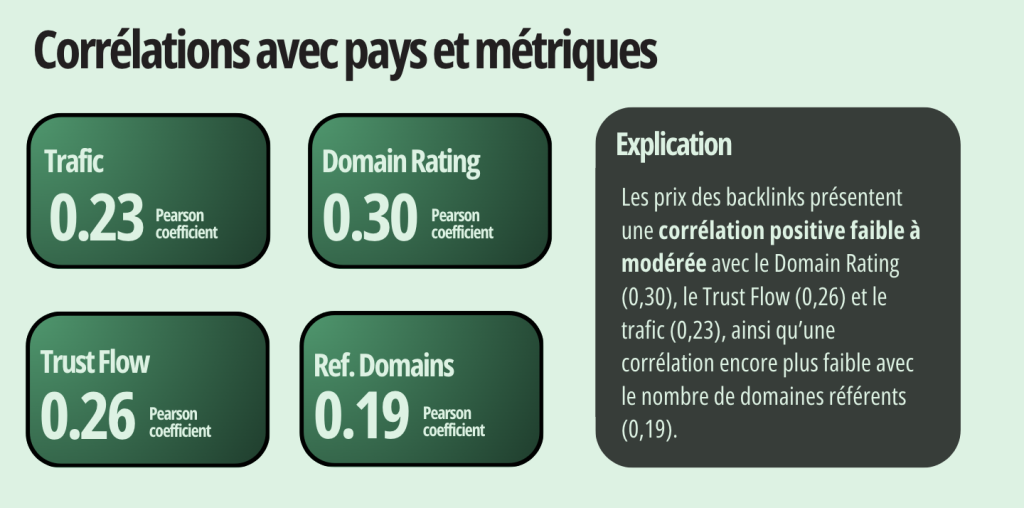
In other words, the price of a backlink never depends on a single metric.
Each factor plays a role but none is decisive on its own.
Two sites with a DR of 50 can have radically different prices, simply because:
- one has fresh, well-themed content,
- the other has been inactive for six months,
- or because one is sold directly and the other through a platform that charges a commission.
That's why it's risky to base a purchase decision solely on a visible score. And that's precisely where the Link Finder tool can make the difference ! It compares real prices observed on thousands of sites, which gives you a much more reliable basis for assessing a link's value for money.
The problem of manipulating metrics to inflate prices
You see a site with a DR of 60, a reasonable Trust Flow, and several thousand monthly visitors displayed on Similarweb. The backlink price is high, which makes sense. Except this site doesn't rank for any relevant keywords. It receives barely two valid links. And its traffic, on closer inspection, appears heavily automated.
Welcome to the inflated metrics game.
Today, the majority of link-building platforms use pricing algorithms. These algorithms rely on well-known SEO indicators: DR, TF, CF, estimated traffic, number of referring domains… In other words, the higher the scores, the higher the price.
The problem? Site owners have learned to play the game. All it takes is a few well-placed links, a bit of optimization on discreet PBNs (Private Blog Network, that is private blog network in French), or a pinch of well-scripted “organic” traffic to blow up the counters. Result: a site that looks solid on the surface, but that will pass on little or nothing to your SEO.
Don't stop at metrics alone
The reflex is to filter by DR or traffic. But that's not enough. To judge the real value of a backlink, you have to dig a little deeper:
- Which real keywords are ranking?
- Which links point to the site?
- Is the content active, themed, indexed?
Because yes, a site with no traffic can sometimes do the job. If its content is well placed, if it is in a clean niche, and if it sends a contextual link to a well-indexed page, that can be enough. It's often riskier, but also cheaper.
Conversely, a site that ranks for solid keywords and attracts real traffic is generally a much better signal for Google. It shows that it's alive, credible, and has a real form of authority. Does it pass more SEO juice? Not always. But it inspires more trust, to Google as to you.
How to define your link-building budget
Spending on links is easy. Spend wisely, that's another matter.
Setting a link-building budget is not just about 'what's left at the end of the month' or copying a competing agency's rates. It's rather about answering a simple question: how many backlinks do you need to surpass your SEO competitors and at what realistic cost?
Start by looking at what others are doing
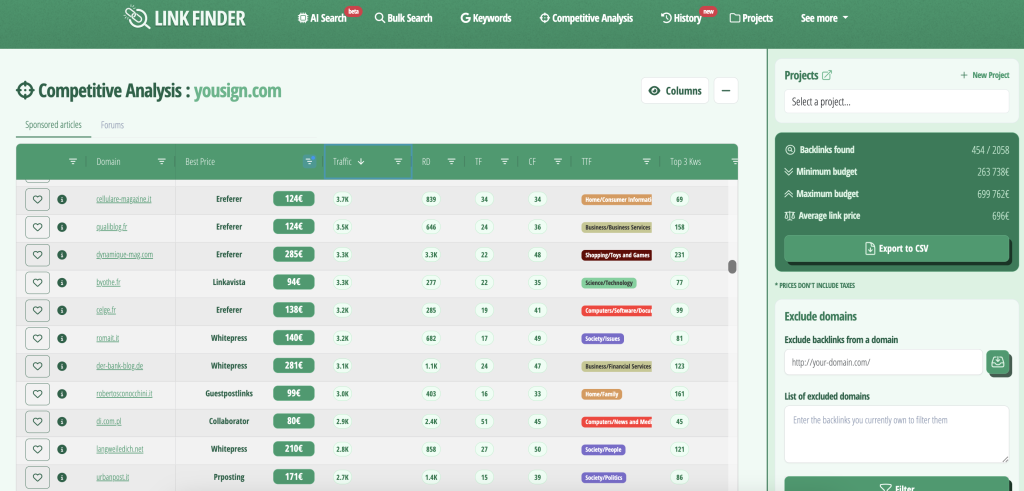
Before pulling out your credit card, take a look around. Tools like Ahrefs, Semrush, Majestic, and of course theLink Finder competitive analysis, allow you to see how many links point to the pages that rank for your target keywords.
You can also analyze estimated budgets, focusing on backlinks bought on marketplaces. Small tip: filter links over €1,000 to exclude “prestige” media that very few buyers actually target. This will give you a more realistic view of SEO investments in your market.
Set a target volume (and aim for a small surplus)
Once you have identified your SEO targets, list the keywords to aim for, and analyze the backlinks that support the well-ranking pages. Look at their quality, diversity, and origin. This will allow you to estimate:
- The number links you would need
- The type sites to prioritize
The +10 to +30% rule is a good benchmark. Aim for slightly more links than your direct competitors, and ideally of better quality. This small gap can make the difference.
Spread spending over time
It's a common mistake to blow €20k or €30k on a single link-building campaign, then wait a year. Bad idea. Not only is Google likely to detect an artificial pattern, but you also lose the “maturity” effect that regular acquisition provides.
A budget smoothed over time is more effective. With the same budget, investing €2,000/month for 11 months is far better than a one-shot €22,000. It's more natural in Google's eyes, it leaves room for adjustment, and it better fits the dynamics of an evolving SEO project.
In short: benchmark, adjust, and treat your backlinks as a regular investment, not a gamble.
Frequently asked questions about backlink costs
Even after diving into the numbers, benchmarks, and DR/€ ratios, there are still gray areas. Here are some concrete answers to the questions we hear most often about cost of a backlink and managing the link-building budget.
Is a €500 backlink necessarily better than a €50 link?
No. Price is never an absolute guarantee of quality. Some sites charge high fees because they're old, well-ranked, or linked to a known media outlet. But that doesn't guarantee they'll pass SEO value to you.
Conversely, €50 links can work very well If the site is healthy, well-themed, and the content is well integrated. It all depends on the context. What matters is not what you pay, but what you actually get.
Can you negotiate the price of a backlink?
On many platforms, it's possible. They use algorithms that often mirror the competition. If you spot the same site sold for less elsewhere, don't hesitate to contact the platform, some adjust prices on the fly.
The Link Finder tool is precisely designed to compare backlink prices across marketplaces, which helps avoid overpaying for a link that's sold three times cheaper elsewhere.
Can you get quality backlinks for less than €20?
Yes, It exists. But at that price, you shouldn't expect to land a premium link on a high-traffic site. You'll mostly find backlinks on small blogs or sites with modest metrics.
That said, low metric ≠ useless link. A well-themed niche site with a well-placed anchor can sometimes do the job much better than an overrated "big" generalist site.
What is the average lifespan of a purchased backlink?
On average, a link remains active between 1 and 3 years, depending on the platforms and agreements made. Some publishers guarantee publication for life (or almost), others may remove articles after a year. Always check the terms.
And keep in mind that sites themselves can disappear, change CMS, or lose their indexing. Nothing is ever completely fixed.
What are the alternatives for getting free links?
It's possible, but nothing is really "free". You can get backlinks without paying:
- By writing guest posts
- By exchanging links with other sites
- By creating highly shareable content (linkbaiting)
- By answering interviews, calls for testimonials, etc.
But all that takes time, energy, relationships. The cost isn't monetary, but it exists. Let's say it's another form of investment, often complementary to outright purchases.
The article “How much does a backlink cost? [Complete study]” was published on the site Abondance.