Google met à jour sa documentation en ajoutant un nouveau user agent baptisé Google-CWS. Ce dernier est utilisé par le Chrome Web Store dans le cadre des “user-triggered fetchers”, c’est-à-dire des récupérations de contenu déclenchées par les actions des utilisateurs.
Ce qu’il faut retenir :
- Google a ajouté un nouveau user agent nommé Google-CWS, propre au Chrome Web Store.
- Ce user agent agit lorsqu’un utilisateur interagit avec une extension ou un thème Chrome, et qu’une URL externe est sollicitée.
- Les “user-triggered fetchers” n’obéissent pas toujours aux directives de robots.txt, car ils dépendent d’une action humaine, non d’un crawl automatisé.
- On peut reconnaître ce fetcher dans les logs serveur sous la forme “Mozilla/5.0 (compatible; Google-CWS)”.
Un nouveau agent débarque dans les logs
Avec l’arrivée de Google-CWS, les développeurs d’extensions Chrome vont désormais voir apparaître un nouvel agent dans leurs logs. Ce fetcher est lié directement aux actions effectuées dans le Chrome Web Store. Il se déclenche lorsqu’un utilisateur consulte, installe ou interagit avec une extension, et que cette extension référence une URL externe dans ses métadonnées.
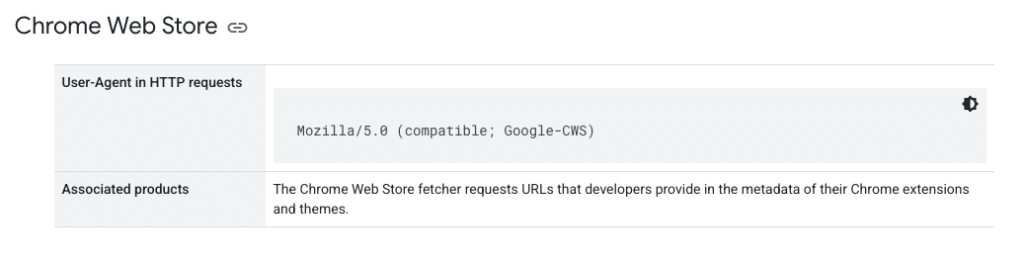
Google précise que ces requêtes ne sont pas effectuées par le crawler classique (Googlebot), mais par un mécanisme distinct et ponctuel, déclenché à l’initiative de l’utilisateur. Ce fonctionnement s’inscrit dans la famille des “user-triggered fetchers” déjà connue pour d’autres cas, comme Google Site Verifier ou certaines fonctionnalités hébergées sur Google Cloud Platform (GCP). Pour rappel, il y a quelques semaines, Google avait ajouté NotebookLM à ses User-Triggered Fetchers.
Pourquoi c’est important pour les SEO
Identifier ce nouveau user agent dans les logs peut éviter des confusions avec d’éventuelles activités suspectes. Contrairement à Googlebot, Google-CWS ne vise pas l’indexation des pages, mais la consultation de contenus liés à des extensions.
Cela permet aussi aux éditeurs et aux experts SEO de mieux comprendre certaines requêtes extérieures qui échappent aux filtres robots.txt, tout en confirmant leur provenance légitime via Google.
L’article “Google ajoute Google-CWS (Chrome Web Store) aux User-Triggered Fetchers” a été publié sur le site Abondance.