Cloudflare lance une fonctionnalité qui transforme automatiquement les pages web en Markdown pour les agents d’intelligence artificielle. Cette innovation baptisée « Markdown for Agents » promet de réduire drastiquement la consommation de tokens, mais soulève des questions épineuses sur les pratiques de référencement naturel et la transparence du contenu web.
Ce qu’il faut retenir :
- La conversion automatique HTML vers Markdown réduit la consommation de tokens de 80%, passant par exemple de 16 180 à 3 150 tokens pour un article de blog
- La fonctionnalité fonctionne via le header Accept: text/markdown et est disponible en bêta pour les clients Pro, Business et Enterprise de Cloudflare
- Google et Microsoft expriment leurs réserves, craignant que cette technologie facilite le cloaking, une pratique consistant à montrer un contenu différent aux robots et aux utilisateurs humains
Un problème de poids dans l’ingestion de contenu par les IA
Les systèmes d’intelligence artificielle font face à un défi de taille lorsqu’ils parcourent le web : le HTML est lourd, encombré d’éléments superflus pour une machine. Barres de navigation, scripts analytiques, balises CSS, footers garnis de dizaines de liens… autant d’éléments qui alourdissent les pages sans apporter de valeur sémantique aux agents IA.
Cloudflare illustre cette problématique avec une métaphore « Fournir du code HTML brut à une IA revient à payer au mot pour lire un emballage plutôt que le texte à l’intérieur ». Concrètement, une simple balise ## About Us en Markdown coûte environ 3 tokens, tandis que son équivalent HTML <h2 class=”section-title” id=”about”>About Us</h2> en brûle entre 12 et 15, sans compter les balises <div>, les barres de navigation et les scripts qui n’ont aucune valeur sémantique.
Le Markdown est rapidement devenu le langage des agents IA grâce à sa structure explicite qui facilite le traitement automatique tout en minimisant le gaspillage de tokens.
Un mécanisme de conversion à la volée
Le fonctionnement de Markdown for Agents repose sur la négociation de contenu HTTP. Lorsqu’un agent IA envoie une requête avec le header Accept: text/markdown, Cloudflare intercepte la demande, récupère le HTML d’origine depuis le serveur source, puis le convertit automatiquement en Markdown avant de le transmettre au client.
Pour les développeurs qui construisent des agents IA avec Workers, l’implémentation se fait simplement en TypeScript en spécifiant les headers appropriés. La réponse inclut un header x-markdown-tokens qui indique le nombre estimé de tokens dans le document Markdown, permettant aux développeurs de mieux gérer leurs fenêtres de contexte et leurs stratégies de découpage de contenu.
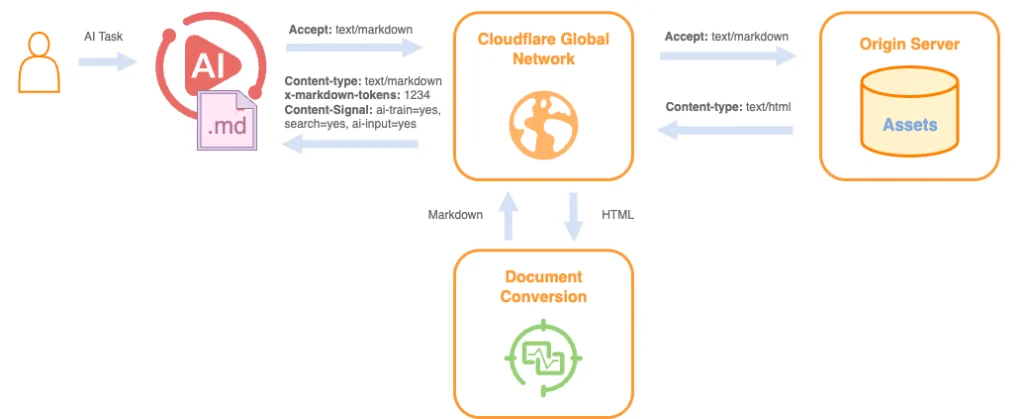
Cloudflare, qui alimente environ 20 % du web mondial, a déjà activé cette option sur son blog et sa documentation développeur. Des agents de codage populaires comme Claude Code et OpenCode envoient déjà ces headers d’acceptation avec leurs requêtes de contenu.
L’intégration des signaux de contenu
Les réponses converties par Markdown for Agents incluent automatiquement le header Content-Signal: ai-train=yes, search=yes, ai-input=yes. Ce signal indique que le contenu peut être utilisé pour l’entraînement de l’IA, les résultats de recherche et l’utilisation par des agents.
Cette implémentation s’inscrit dans le cadre des Content Signals, un framework que Cloudflare avait annoncé lors de sa dernière Birthday Week. Ce système permet à quiconque d’exprimer ses préférences concernant l’utilisation de son contenu après son accès. Cloudflare prévoit d’offrir des options pour définir des politiques de Content Signals personnalisées dans le futur.
Les inquiétudes du monde SEO autour du cloaking
Cette innovation ne fait pas l’unanimité dans la communauté du référencement naturel. Le principal grief concerne le risque de faciliter le cloaking, une pratique de black hat SEO qui consiste à servir un contenu différent aux robots d’indexation et aux utilisateurs humains.
Le header Accept: text/markdown étant transmis au serveur d’origine, il devient techniquement possible pour les propriétaires de sites d’injecter des instructions cachées ou des données modifiées destinées uniquement aux IA. Cette possibilité représente une brèche potentielle dans les principes de transparence qui régissent le web.
Les réactions de Google et Microsoft
Les géants de la recherche, en particulier Google et Bing, ont rapidement pris position contre cette pratique. John Mueller, de Google, s’interroge ouvertement sur la pertinence de cette approche : « Les LLM se sont entraînés sur des pages web classiques depuis le début, ils les ont lues et analysées. Il semble évident qu’ils n’ont aucun problème à traiter le HTML. Pourquoi voudraient-ils voir une page qu’aucun utilisateur ne voit ? Et s’ils vérifient l’équivalence, pourquoi ne pas utiliser le HTML ? ».
Fabrice Canel, de Microsoft, adopte une position encore plus ferme en prévenant que Bing crawlera de toute façon les deux versions, HTML et Markdown, pour vérifier leur similarité. Cette déclaration suggère que les moteurs de recherche pourraient mettre en place des mécanismes de contrôle pour détecter d’éventuelles divergences entre les versions servies aux différents types de visiteurs.
Une disponibilité immédiate en version bêta
Pour activer Markdown for Agents, les clients doivent se connecter au tableau de bord Cloudflare, sélectionner leur compte et leur zone, puis basculer le bouton Markdown for Agents dans les Quick Actions. La fonctionnalité est disponible dès aujourd’hui en version bêta sans coût supplémentaire pour les plans Pro, Business et Enterprise, ainsi que pour les clients SSL for SaaS.
Cloudflare propose également d’autres méthodes de conversion de documents vers Markdown pour les développeurs qui construisent des systèmes IA nécessitant une conversion arbitraire de documents en dehors de Cloudflare. Workers AI offre une fonction AI.toMarkdown() qui supporte plusieurs types de documents, pas seulement le HTML, ainsi que la synthétisation. L’API REST Browser Rendering /markdown permet la conversion Markdown si vous devez rendre une page dynamique ou une application dans un véritable navigateur avant de la convertir.
Un suivi des usages via Cloudflare Radar
Anticipant une évolution dans la façon dont les systèmes IA naviguent sur le web, Cloudflare Radar inclut désormais des informations sur les types de contenu pour le trafic des bots et crawlers IA. Ces données sont disponibles globalement sur la page AI Insights et dans les pages d’information individuelles de chaque bot.
La nouvelle dimension et filtre content_type affiche la distribution des types de contenu retournés aux agents et crawlers IA, regroupés par catégorie de type MIME. Il est également possible de visualiser les requêtes pour Markdown filtrées par agent ou crawler spécifique, comme OAI-Searchbot, le crawler utilisé par OpenAI pour alimenter la recherche de ChatGPT. Ces nouvelles données permettront de suivre l’évolution de la consommation de contenu web par les bots, crawlers et agents IA au fil du temps.
L’article “Cloudflare propose une conversion automatique du HTML en Markdown pour les agents IA” a été publié sur le site Abondance.