Si vous avez déjà travaillé sur un projet de développement de site web, vous avez sûrement déjà rencontré JavaScript. En effet, il s’agit depuis longtemps du langage de scripts le plus populaire.
TypeScript quant à lui, est un langage de programmation plus adapté aux grandes applications : open-source, il a été développé par Microsoft en 2012, principalement parce que le code JavaScript devenait trop complexe à gérer lorsqu’il s’agissait d’applications à grande échelle.
TypeScript est un sur-ensemble de JavaScript : de manière générale, tout ce qui est du code en JavaScript est donc également valable en TypeScript.
En résumé, JavaScript + davantage de fonctionnalités = TypeScript.
Ainsi, si vous enregistrez votre fichier JavaScript (.js) avec une extension TypeScript (.ts), il fonctionnera quand même parfaitement. Attention toutefois aux conclusions hâtives, en effet cela ne signifie pas pour autant que TypeScript et JavaScript sont identiques.
Avant d’exposer les différences entre les deux, comprenons à quoi ressemble chaque langage !
JavaScript
Souvent abrégé en JS, JavaScript est un langage de conception de logiciels qui suit la disposition ECMAScript. La compilation du JavaScript se fait immédiatement avant l’exécution.
Il contient un typage dynamique, une syntaxe à accolades, des fonctions de première classe et une orientation objet basée sur des prototypes. Avec les langages CSS et HTML, JavaScript est l’une des technologies essentielles du Web.
JavaScript permet de créer des pages Web interactives, qui constituent un aspect indispensable des sites internet modernes. Puisque l’immense majorité des sites internet l’utilisent pour le comportement de leurs pages côté client, il est logique que tous les navigateurs Web disposent d’un moteur JavaScript dédié à cet effet. A noter que si les moteurs JavaScript n’étaient autrefois présents que dans les navigateurs web, ils sont désormais insérés dans certains serveurs (généralement via Node.js). Il existe de nombreux dérivés de JavaScript comme TypeScript, CoffeeScript, Dart et Kotlin.
Ceux-ci sont également implantés dans de multiples applications formées avec des frameworks tels que Cordova et Electron.
En tant que langage de programmation multi-paradigme, JavaScript prend en charge les styles impératifs, événementiels et fonctionnels et dispose d’une interface de programmation d’applications (API) lui permettant de traiter les dates, le texte, les structures de données standard, le Document Object Model (DOM) sans oublier les expressions régulières.

Avantages de JavaScript
JavaScript peut être considéré comme la solution parfaite pour de petits projets web et les petites équipes. Il est courant d’utiliser JavaScript sans l’aide d’outils de construction, et si vous recourez à l’utilisation de frameworks, certains d’entre eux ne prennent pas en charge TypeScript.
De plus, en utilisant les bibliothèques et les frameworks JavaScript existants, vous pouvez développer des applications Web plus rapidement tout en rationalisant votre processus de développement logiciel.
TypeScript a besoin d’installer les bibliothèques JS que vous souhaitez utiliser : un type de définition supplémentaire se traduit par un paquet epm supplémentaire… Il est donc préférable d’utiliser une bibliothèque JavaScript populaire pour votre développement, car elle sera correctement maintenue à l’avenir.
TypeScript
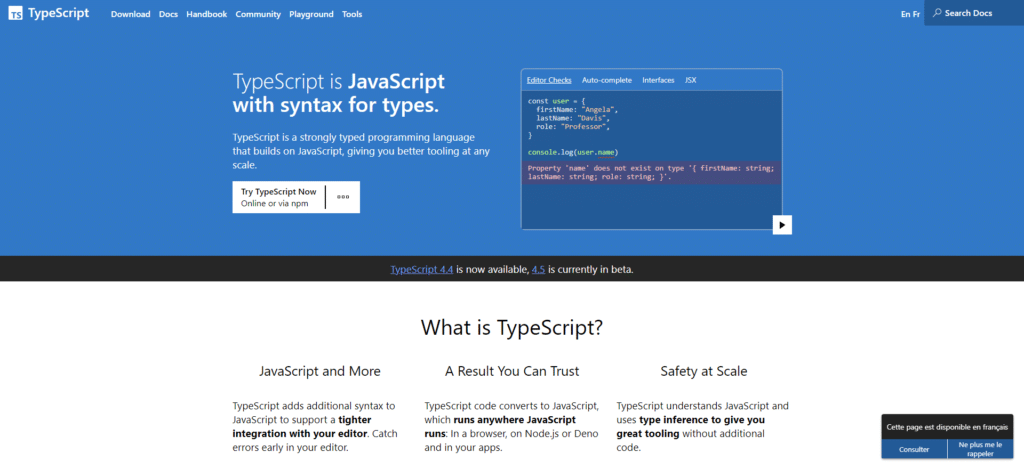
TypeScript est un langage de programmation orienté objet et open-source. Créé et maintenu par Microsoft, TypeScript est en fait un sur-ensemble syntaxique de JavaScript, ajoutant au passage un typage statique facultatif.
TypeScript est destiné à la construction de grandes applications et trans-compile vers JavaScript.
Les programmes JavaScript courants sont également des programmes TypeScript valides, et le langage peut être utilisé pour créer des applications JavaScript pour une exécution côté serveur et pas seulement côté client.
Il existe de nombreuses alternatives pour la trans-compilation pour transformer TypeScript en JavaScript, on peut utiliser le vérificateur TypeScript par défaut, ou bien le compilateur Babel.
TypeScript supporte les fichiers qui peuvent inclure les données de type des bibliothèques JavaScript actuelles, tout comme les fichiers d’en-tête C++ peuvent définir la construction des fichiers objets actuels, ce qui permet à d’autres programmes d’exercer les valeurs définies dans les fichiers comme s’il s’agissait d’entités TypeScript typées statiquement.
Il existe des fichiers d’en-tête tiers pour des bibliothèques prévalentes comme D3.js, jQuery et MongoDB. Les en-têtes TypeScript pour les modules élémentaires Node.js sont également accessibles, permettant le développement de programmes Node.js dans TypeScript.
Le compilateur TypeScript est écrit en TypeScript et assemblé en JavaScript. Il est enregistré sous la licence Apache 2.0.
Avantages de TypeScript
TypeScript est idéal pour vos projets de grande envergure ou si votre équipe compte de nombreux développeurs qui travaillent sur un gros projet alors TypeScript est une meilleure option que JavaScript. Les modificateurs d’accès et l’interface de TypeScript peuvent être un avantage supplémentaire dans la communication des API.
Si votre projet utilise React et que votre équipe n’est pas habituée à son API, TypeScript propose des définitions de type. Vous pouvez également utiliser IntelliSense, qui vous aidera à naviguer et à vérifier les nouvelles interfaces.
Il n’est pas facile de développer du code JavaScript simple, surtout si vous préférez la vérification des erreurs au moment de la compilation : avec TypeScript, il est tout à fait possible d’exécuter une confirmation de type au moment de l’exécution, et une validation au moment de la compilation.
Quelles différences entre TypeScript vs JavaScript ?
Ecosystème
L’écosystème de TypeScript est intuitif et puissant, et vous permet de taper statiquement divers types de traits JavaScript idiomatiques comme l’intersection, les types d’union et l’union discriminée.
JavaScript offre quant à lui la possibilité de découvrir et de coder sans phase de construction.
Liaison de données
TypeScript utilise des concepts tels que les interfaces et les types pour définir les données utilisées.
Aucune notion de ce type n’est présentée en JavaScript…
Courbe d’apprentissage
TypeScript a une courbe d’apprentissage assez raide et nécessite des connaissances avancées en matière de scripting.
JavaScript est en revanche facile à apprendre, et constitue un langage flexible pour l’écriture de scripts.
Paquets Npm
Avec TypeScript, d’innombrables paquets npm ont des définitions de types statiques (ou en ont une extérieure, plus simple à installer).
JavaScript possède la capacité de rechercher et de former du code, toujours sans aucune étape de construction.
Annotation et typage
Pour tirer le meilleur parti de ces caractéristiques, les développeurs TypeScript doivent constamment annoter le code, alors qu’aucune annotation n’est nécessaire pour JavaScript.
Compilateur
Le code TypeScript doit être compilé, alors qu’évidemment il n’y a aucune obligation de compiler le code en JavaScript.
Côté client / côté serveur
Bien qu’il puisse être employé côté serveur, TypeScript est surtout utilisé côté client.
JavaScript est utilisé aussi du côté serveur que du du côté client.
Communauté
TypeScript a une plus petite communauté de développeurs que JavaScript, ce dernier étant bien plus populaire auprès des développeurs de logiciels.
Conclusion
En observant les différences entre TypeScript et JavaScript, on peut dire que les deux technologies, tout en étant proches, ont leurs avantages et leurs inconvénients.
En effet, JavaScript n’est peut-être pas le langage de codage le plus complet, mais il est utilisé avec le HTML pour améliorer la qualité des pages Web. De plus, il existe des milliers de développeurs expérimentés qui codent en JavaScript et est adopté par tous les navigateurs.
TypeScript, en revanche, est une option qui reste privilégiée par les développeurs qui veulent produire un code propre et beau, compact et lisible. Sans parler des divers avantages offerts par TypeScript en matière de vérification des erreurs en direct, et du typage statique. Le gros point faible de TypeScript est qu’il n’est pas encore natif sur tous les navigateurs web, comme l’est JavaScript.
La conclusion reprendra donc ce que nous avions déjà appris en début d’article : JavaScript est le plus adapté lorsque vous disposez d’une équipe modeste, qui travaille sur de petits projets Web. En revanche, si vous disposez d’une équipe ayant davantage d’expérience, de bonnes connaissances et que vous voulez lui confier la gestion d’un projet plus complexe, alors TypeScript est un choix plus judicieux.
TypeScript, même présenté comme un « Super JavaScript », n’a pas vocation à remplacer ou à rendre JavaScript obsolète : JavaScript résiste et reste toujours le langage de script côté client le plus populaire. De plus, pour les projets les plus modestes, avoir recours à TypeScript peut représenter une surcharge, car la transcription du code en JavaScript prend du temps, ce qui constitue une étape supplémentaire pour le rendu. JavaScript étant exécuté directement sur le navigateur, il est plus facile de rafraîchir ou de déboguer le code pour des petits scripts, alors que dans le cas de TypeScript, le développeur aura besoin d’un IDE et d’une configuration appropriés pour exécuter son code.
Quelle que soit votre préférence, vous pourrez trouver des développeurs sur Codeur.com pour renforcer votre équipe. Décrivez votre projet TypeScript ou JavaScript gratuitement sur la plateforme pour recevoir les devis de nos experts freelances.