Pour un site e-commerce, le taux de conversion est un paramètre à prendre en considération. Car réussir à attirer des visiteurs sur son site marchand est une première nécessité, mais l’absence de conversion ne vous permettra pas de développer votre business.
Alors pour livrer la meilleure expérience utilisateur possible, l’UX e-commerce entre en jeu avec pour objectif d’optimiser le taux de conversion en un parcours orienté vers une expérience optimale aux visiteurs.
C’est cette expérience qui sera l’élément déclencheur pour les ventes et permettra de développer une image positive du site e-commerce. L’UX est à prendre en compte dès l’étape de conception et de création du site e-commerce, mais il est également possible d’optimiser un site après sa mise en ligne.
Offrez de la confiance à vos utilisateurs avec un UX e-commerce optimisé
Lorsqu’un client se rend dans une boutique physique, il s’attardera sur des petits détails qui lui apporteront un sentiment de confiance. Si malheureusement ce sentiment de sécurité n’est pas présent, le client potentiel risque tout simplement de se sentir mal à l’aise et la vente n’aboutira pas.
Ce constat reste scrupuleusement identique sur un site e-commerce. Si vous ne peaufinez pas les différents détails du site marchand, vous n’êtes pas en mesure de créer un climat de confiance et il n’aura qu’à poursuivre sa recherche sur un site concurrent.
Souvent, c’est un visiteur qui ne reviendra pas alors que vous auriez pu éviter cette situation en jouant sur les détails. Voilà pourquoi il est impératif que l’UX e-commerce soit pensé pour développer des pages claires, sans la moindre confusion possible. L’ergonomie doit être placée au cœur de vos préoccupations, vous permettant de développer un rapport de confiance.
Non seulement il vous faudra suivre les standards du Web, mais également développer des fonctionnalités technologiques permettant de couvrir les besoins des visiteurs. Inutile de réinventer la roue, il suffira de vous inspirer de ce qui se fait actuellement.
Cela nécessite d’avoir un UX e-commerce au goût du jour et de vous faire aiguiller par un professionnel pour que celui-ci vous apporte une vision objective.
Par exemple, les informations de contact doivent impérativement être visibles pour faciliter l’interaction. Cette transparence permet de rassurer le consommateur et d’apporter des éléments de réponse sur des sujets très divers et variés. Mais n’oubliez pas non plus d’incorporer un service client disponible et réactif en offrant des possibilités de contact via les réseaux sociaux.
Quelques astuces pour développer la confiance.
Non seulement vous devez soigner l’UX e-commerce , mais également le faire à travers les moyens de paiement. Utilisez directement les symboles de confiance comme « 3D-secure » et « verified by visa ». Si vous autorisez le règlement par PayPal, n’hésitez pas non plus à l’indiquer.
L’expérience sociale est aujourd’hui un élément incontournable dans la vente en ligne, alors utilisez un module de retour d’expérience. Il vous permettra de mettre en avant les avis positifs et encore une fois il s’agit d’un indicateur de confiance pour les utilisateurs de votre site marchand.
Offrez de la crédibilité à travers l’UX e-commerce

Au cours du processus d’achat, la crédibilité de votre site e-commerce doit être irréprochable. Inspirer confiance est une chose, mais vous devez également prendre des engagements afin de fidéliser votre clientèle.
Votre image de marque doit donc être développée dans ce sens à travers une véritable identité visuelle. Le choix des formes et des couleurs influencera directement le client et celui-ci s’orientera plus facilement vers un produit ou un autre.
Si l’expérience offerte n’est pas satisfaisante, non seulement vous perdez un client, mais celui-ci vous fera une publicité négative. Dans le cas contraire, il recommandera votre marque et deviendra un ambassadeur fidèle de votre entreprise.
Il est donc essentiel d’utiliser l’UX e-commerce pour développer du contenu et une charte graphique en adéquation avec vos valeurs. Il s’agit non seulement de travailler les visuels, mais également les textes, votre logo et les différents articles que vous publiez.
Être concis et clair
Si vous avez un site marchand correctement développé, mais malheureusement avec une interface utilisateur brouillon, cela se fera directement ressentir sur votre taux de conversion. Comme expliqué précédemment, la confiance reste primordiale, mais également la visibilité des informations.
L’utilisateur doit comprendre en seulement quelques secondes quels types de services et de produits vous vendez. Pourquoi un visiteur devrait vous faire confiance et acheter vos produits ? Inutile d’opter pour un long texte vantant les mérites de votre entreprise. Vous devez vous montrer clair dans votre argumentaire avec des visuels percutants et l’utilisation de bullet points.
Sur l’ensemble du site marchand, vous devez proposer à vos clients un design cohérent et abouti. Si malheureusement votre site n’est pas terminé ou si vous utilisez des couleurs et des éléments visuels différents, cela entraînera automatiquement une distraction chez les visiteurs. Malheureusement, ce phénomène ne vous sera pas bénéfique, car les distractions nuisent au taux de conversion.
La navigation au cœur de vos priorités
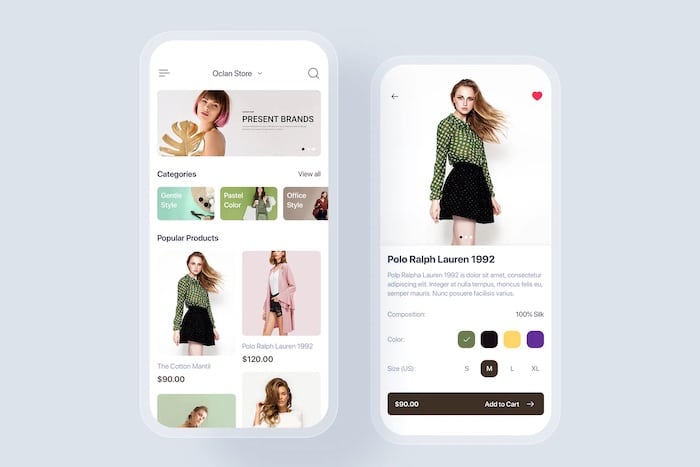
La conception des sites Internet ecommerce se doit de respecter les standards d’Internet et du mobile
Mais, au-delà des recommandations précédentes, nous entrons cette fois-ci dans une partie plus technique.
Bien évidemment, vous pouvez vous faire aider par des développeurs spécifiques qui n’auront aucun mal à déployer certaines fonctionnalités. Comme le fait d’utiliser des filtres horizontaux, car il s’agit actuellement de la norme en la matière.
En effet, les filtres horizontaux offrent de nombreux atouts :
- Ils présentent une certaine flexibilité en intégrant différentes options via des dropdowns menus.
- Aucun problème d’affichage au cours de la navigation sur une tablette ou sur un téléphone portable.
- Vous bénéficiez d’une utilisation full-page.
- L’accessibilité reste permanente, même lorsque l’utilisateur effectue un scroll. Cette distinction offre indéniablement une expérience de navigation plus agréable.
De plus chaque élément technique doit être optimisé, c’est-à-dire l’usage d’image, du menu, des catégories et bien sûr le temps de chargement
Autre élément technique à considérer, la mise en place des CTA. En effet, vous désirez que votre visiteur exécute une action bien particulière. Mais pour qu’il puisse l’accomplir, l’incitation doit être claire et rassurante. Voilà pourquoi vous devez vous montrer rassurant en proposant des CTA attractifs et compréhensibles sous la forme de bouton.
Enfin, n’abusez pas des pops-ups, car ce sont des éléments rendant la navigation désagréable. Si vous les utilisez, limitez leur nombre en soignant l’UX e-commerce pour les rendre attractifs et simples.
Quelques conseils sur le taux de conversion

Le développement d’un site e-commerce permet de faire connaître votre marque et de développer votre présence en ligne. Cependant, il ne faut pas perdre de vue que votre objectif principal qui sera de vendre.
Dans cette optique, appuyez-vous sur des formulaires simplifiés de type checkout ou sign in. Une fois le visiteur conquis par votre site e-commerce, vous allez pouvoir maximiser les conversions en utilisant des formulaires simplifiés pour éviter de générer la confusion.
Ne vous attardez pas sur des informations futiles, demandez simplement un e-mail et un pseudonyme. Si d’autres informations doivent être utilisées, le visiteur aura la possibilité de les compléter ultérieurement.
Gardez en tête d’avoir un tunnel de conversion fluide que ce soit sur tablette, un téléphone portable ou sur un ordinateur. En choisissant un processus de conversion simplifié, vous maximisez les chances de retenir l’internaute.
N’hésitez pas à multiplier les tests utilisateurs

Vous avez développé l’UX e-commerce de votre site marchand, mais sachez que certains éléments apparaissant comme une évidence pour vous, ne le seront pas forcément pour l’utilisateur.
Plutôt que de vous fier à votre intuition première, les tests utilisateurs sont là pour enregistrer différents paramètres et notamment surveiller le taux de conversion. C’est une phase absolument essentielle pour éviter de perdre de l’argent et du temps.
Les avantages sont alors multiples, car vous allez pouvoir vous orienter vers la formule garantissant le meilleur taux de conversion.
À vrai dire, il n’y a pas de solution miracle et vous devez travailler tous les éléments de votre site marchand pour optimiser le taux de conversion. C’est un ensemble de paramètres sur lesquels vous devez impérativement agir en gardant à l’esprit d’offrir la meilleure expérience client, tout en réussissant à convaincre vos visiteurs.
Notre astuce afin d’optimiser l’UX e-commerce
Aujourd’hui, l’UX e-commerce est une notion indispensable dans la vente en ligne. C’est une façon de vous démarquer de la concurrence et d’attirer des clients potentiels.
Mais attention, pour offrir l’expérience utilisateur le plus agréable, vous devez développer votre image de marque et soigner chaque élément pour laisser la meilleure impression possible. Il est donc essentiel de confier cette mission à un développeur e-commerce freelance qui vous apportera son conseil.
Grâce a son expérience, vous profiterez d’un site marchand qui rencontrera le succès escompté et même au-delà.