Saviez-vous que certains noms de domaine valent des milliers, voire des millions d’euros ? Estimer la valeur d’un nom de domaine que vous possédez ou que vous vouler acheter est important si vous vous lancez sur le web.
Vous avez une short-list de noms de domaines à acheter mais qui ne sont pas réservables directement ? Envie de vendre le nom de domaine que vous possédez depuis des années ?
Prenez le temps de faire une estimation de la valeur d’un nom de domaine pour éviter de l’acheter au-dessus de sa réelle valeur ou de le vendre à perte !
Mais comment estimer au mieux le prix d’un NDD ? On vous dit tout !
Préambule à l’estimation d’un nom de domaine
Tout d’abord, il faut bien comprendre la composition d’un nom de domaine. Ce dernier se divise en deux parties, ayant chacune leur importance :
- Le SLD (Second-level domain) qui contient le plus souvent le nom du site web ou de l’entreprise propriétaire.
- L’extension ou le TLD (Top-level domain) qui vient à la fin du nom de domaine. Il s’agit des .com, .net, .fr, .gouv, etc.
À lire aussi : .fr, .com, .tech… Comment choisir son extension de nom de domaine ?
Les techniques pour estimer la valeur d’un nom du domaine
Maintenant que vous comprenez comment est composé un NDD, il est temps d’analyser les éléments qui entrent en compte dans sa valeur.
1. Vérifier la popularité de l’extension
Le TLD est la première chose attrayante dans un nom de domaine. En général, les plus prisés restent ceux en .com. La raison ? Il est plus reconnaissable et plus courant chez les internautes. En plus, il s’adresse à un marché international, contrairement aux extensions locales (.fr, .be, .ch, .lu, etc.).
Les extensions .org, .pro, .biz ou encore .net sont spécifiques et peuvent réduire la valeur du nom de domaine. Cela va dépendre du marché visé et de la concurrence.
2. Le sens et la langue du nom de domaine
Le nom de domaine correspond-il à quelque chose ? Un nom commun a souvent plus de valeur qu’un mot ou un nom “inventé” tout simplement parce qu’il correspond à un véritable mot-clé SEO qui est déjà tapé et recherché par les internautes.
Les noms de domaine “exact match” ont donc une valeur nettement supérieure à des noms de domaines qui ne correspondent pas forcément à un mot réel.
Les noms de domaine qui correspondent à des mots anglais ont encore plus de valeur puisqu’ils ont une portée internationale. L’estimation d’un nom de domaine peut vite s’envoler avec un mot court en anglais qui termine par .com !
3. Analyser le trafic du nom de domaine

Le niveau de trafic que reçoit un site est un facteur essentiel dans l’estimation de sa valeur. La raison est assez simple : si le domaine est associé à une audience existante, l’acheteur peut immédiatement tirer profit de ce trafic pour son activité.
Le pagerank et les backlinks sont également des critères à évaluer. Si le site reste indexé par Google avec un classement significatif et des liens entrants de forte qualité, sa valeur est plus grande.
À lire aussi :
4. Évaluer la pertinence des mots-clés
Inclure les bons mot-clés dans votre nom de domaine représente un autre aspect crucial du référencement.
Par exemple, si le site web le mieux noté pour la requête « hôtel » est www.hotels.com, alors ce nom de domaine a encore plus de valeur. Lorsque la combinaison volume de recherche / exact match / mot-clé court / tld populaire s’alignent, la valeur du domaine augmente considérablement.
À lire aussi : SEO : Comment trouver des mots clés pertinents ?
5. Vérifier l’orthographe de l’URL
Cela peut sembler évident, mais un nom de domaine correctement orthographié est plus valorisant qu’une URL contenant une faute. Le risque est de paraître peu professionnel, voire louche auprès de votre audience. Dans ce cas, vous risquez de ne jamais rentabiliser votre achat.
Dans le même temps, l’utilisation d’une orthographe inattendue peut parfois être un avantage. Cela rend le domaine plus facile à retenir, plus authentique. Tumblr.com en est un parfait exemple.

6. Faire attention à la longueur du nom de domaine
Plus un nom de domaine est court, plus il attire les acheteurs. Pourquoi ? Un nom de domaine concis est rare et donc plus précieux. Il reste facile à mémoriser et à partager, ce qui est bon pour le SEO.
7. Vérifier l’âge du domaine
L’âge du domaine désigne sa date de création. Si le domaine est actif depuis plusieurs années, il a acquis une certaine notoriété auprès de Google. Il est souvent mieux positionné que ses concurrents plus jeunes.
À l’inverse, un nom de domaine récent ou un nom de domaine ancien mais avec un historique qui ne correspond pas à la future activité du site peut dévaloriser l’estimation du nom de domaine.
Un nom de domaine avec un historique peut disposer de nombreux backlinks négatifs, ce qui peut faire baisser sa valeur.
8. Rechercher les domaines similaires vendus
Pour savoir ce que vaut votre nom de domaine, vous devez savoir ce que les autres facturent pour des domaines similaires. Une certitude : sa valeur change au fil du temps !
À ce stade, vous devrez vérifier le prix de vente de noms de domaine similaires au vôtre.
Plusieurs sites collectent ces informations afin de vous guider dans votre achat (ou vente) : DN Journal, Domain Name Wire ou ShortNames.
9. Utiliser un service d’évaluation
Un service d’évaluation de nom de domaine vous permet d’estimer, en quelques clics, sa valeur. Ce type d’outil analyse tous les facteurs décrits précédemment (extension, ancienneté, mot-clé, longueur…) pour vous proposer une estimation au plus juste.
C’est l’une des méthodes les plus simples pour obtenir une réponse éclairée sur la valeur de votre nom de domaine.
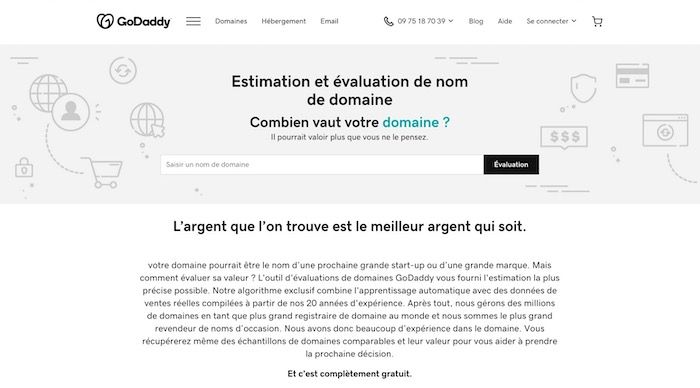
Parmi ces outils, vous trouverez : estibot, GoDaddy ou SitePrice.
10. Vérifier ce que les acheteurs sont prêts à payer
Faire des recherches et utiliser des outils d’estimation vous donne une idée du prix à facturer. Cependant, existe-t-il une demande pour votre domaine ? Les potentiels clients sont-ils prêts à l’acheter au prix estimé ?
Plus la demande est forte, plus la valeur de votre domaine augmente et… inversement !
La meilleure façon de le savoir est de mettre votre nom de domaine en vente via un système d’enchères. Vous pouvez fixer un prix de réserve et voir si les enchères prennent.
Vous avez un nom de domaine court, avec les bons mots-clés, populaire et ancien ? Vous disposez probablement d’une mine d’or. Mais avant de le mettre en vente, prenez le temps de l’évaluer et d’analyser le marché. De même, si vous voulez acheter une URL, ne foncez pas tête baissée avant d’avoir fait toutes les vérifications d’usage.
Vous avez votre nom de domaine et souhaitez créer votre propre site ? Trouvez le développeur freelance qu’il vous faut sur Codeur.com !