Suivre ses positions sur Google, ce n’est plus l’unique indicateur à surveiller. Aujourd’hui, les marques veulent savoir ce que ChatGPT dit d’elles. Et ce n’est pas une simple curiosité : c’est une nouvelle dimension du search qui redéfinit les règles du jeu.
Ce qu’il faut retenir :
- Les IA génératives influencent déjà la visibilité des marques.
- Le GEO s’impose comme une extension naturelle du SEO classique.
- Qwairy se démarque sur le marché francophone avec une approche complète.
- D’autres outils comme Otterly, RankScale ou VoicIA proposent des alternatives.
- Les audits de visibilité doivent désormais inclure les réponses IA.
Les IA génératives : nouveau terrain de jeu des marques
Jusqu’à récemment, surveiller son positionnement dans les résultats de Google suffisait à la plupart des marques. On traquait les positions, le nombre de mots-clés bien classés, les clics, les backlinks… bref, tout ce qui permettait de briller sur la première page de Google.
Mais voilà : une part croissante des recherches s’effectue désormais directement dans des interfaces conversationnelles. ChatGPT, Gemini, Perplexity… Ces assistants génèrent des réponses synthétiques à la place des listes de liens. Parfois sans aucune citation. Parfois en suggérant un concurrent à votre place.
Alors la question se pose : êtes-vous visible dans ces nouveaux moteurs de réponse ?
Bienvenue dans l’ère du GEO (Generative Engine Optimization)
Le SEO tel qu’on le connaît ne disparaît pas, mais il glisse doucement vers une nouvelle logique. Celle du GEO, ou optimisation pour les moteurs génératifs.
On ne cherche plus seulement à être premier sur Google. On veut :
- que l’IA mentionne notre marque spontanément,
- que l’URL de notre site apparaisse comme source crédible,
- que les réponses générées soient cohérentes, factuelles… voire flatteuses,
- et que, dans les classements ou comparatifs IA, on ne soit pas absent.
Un consultant SEO qui pilote un plan de visibilité aujourd’hui ne peut plus se contenter des vieux outils. Il doit savoir ce que l’IA répond quand un utilisateur demande « Quel est le meilleur logiciel de facturation en 2025 ? » ou « Quelle agence choisir pour une refonte e-commerce ? ».
Qwairy, un pas d’avance sur le terrain francophone
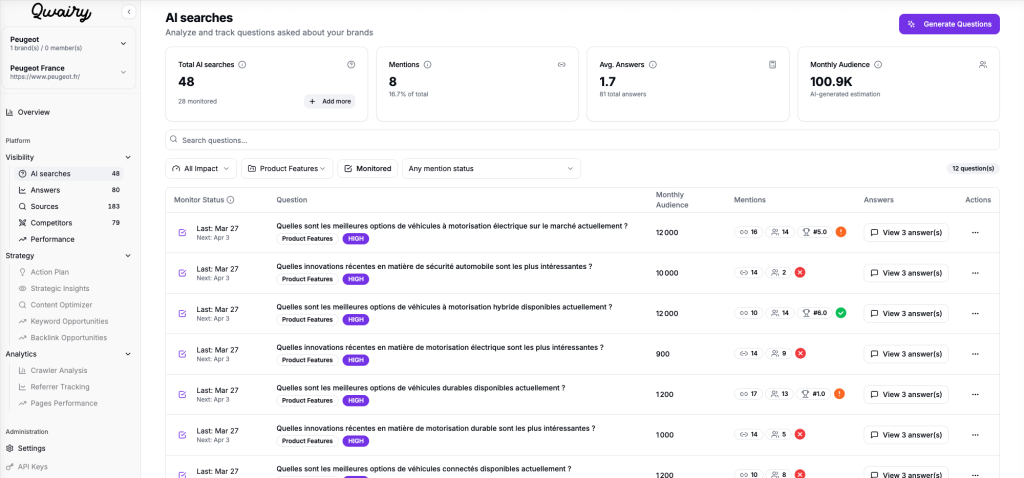
Parmi les nouveaux venus sur ce terrain, Qwairy mérite qu’on s’y attarde. Développée en France par Luca Fancello (connu pour le podcast SEO Position 0 et auteur d’une formation sur le SEO programmatique chez FormaSEO), Nicolas Ihle et Aimé Dushimire, la plateforme s’attaque à un problème bien identifié : donner aux marques une vraie vision de leur visibilité dans les réponses générées par les IA.
L’outil s’adresse à tous ceux qui veulent aller plus loin que le simple « Est-ce qu’on est là ? », et comprendre comment, pourquoi et dans quel contexte leur marque est citée par l’IA.
Voici ce que Qwairy permet de suivre :
- les requêtes posées aux IA à propos de votre entreprise,
- les réponses données en temps réel par des LLMs comme ChatGPT, SearchGPT, Gemini, Perplexity ou Claude,
- les sources réellement citées (ou non),
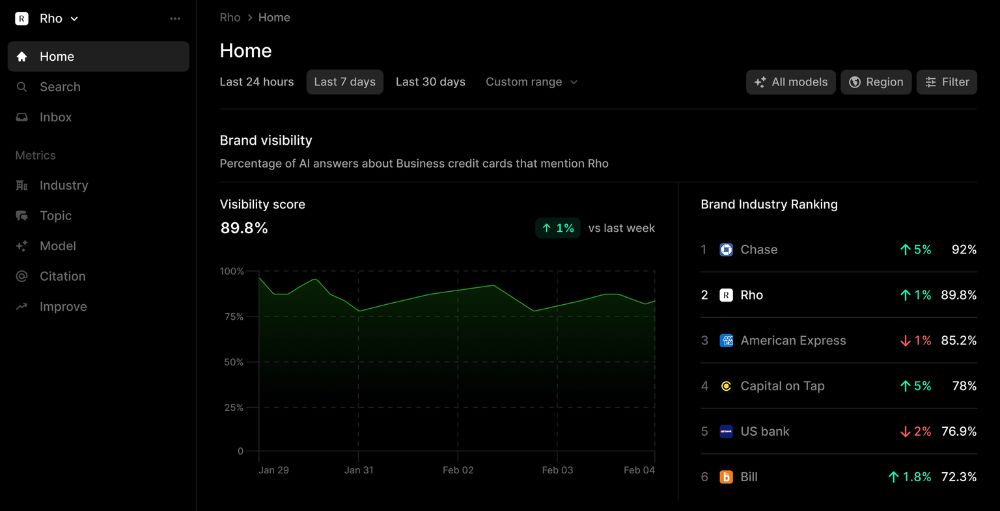
- votre part de visibilité face à vos concurrents.
Mais Qwairy ne s’arrête pas là. Chaque semaine, la plateforme vous propose un plan d’action basé sur les données issues des IA, identifie des requêtes stratégiques, et vous aide à mesurer les visites provenant des assistants intelligents.
C’est concret. Et surtout, c’est local : la solution a été pensée pour le marché européen, en tenant compte de ses particularités linguistiques et réglementaires.
D’autres acteurs émergent se positionnent (souvent côté anglo-saxon)
Si Qwairy incarne une réponse locale bien pensée pour le marché européen, il n’est pas seul sur ce nouveau terrain. Le suivi de la visibilité des marques dans les LLM (comme ChatGPT, Claude ou Perplexity) devient un enjeu global, et plusieurs solutions, principalement anglo-saxonnes, se positionnent.
Cependant, dans cet écosystème encore jeune, les outils sont nombreux, mais leurs approches diffèrent largement. Certains se concentrent sur l’analyse des citations, d’autres sur les classements de marque, ou encore sur la détection d’opportunités manquées. Tous n’ont pas le même niveau de maturité ni les mêmes objectifs.
 Pour aider à s’y retrouver, nous avons recensé les outils les plus visibles ou prometteurs dans ce domaine :
| Outil | Pays d’origine | Spécialité principale | Prix |
|---|---|---|---|
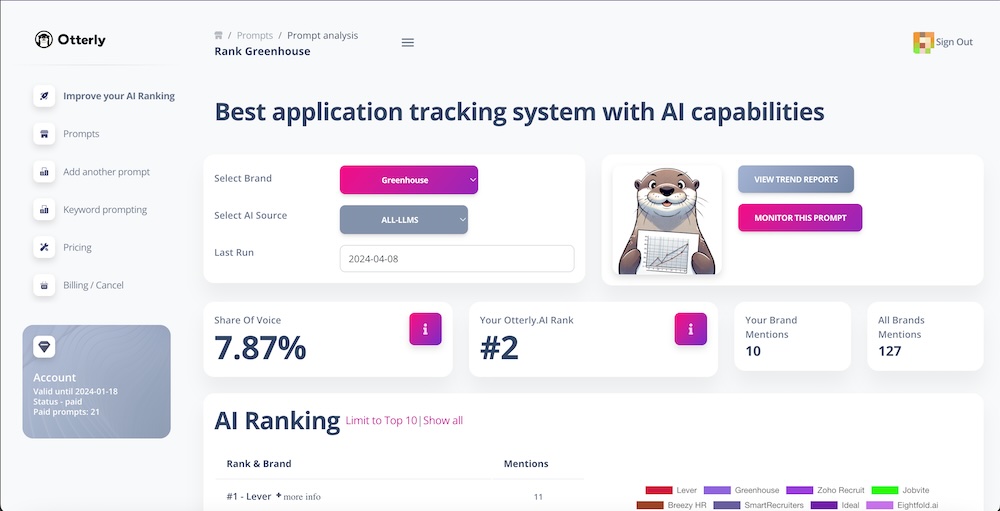
| Otterly.ai | Autriche | Alertes sur mentions ChatGPT/Perplexity | À partir de 29 €/mois |
| RankScale.ai | Autriche | Classement IA + recommandations | Accès anticipé sur demande |
| Profound | USA (New York) | Reporting multi-LLM + insights & API | Tarifs entreprise personnalisés |
| Semrush (ChatGPT) | USA | Suivi de réponses ChatGPT | À partir de 139,95 $/mois |
| Nightwatch | Slovénie | SEO + tracking ChatGPT | À partir de 32 €/mois |
| seoClarity | USA | SEO entreprise + suivi IA | À partir de 2 136 €/mois |
| Similarweb | USA (New York) | Analyse trafic web (complément IA) | À partir de 199 $/mois |
| Azoma.ai | UK (Londres) | E-commerce : mentions + fiches produit | Tarifs entreprise personnalisés |
| AthenaHQ | USA (San Francisco) | Plans éditoriaux IA automatisés | À partir de 270 $/mois |
| LLMrefs | USA | Analyse fréquence & qualité des citations IA | Freemium |
| PromptWatch | Pays-Bas (Amsterdam) | Suivi en temps réel des conversations IA (tous modèles) | À partir de 89 €/mois |
Bien que ces outils soient prometteurs, beaucoup restent orientés marché US/UK ou en phase d’exploration.
Comment choisir son outil GEO ?
Avec la montée en puissance des outils de suivi de visibilité dans les réponses IA, le choix peut vite devenir complexe. Le marché est jeune, les solutions sont nombreuses, et leurs approches varient beaucoup. Certaines se concentrent sur l’analyse des citations, d’autres sur les classements, d’autres encore sur la génération de recommandations ou la veille concurrentielle.
Alors, pour éviter de se perdre dans les démos et les promesses marketing, voilà quelques bonnes questions à se poser avant de s’engager.
- Est-ce que l’outil interroge les IA en continu, ou est-ce juste ponctuel ?
Un bon outil GEO doit pouvoir lancer des centaines, voire des milliers d’invites, à fréquence régulière. Sinon, on se retrouve avec une vision partielle, biaisée… ou simplement pas fiable. - Quels modèles sont couverts ?
ChatGPT, Gemini, Claude, Perplexity… Tous ne donnent pas les mêmes réponses, et chaque LLM a ses particularités. Mieux vaut un outil qui couvre plusieurs moteurs, pour avoir une vue d’ensemble réaliste. - Est-ce que je peux suivre mes concurrents ?
C’est bien de savoir ce que l’IA dit de vous. Mais c’est encore mieux de savoir ce qu’elle dit des autres. Certains outils intègrent une vision comparative qui permet de repérer les opportunités manquées ou les marques qui vous doublent dans les réponses. - Est-ce que l’outil fonctionne bien en français (ou dans ma langue) ?
Beaucoup de plateformes sont encore très centrées sur l’anglais US. Pour une marque française ou européenne, c’est un vrai sujet. Vérifiez que les invites multilingues sont gérées, et que l’outil peut analyser les réponses dans votre langue, avec les bonnes nuances. - Est-ce que les données sont exploitables ?
Un bon outil, ce n’est pas juste des lignes dans un dashboard. C’est un outil qui explique le contexte, segmente les résultats par sentiment, thème, source, et vous suggère des pistes d’action. Bref, qui vous aide à décider, pas juste à observer. - Et le support, la roadmap ?
Enfin, posez-vous une question toute simple : est-ce que ce produit évolue ? Est-ce qu’il y a une vraie équipe derrière, des mises à jour, une écoute client ? Parce qu’un bon outil GEO, ce n’est pas juste un outil. C’est un partenaire pour naviguer dans un terrain qui bouge très vite.
Les agences SEO aussi développent leurs outils maison
Face à cette mutation, certaines agences n’ont pas attendu que le marché mûrisse. Elles ont lancé leurs propres solutions internes pour leurs clients.
Chez iProspect, la solution LLMInsights permet de visualiser la place d’une marque dans les réponses générées par l’IA, avec une vision fine du processus de génération.
Du côté de Peak Ace, VoicIA propose un suivi de la part de voix, une analyse des sentiments associés aux marques, et un système de reporting dynamique.
Ces outils ont une double fonction : apporter des données concrètes aux clients, mais aussi valoriser la capacité d’innovation de l’agence sur un sujet encore peu structuré.
Et maintenant ?
Les entreprises doivent commencer à intégrer les IA génératives dans leur réflexion sur la visibilité.
Aujourd’hui, une part croissante des recherches passe par des outils comme ChatGPT ou Perplexity. Ce sont de nouveaux points de contact entre les utilisateurs et les marques. Et dans de nombreux cas, ce sont même les premiers.
Un audit SEO en 2025 ne peut plus se limiter aux résultats classiques de Google. Il doit aussi évaluer ce que les IA disent, ne disent pas, ou disent mal à propos de votre entreprise.
Est-ce que votre marque est citée ? Est-ce que vos contenus sont repris ? Est-ce que l’information transmise est fiable et favorable ? Si ces questions ne font pas encore partie de vos analyses, il est temps de les intégrer.
Et ce n’est sans doute qu’un début : on verra émerger bien d’autres outils spécialisés pour analyser la position des marques dans les réponses IA, dans les mois et années à venir.
L’article “IA génératives : êtes-vous effacé des réponses sans le savoir ?” a été publié sur le site Abondance.