Les annonces Google Ads ont un taux de conversion 50% supérieur à celui du trafic organique. Et ce n’est pas leur seul atout ! Ces liens sponsorisés génèrent un retour sur investissement de 200%.
Google Ads constitue l’un des meilleurs investissements pour votre entreprise. Ceci, pour deux raisons :
- La précision du ciblage : votre annonce n’apparaît que lorsque les internautes recherchent votre produit ou service sur Google. Vous touchez votre prospect idéal au moment précis où il cherche à réaliser une action (achat, téléchargement, comparaison…).
- Le faible risque financier : vous payez en fonction des performances et des clics (ou même des conversions). Le retour sur investissement est donc garanti.
Cependant, vous ne disposez que d’un espace limité pour attirer l’attention de l’internaute. Avec seulement 30 caractères autorisés dans le titre, il peut être difficile de rédiger une annonce convaincante.
Pourtant, certaines entreprises écrasent quotidiennement leurs concurrents avec des Google Ads efficaces. Alors, comment font-elles ? Et comment pouvez-vous les copier ?
Voici 13 exemples dont vous pouvez vous inspirer.
1. Mise en avant des avantages
Google juge l’expression « cliquez ici » inappropriée, de même que tous les autres appels à l’action « génériques ». Cela signifie que vous devez demander implicitement à l’internaute de cliquer sur l’annonce.
Comment ? Grâce à un texte orienté vers l’action qui met l’accent sur les résultats positifs et présente les avantages du point de vue de l’internaute.
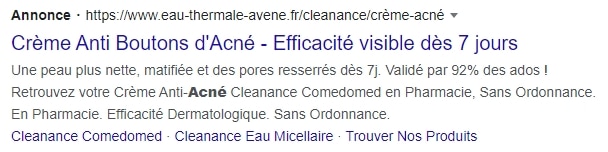
Ici, Avène liste les actions bénéfiques de sa crème dès la première phrase et valorise le taux de satisfaction chez les adolescents. À aucun moment, la marque n’incite explicitement au clic. Elle donne simplement envie d’en savoir plus sur le produit.
2. Usage des extensions de liens
Selon Google, les extensions de liens augmentent les conversions de 10 à 20%. Ces liens supplémentaires placés au pied des annonces sont utiles pour augmenter les clics.
Elles apparaissent sur tous les appareils et peuvent être paramétrées avec différentes variables. Ce qui vous permet de multiplier les appels à l’action et d’aider les prospects à trouver précisément ce qu’ils recherchent.
Les extensions de liens offrent également une segmentation plus précise des prospects dès le SERP, en les envoyant vers des landing pages spécifiques. Une technique qui rationalise l’entonnoir de vente (et son efficacité).
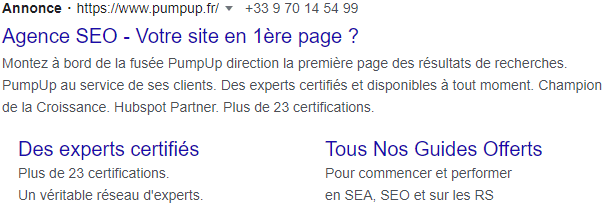
Sur cette annonce de l’agence SEO Pumpup, on remarque l’ajout de deux pages de leur site. Probablement, celles les plus fréquentées ou qui génèrent le plus de conversions. De plus, les internautes qui sont prêts à passer à la prochaine étape peuvent cliquer sur la section « Tous nos guides offerts » et se convertir en prospects.
3. Ajout d’une preuve sociale
Avant de prendre une décision d’achat, 89% des consommateurs consultent les avis. En intégrant une preuve sociale dans vos annonces, vous pouvez augmenter les taux de clics.
Pensez à utiliser l’extension d’annonce Avis sur le marchand dans vos publicités. Les étoiles attirent l’œil et surtout, elles donnent confiance aux internautes, ce qui les encourage à cliquer.
Une stratégie utilisée par Maisons du Monde. L’enseigne affiche fièrement sa note de 4.3/5 dans sa Google Ad :

4. Mise en évidence des informations sur l’entreprise
46% des recherches sur Google sont locales. Les internautes qui recherchent des commerces de proximité préfèrent voir apparaître des résultats près de chez eux. Logique, puisqu’ils ont besoin de s’y rendre !
Les meilleurs exemples d’annonces Google locales intègrent des extensions comme les numéros de téléphone et les adresses Google My Business liées, pour augmenter le taux de clics.
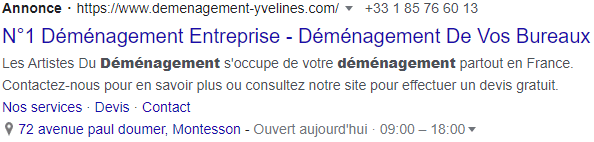
Par exemple, cette annonce de l’entreprise « Les Artistes du Déménagement » inclut l’adresse géographique, ainsi que le numéro de téléphone et les horaires d’ouverture. Les internautes bénéficient de tous les renseignements nécessaires pour les contacter ou s’y rendre directement.
5. Ajout de chiffres
Les annonces Google contenant des chiffres dans les titres et descriptions sont plus performantes. Elles génèrent 217% de clics supplémentaires et de 23% de conversion en plus.
Cela s’explique par le pouvoir de la spécificité. Les détails, y compris les chiffres, créent une impression d’authenticité et attirent l’attention des internautes. Plus le chiffre est précis, plus l’impact est grand.
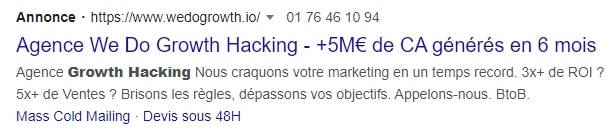
Dans cet exemple, l’agence de Growth Hacking met le paquet sur les statistiques pour démontrer son expertise et son efficacité, afin de captiver l’attention des internautes.
6. Affichage du prix
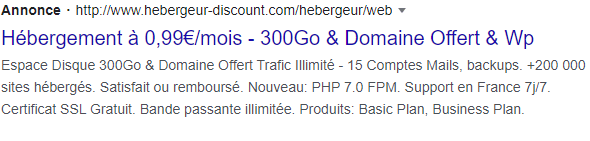
Inclure le prix réel d’un produit ou d’un service dans votre annonce dissuade les internautes qui ne sont pas prêts à payer ce tarif. Résultat : votre annonce bénéficie d’un meilleur taux de conversion et d’un quality score au top !
Mais afficher clairement le tarif peut aussi montrer un fort avantage concurrentiel et attirer du trafic intéressé. Comme ici, sur l’annonce de l’hébergeur web, Hebergeur-discount.com. Le prix de 0.99€/mois est forcément très attractif et va susciter la curiosité des internautes.
7. Usage de termes forts
L’utilisation d’expressions rassurantes et fortes dans les annonces Google Ads est une technique performante pour augmenter le taux de clics.
L’un des meilleurs mots-clés utilisés pour déclencher une réponse émotionnelle est « gratuit » !
La gratuité est le mot-clé le plus efficace que vous puissiez utiliser dans vos annonces Google pour augmenter le trafic et les conversions.
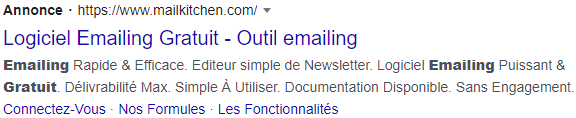
Si vous regardez attentivement, cette annonce de l’outil d’emailing Mailkitchen utilise plusieurs mots-clés émotionnels, dont les suivants :
- Rapide
- Efficace
- Simple
- Puissant
- Gratuit
- Sans engagement
Que des termes rassurants pour l’utilisateur !
8. Appel à l’action clair
Le but ultime de vos annonces est qu’un utilisateur effectue l’action que vous souhaitez. Quel que soit votre objectif de conversion, expliquez-le clairement dans votre publicité.
En plus d’inviter leur cible à demander une présentation, Index-education ajoute un bouton « Téléchargez et Testez » à l’annonce. C’est clair, simple, concis et ça donne envie de cliquer.

9. Répétition du CTA
Nous venons de le dire, un appel à l’action clair et compréhensible est important pour la réussite de vos Google Ads. Mais vous avez aussi le droit de le répéter !
Il existe plusieurs façons de placer le CTA, mais les deux principales combinaisons sont les suivantes :
- Répéter le CTA dans le titre et la description
- Utiliser les extensions de liens
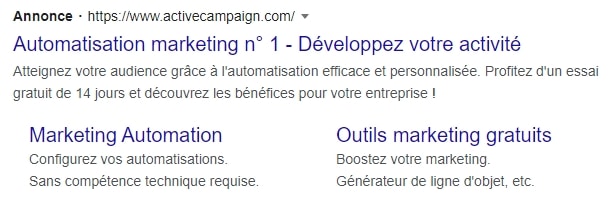
Dans cet exemple, l’outil propose plusieurs call-to-action qui convergent vers le même objectif : faire souscrire l’internaute. Pour ce faire, Active Campaign utilise plusieurs expressions comme : « développez votre activité » (dans le titre), « profitez d’un essai gratuit » (dans la description), « configurez vos automatisations » et « boostez votre marketing » (dans les extensions de lien).
10. Utilisation du concept d’actualité
Certaines annonces sont plus pertinentes ou plus intéressantes lorsqu’elles intègrent un élément d’actualité. Ce qui s’est passé récemment suscite forcément l’attention des internautes. Il en va de même pour les Google Ads.
Vous pouvez insérer dans votre annonce un texte qui indique le nombre de clients que vous avez satisfaits le mois dernier ou qui fait référence à l’année en cours, comme dans cette publicité de Nouvelle-epargne.
Les internautes sont rassurés lorsqu’un événement récent ou la date apparaît, car cela montre que le produit ou service est parfaitement adapté à leurs besoins du moment. Or, s’ils effectuent une recherche Google à cet instant, c’est qu’ils ont un besoin immédiat.

11. Intégration de l’urgence
Le FOMO (Fear Of Missing Out) peut également être utilisé dans vos annonces. Le compte à rebours de Google Ads décompte littéralement les jours ou les heures avant la fin d’une offre spéciale.
En intégrant cet aspect dans vos annonces textuelles, vous pouvez créer un sentiment d’urgence ou de rareté à travers des offres ou transactions à durée limitée. Un biais cognitif connu et reconnu dans le marketing, pour inciter aux clics et achats d’impulsion !
Une stratégie utilisée par Free Mobile dans cette annonce. Le célèbre opérateur annonce une « promo exclusive » valable jusqu’au 05/10 pour attirer les prospects.

12. Introduction de l’intention de l’utilisateur
Comprendre l’intention de l’utilisateur est la clé de réussite de toute stratégie marketing efficace. Avec Google Ads, vous disposez d’un espace très court pour faire passer votre message. Cela signifie que si l’utilisateur a le moindre doute quant à votre capacité à répondre à ses besoins, il ne cliquera pas. Mais comment éviter ce doute ? L’intention d’utilisateur !
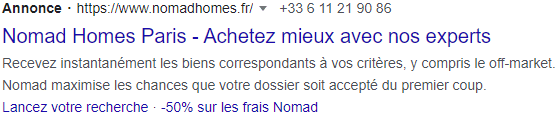
L’agence immobilière Nomad Homes cible les utilisateurs qui ont l’intention de rechercher des biens immobiliers. Par conséquent, elle a ajouté l’extension de lien « Lancez votre recherche » dans son annonce.
13. Personnalisation de l’annonce
De nombreuses Google Ads parlent de « l’entreprise » ou font des promesses telles que « Nous vous aiderons à réussir ». Cela affaiblit le lien personnel.
Il est plus efficace de s’adresser directement à votre cible. Évitez donc toutes les formes de « nous » et optez directement pour la forme « vous ».
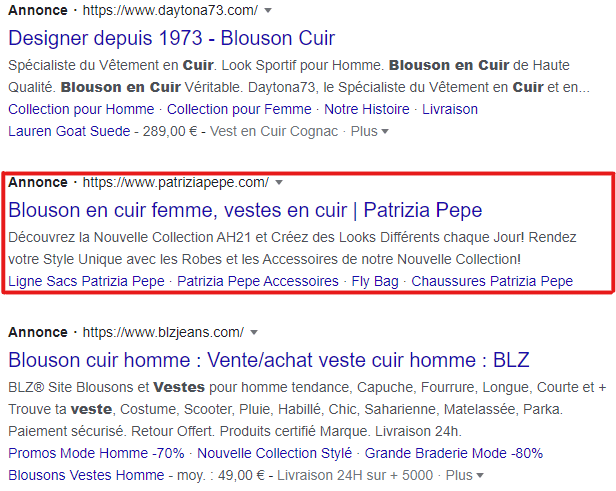
Parmi les annonces ci-dessous, celle de Patrizia Pepe attire davantage l’attention de l’internaute car elle l’interpelle directement. Les formules qui commencent par un « vous » établissent un lien, alors que les concurrents focalisent tout sur les caractéristiques produit.
14. Mention du « Made in France »
Les consommateurs sont de plus en plus attachés aux valeurs d’une entreprise. Parmi les engagements qui leur tiennent à cœur, on peut citer le made in France !
Quand vous ciblez vos annonces sur la France, pensez à bien mettre en avant le côté local pour rassurer les internautes et leur donner envie de vous découvrir. Un aspect d’autant plus important si vos concurrents sont essentiellement étrangers.
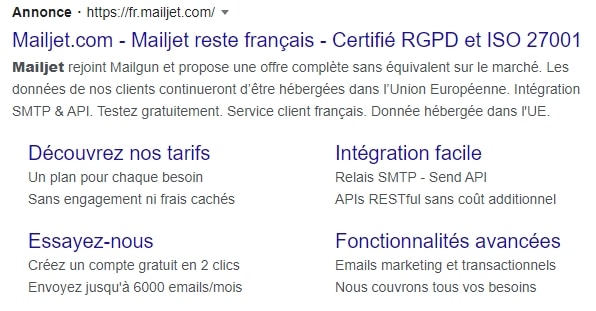
Mailjet affiche clairement son côté français, même en ayant intégré un groupe international. L’outil se veut rassurant en promettant que les données de ses clients continuent d’être hébergées en Europe.
Conclusion
Ces exemples de Google Ads intègrent les meilleures pratiques pour augmenter les taux de clics et encourager les conversions. Si vous cherchez à améliorer les performances de vos annonces, inspirez-vous de ces stratégies !
Et comme toujours en marketing, n’hésitez pas à réaliser des A/B tests pour trouver la formule qui génère le meilleur retour sur investissement.
Vos annonces Google Ads n’ont pas le ROI attendu ? Demandez conseil à un consultant SEA de Codeur.com.