Google a achevé le déploiement de sa mise à jour anti-spam d’août 2025 hier. L’update a duré 27 jours, du 26 août 2025 au 22 septembre 2025.
Google a terminé sa mise à jour anti-spam
La Spam Update d’août 2025 s’est achevée hier, comme ondiqué au sein Google Search Status Dashboard :
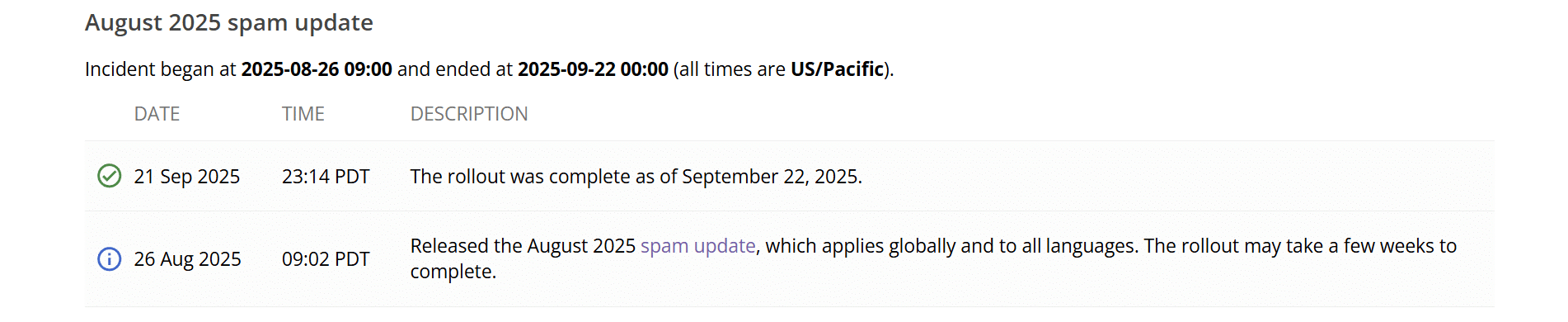
Retrouvez toutes les dernières updates de Google sur notre page dédiée.
Ai-je été impacté ?
 Cette fin de mise à jour coïncide avec le récent abandon du paramètre num=100. Le problème ? Ce changement a fait chuter les impressions et augmenté la position moyenne dans la Google Search Console. Difficile donc d’utiliser ces métriques pour savoir si vous avez été impacté.
Les KPI à analyser pour savoir si vous avez été impacté par la Spam Update :
- La position moyenne au sein des outils tenant compte du changement de tracking num=100 (ex : Monitorank, qui a pris en compte le changement depuis début 2024).
- La position moyenne du Top 10 (qui ne semble pas impacté par l’abandon du num=100, ahrefs ayant déclaré “rankings beyond the top 10 will show inconsistencies”)
- Le nombre de clics (non impactés par l’abandon du num=100).
En plus de ces métriques, analysez votre indexation : les rapports Pages ou Sitemaps de la Search Console vous donneront une indication sur les pages désindexées.
Enfin, utilisez des outils comme SEObserver pour constater de fortes variations sur votre SERP : des sites au profil spammy ont-ils disparu ou ont-ils fortement chuté ? Avez-vous fortement chuté alors que les autres n’ont pas bougé ?
Vous pouvez également réaliser un audit SEO afin de vous aider à corriger les problèmes.
Quand mesurer ?
Google recommande généralement d’attendre 1 semaine : collectez 7 jours de données après la fin de la mise à jour et comparez ces données à 7 jours de données avant le début de la mise à jour. En d’autres termes, comparez la période du 23 au 30 septembre 2025 à la période du 19 au 26 août 2025. PS : tenez compte de la saisonnalité 
Que dit Google ?
Si vous pensez avoir été impacté, consultez les règles de Google concernant le spam, en voici un récap.
Que cible une mise à jour anti-spam ?
Une “mise à jour anti-spam” cible spécifiquement les pratiques de spam sur les sites web, comme le contenu généré automatiquement en masse, le contenu de faible qualité ou dupliqué, les redirections trompeuses, et d’autres abus visant à manipuler le classement. Elle vise à nettoyer les résultats de recherche des contenus trompeurs ou abusifs en améliorant les systèmes automatisés anti-spam de Google.
Vous ne pourrez pas forcement récupérer vos positions
Apporter des modifications peut ne pas entraîner d’amélioration. Lisez plutôt :
Lorsque nos systèmes suppriment les effets que les liens spammy peuvent avoir, tout avantage en termes de classement que ces liens pouvaient générer auparavant pour votre site est perdu. Les avantages potentiels en termes de classement générés par ces liens ne peuvent pas être récupérés.
Les principales formes de spam ciblées lors d’une Spam Update
- Cloaking (un contenu différent présenté aux moteurs de recherche et aux internautes) & texte et liens cachés (texte ou liens non visibles pour les utilisateurs mais visibles pour les moteurs).
- Pages satellites (pages ou sites hors de la structure, créé suniquement pour se positionner – de plus en plus rare en 2025)
- Utilisataion abusive de domaines expirés (utilisation de la puissance d’un ancien nom de domaine pour publier du contenu sans valeur ajoutée)
- Keyword stuffing (remplir une page de mots clés de façon non naturelle)
- Liens toxiques et pratiques abusives de netlinking (on vous alisse juger vous même de la toxicité de vos liens, si vous savez, vous savez).
- Utilisation abusive de contenus à grande échelle (contenus non originaux via IA ou scraping)
Et évidemment : le contenu piraté, les pratiques malveillantes, le parasite SEO, les redirections trompeuses ou encore l’affiliation sans valeur ajoutée.
Les ressources pour comprendre les Updates

L’article “SEO : Google a terminé sa mise à jour Anti-Spam (Spam Update d’Août 2025)” a été publié sur le site Abondance.