Google vient d’introduire un nouveau user-agent baptisé « Google-Agent », conçu pour permettre à ses agents IA de parcourir le web et d’effectuer des actions à la demande des utilisateurs. Un signal fort de la montée en puissance des agents autonomes dans l’écosystème Google.
Ce qu’il faut retenir :
- Google a ajouté un nouveau user-agent appelé « Google-Agent » dans la catégorie des « user-triggered fetchers ».
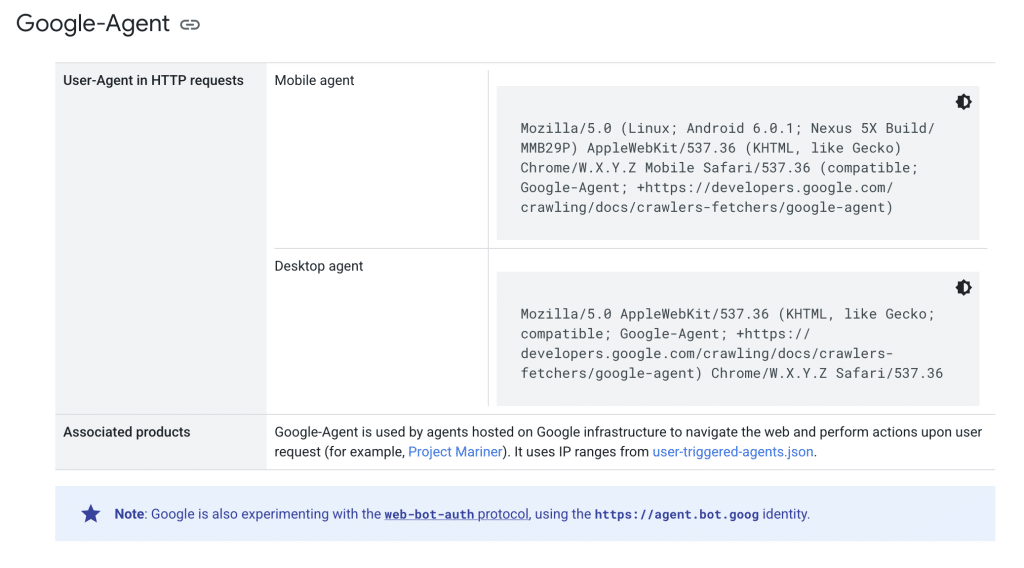
- Il est utilisé par des agents hébergés sur l’infrastructure Google pour naviguer sur le web et effectuer des actions à la demande des utilisateurs.
- Project Mariner est cité comme exemple concret d’utilisation.
- Google expérimente également le protocole web-bot-auth avec l’identité https://agent.bot.goog.
Depuis le 23 mars 2026, Google a officiellement documenté l’arrivée d’un nouveau user-agent : Google-Agent. Ce dernier rejoint la liste des « user-triggered fetchers », c’est-à-dire des robots déclenchés non pas par le moteur de recherche lui-même, mais par une action directe d’un utilisateur.
Concrètement, quand vous demandez à un agent Google d’effectuer une tâche sur le web, c’est ce user-agent qui se présente aux serveurs des sites visités. Google précise que le déploiement s’effectue progressivement sur plusieurs semaines.
Un user-agent lié aux agents IA de Google
L’user-agent Google-Agent est associé à des agents hébergés directement sur l’infrastructure de Google. Ces agents ont la capacité de naviguer sur des pages web et d’y effectuer des actions, à la manière d’un utilisateur humain mais de façon automatisée.
Google cite Project Mariner comme exemple d’utilisation. Pour rappel, Project Mariner est l’agent IA de Google capable de prendre le contrôle d’un navigateur pour accomplir des tâches à la place de l’utilisateur : remplir des formulaires, effectuer des recherches, interagir avec des interfaces web, etc.
Sur le plan technique, Google-Agent utilise les plages IP référencées dans le fichier user-triggered-agents.json, ce qui permet aux administrateurs de sites et aux développeurs d’identifier et de filtrer ces requêtes si nécessaire.
Le protocole web-bot-auth entre en scène
En parallèle de ce nouveau user-agent, Google indique qu’il expérimente le protocole web-bot-auth, une norme émergente destinée à authentifier les bots sur le web. Google utilise pour cela l’identité https://agent.bot.goog.
Ce protocole vise à apporter plus de transparence dans les interactions entre agents automatisés et sites web : plutôt qu’un simple user-agent que n’importe qui peut usurper, web-bot-auth permettrait de vérifier qu’un bot est bien celui qu’il prétend être. C’est un enjeu important pour les éditeurs qui souhaitent contrôler les accès à leur contenu à mesure que les agents IA se multiplient.
L’article “Google lance un nouvel User-triggered fetcher pour l’IA” a été publié sur le site Abondance.