Matomo VS Google Analytics : et si vous changiez de solution d’analyse ?
Google Analytics représente près de 86% de parts sur le marché des outils d’analyse d’audience. Plus de 440 000 sites web français l’utilisent. Le problème ? Google Analytics n’est pas conforme aux dispositions du RGPD (Règlement Général sur la Protection des Données).
Pour ne pas risquer une amende de la part de la CNIL, vous devez passer à Google Analytics 4 ou mieux encore, adopter une alternative aussi bien performante que RGPD-friendly. Par exemple, Matomo, dont le nom signifie “Honnêteté” en japonais.
Matomo Vs Google Analytics, lequel remporte le match de la conformité avec le RGPD ? Quels sont les atouts phares de chaque solution ? Et comment faire si vous voulez utiliser GA malgré tout ? On vous dit tout dans cet article !
Google Analytics, des éditeurs de sites déjà mis en demeure
En février 2022, la Commission Nationale de l’Informatique et des Libertés (CNIL) annonçait la mise en demeure d’un gestionnaire de site web en raison de son utilisation de Google Analytics.
Pourquoi une telle décision ? Car l’outil made in Google ne respecte pas le Règlement Général sur la Protection des Données (RGPD). En effet, ce dernier transfert les données des internautes européens vers les États-Unis, violant ainsi les articles 44 du RGPD. Dans les conditions actuelles, les informations personnelles des utilisateurs ne sont pas suffisamment protégées des services de renseignements américains et leur transfert ne peut être validé par la CNIL. Mais, ce n’est pas tout !
Google ne garantit pas l’anonymisation des données recueillies via son outil. Pire, elles sont partagées avec ses autres services dans le but d’améliorer la pertinence et la personnalisation des publicités.
Même si Google Analytics dispose d’un cadre de consentement, celui-ci n’est pas vraiment fiable. Il attribue un identifiant aux visiteurs de votre site web, ce qui va à l’encontre des exigences du RGPD.
Pour éviter de perdre ses utilisateurs européens, la firme de Mountain View a amorcé des réformes, notamment la fin prochaine d’Universal Analytics.
Google Analytics 4, la réponse de Google au RGPD
Google a annoncé, pour 2023, la disparition de la version Google Analytics 3 ou Universal Analytics. À partir du 1er juillet 2023, vous ne pourrez plus collecter les données des visiteurs avec Universal Analytics. En octobre de la même année, ce sera au tour d’Universal Analytics 360 de rendre les armes.
À partir de janvier 2024, toutes les données antérieures récoltées seront effacées. En remplacement, les utilisateurs sont invités à passer à Google Analytics 4 dès maintenant. Une nouvelle version, jugée plus respectueuse de la confidentialité des visiteurs de votre site web.
Si vous utilisez GA, vous avez sûrement vu ce message lorsque vous vous connectez à votre tableau de bord :

Qu’est-ce que cela change ? Concrètement, Google Analytics 4 utilise le machine learning pour éviter de collecter des données sur le parcours client à travers ses plateformes. Cela va changer, à tout point de vue, le suivi des données :
- Un mode de consentement permettant au visiteur de choisir entre la collecte des données liée à l’analyse ou aux publicités est désormais disponible.
- GA4 anonymise, masque et ne stocke plus les adresses IP.
- GA4 signe la fin du modèle basé sur les cookies et les sessions pour la mesure de l’audience et passe à un modèle basé sur les événements
L’arrêt du stockage des adresses IP a pour conséquence directe, la réduction du transfert des données de Google Analytics. Les autres changements incluent :
La réduction du délai de conservation des données
Avec Universal Analytics, vous pouvez choisir une période de conservation des données allant jusqu’à 64 mois. Dans GA4, vous n’avez que deux options : 2 mois ou 14 mois.
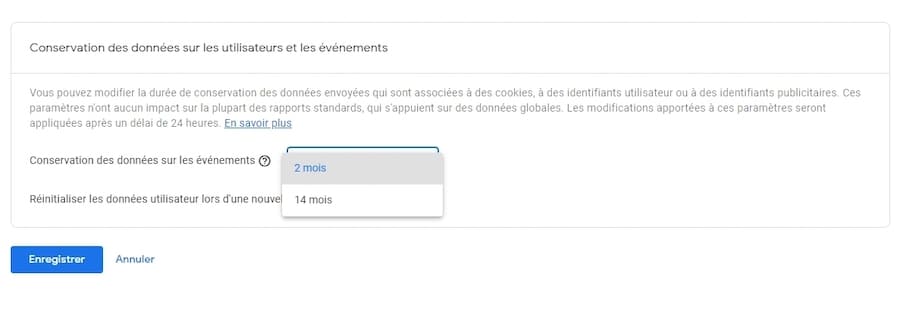
Un changement plus conforme au RGPD, mais pas encore optimal, puisque ce règlement prévoit que le délai de conservation soit de 13 mois maximum pour les cookies publicitaires et 24 mois pour ceux concernant l’audience.
La possibilité de supprimer les données d’un visiteur individuel
Google Analytics 4 permet de supprimer les données d’un utilisateur spécifique. Cela constitue une grande amélioration par rapport à Universal Analytics qui permettait uniquement de supprimer les données dans une plage de temps définie.
Avec GA4, vous pouvez désactiver le déclenchement de l’outil jusqu’à ce que les utilisateurs donnent leur consentement. Dans ce cas, vous ne collecterez aucune information personnelle et ne courrez donc aucun risque de traiter des données sensibles.
Le partage avec d’autres produits Google
Lorsque vous configurez votre compte GA4, vous pouvez choisir de partager des données avec les équipes d’assistance technique de Google, les gestionnaires de compte et/ou d’autres produits.
Veillez à examiner attentivement ces options, car certaines d’entre elles nécessiteront des divulgations supplémentaires de données confidentielles.
Bon à savoir : pour simplifier les choses, vous pouvez désactiver le partage des données.
Matomo VS Google Analytics : et si vous changiez d’outil ?
Dans sa liste officielle des outils identifiés par la CNIL comme RGPD-friendly, on retrouve Matomo.
Anciennement connu sous le nom de PIWIK, il permet de suivre les visites sur votre site web et vos applications. Solution libre et open source, l’outil dispose d’une version SaaS hébergée en Allemagne. Ses fonctionnalités sont tout particulièrement étudiées pour être aux normes du Règlement Général sur la Protection des Données.
Un fonctionnement on-premise
Matomo est basé sur PHP et MySQL, et peut être installé sur son propre serveur, ou fonctionner dans le cloud avec un service payant. Grâce à cette installation on-premise, vous pouvez gérer vous-même les données des visiteurs et votre conformité avec le RGPD.
Il offre des fonctionnalités natives qui vous permettent d’anonymiser et de pseudonymiser automatiquement les adresses IP des internautes. Ce qui élimine le caractère personnel des données comme stipulé par le RGPD. Dans le match Matomo VS Google Analytics : l’outil au nom japonais gagne un point !
Le choix du lieu de stockage des données
Matomo indique sur son site web que les données collectées ne sont pas transmises et restent entièrement chez le gestionnaire du site web. Vous pouvez donc déterminer les centres de données où les informations seront stockées et conservées. Cela constitue une grande différence avec Google Analytics.
Une évolutivité et des mises à jour automatiques
Matomo dispose d’une boutique via laquelle vous pouvez acheter des plug-ins pour faire évoluer ses fonctionnalités. Vous pourrez suivre plus précisément le comportement de vos visiteurs, tout en garantissant leur anonymat.
Par ailleurs, l’outil promet une mise à jour automatique en cas d’évolution du RGPD grâce à un gestionnaire avancé.
Des données en temps réel
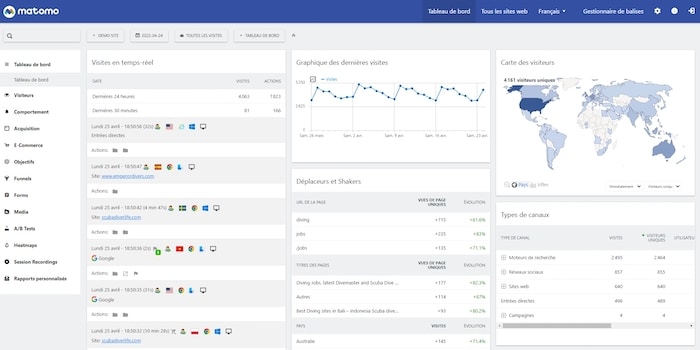
Ce qui distingue Matomo des autres outils, c’est qu’il est particulièrement utile pour analyser les données en temps réel. Il dispose de fonctionnalités différentes qui permettent d’identifier l’activité et l’origine du trafic d’un site web à tout moment.
Cela en fait un outil idéal pour analyser à la fois l’efficacité des campagnes marketing et la capacité d’un site à convertir les leads en clients.
De meilleures options de collecte des données
Vous n’avez pas besoin d’écran de consentement de cookies avec Matomo. Dès son installation, l’outil vous permet de choisir la méthode de collecte des données. La plus classique est celle proposée par la plupart des outils analytiques : une balise JavaScript à intégrer sur le front-end du site.
L’outil offre également une intégration côté serveur basée sur l’analyse des logs pour identifier un visiteur pendant sa visite. Grâce à cette solution, vous bénéficiez d’une image plus précise du trafic et des interactions sur votre site.
Rassurez-vous, cela ne pose pas de problème de confidentialité. Les données collectées sont exclusives et ne sont pas partagées. Vous ne les utilisez qu’à des fins d’analyse et non pour créer des audiences à recibler.
Optimisation de la conversion
Matomo dispose de fonctionnalités comme :
- Les heatmaps
- Les enregistrements de sessions
- Les analyses et suivis de formulaires automatiques
- Les entonnoirs
Le but de ces options est de vous aider à améliorer votre tunnel de conversion et donc, vos ventes.
Tout comme Google Analytics, Matomo permet de définir et suivre vos objectifs commerciaux ; de définir des événements pour identifier et mesurer la progression de l’utilisateur sur votre site web.
Ces fonctions destinées à optimiser la conversion vous aident aussi à créer des tests A/B.
Une compatibilité avec Google Ads
Dans le match Matomo VS Google Analytics, on pourrait croire que l’intégration avec Google Ads est l’apanage de l’outil de Mountain View. Sauf que tous les outils Google sont compatibles avec Matomo, Google Ads inclus. Vous avez la possibilité de gérer vos annonces et d’améliorer votre référencement payant depuis l’outil.
Bon à savoir : si vous utilisez actuellement Google Analytics, vous pouvez importer vos données Google Ads pour les intégrer à Matomo. De cette façon, vous n’aurez pas besoin de mettre en pause vos campagnes marketing !
Matomo Vs Google Analytics : comment choisir ?
Choisir Matomo, c’est opter pour un outil déjà respectueux des dispositions du RGPD. Vous ne perdrez plus de temps à mettre en place les paramètres requis. Tout est fait pour vous faciliter la vie !
Toutefois, si vous souhaitez rester fidèle à Google Analytics, vous devez passer à la version 4, plus conforme au RGPD. Ceci, pour ne pas risquer d’amende de la part de la CNIL. Vous avez jusqu’en 2023, mais vous devez savoir que la commission peut examiner votre site web à tout moment.
Notre astuce pour choisir entre Matomo et Google Analytics
Que vous choisissiez de passer à Google Analytics 4 ou d’adopter Matomo, nous vous conseillons de vous faire accompagner.
Un professionnel sera en mesure de paramétrer parfaitement ces outils en fonction de vos objectifs, mais aussi de vous former à leur utilisation parfois complexe. Le but est que vous puissiez tirer profit au maximum des données RGPD friendly transmises par l’outil.
Alors, n’attendez plus pour poster votre annonce sur Codeur.com afin de trouver un consultant analytics freelance pour vous accompagner !