Bien se hisser dans le top 10 de Google n’est plus la garantie de briller dans les réponses générées par l’IA. Une étude Ahrefs menée sur 15 000 requêtes révèle que ChatGPT, Gemini, Copilot et Perplexity citent majoritairement des sources absentes des pages les mieux classées par Google ou Bing. Résultat : plus de 8 citations sur 10 renvoient vers des contenus invisibles dans les SERPs classiques. Pourquoi ce décalage ? Parce que les IA ne “pensent” pas en termes de classement unique, mais multiplient et fusionnent les variantes de requêtes, retournant les règles du référencement.
Ce qu’il faut retenir :
- Seuls 12 % des liens cités par les assistants IA figurent dans le top 10 Google pour la requête d’origine.
- Perplexity est l’assistant IA dont les citations s’alignent le plus avec Google (près de 29 % d’overlap), loin devant ChatGPT et Gemini (~8 %).
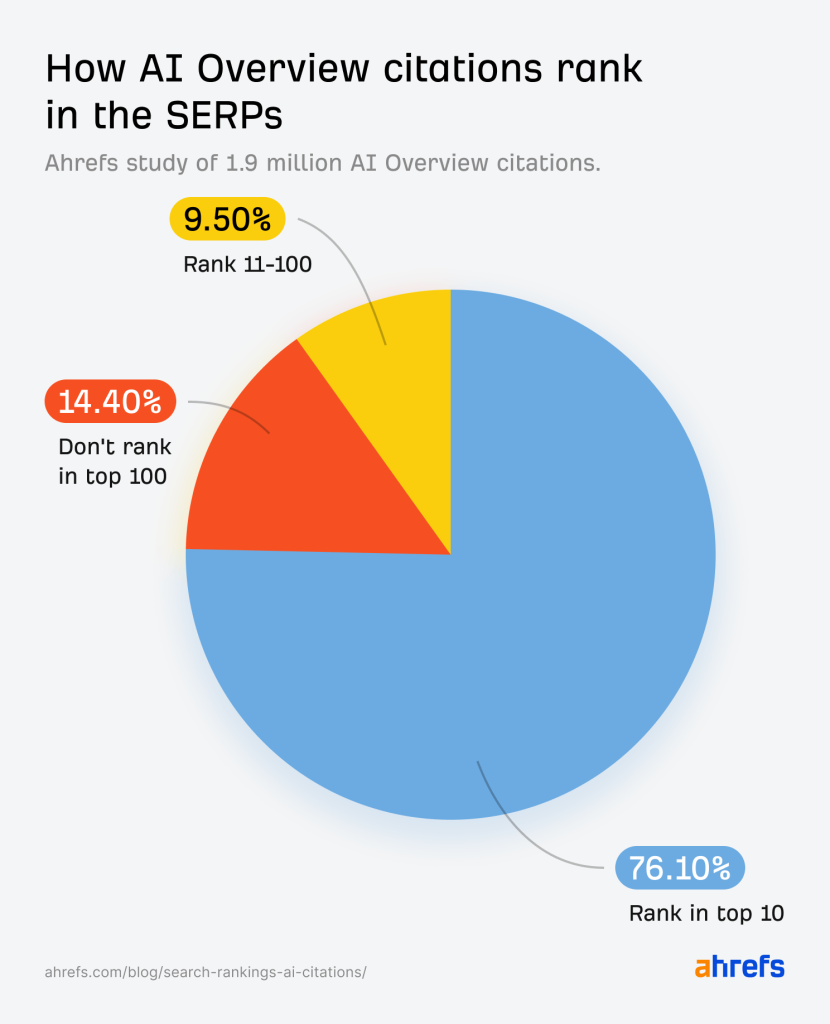
- À l’inverse, 76 % des liens sélectionnés dans les Google AI Overviews proviennent de pages classées top 10 sur Google.
- Les IA et les moteurs de recherche n’utilisent pas les mêmes critères ni la même logique pour sélectionner leurs sources, rendant l’optimisation bien plus complexe.
Les (faibles) liens entre citations IA et top 10 google
Les résultants sont sans appel : après avoir analysé 15,000 requêtes longues traînes et leurs citations par quatre grands assistants IA, on découvre que seule une minorité des liens (12 %) cités apparaissent dans le top 10 Google pour la même question. En clair, plus de 80 % des liens cités par ChatGPT, Gemini ou Copilot ne figurent même pas parmi les 100 premiers résultats Google pour ces requêtes !
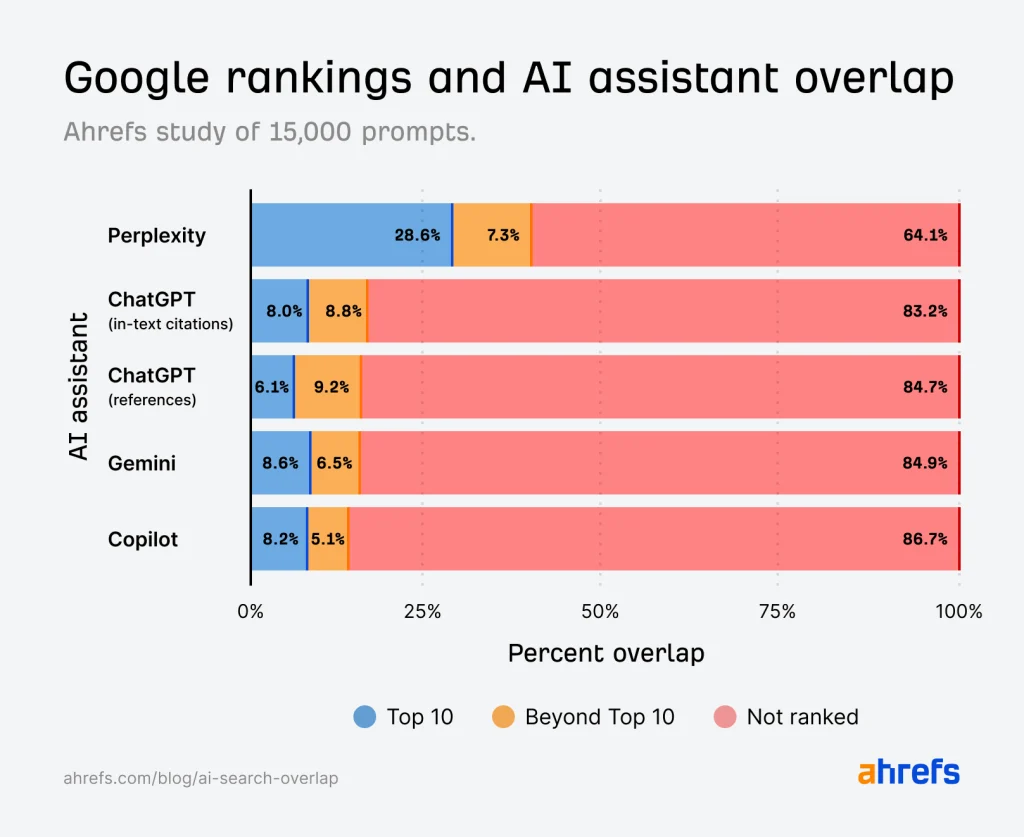
Perplexity se distingue néanmoins de l’ensemble : près d’une URL citée sur 3 renvoie ene ffet vers une page classée top 10 Google, contre moins de 1 sur 10 pour les autres assistants. Copilot, lié à Microsoft, tire logiquement son épingle pour Bing, mais là aussi, l’overlap reste bas (10 %).
Google AI Overviews : une logique inverse
Lorsque cela concerne les AI Overviews, la logique s’inverse : 76 % des liens cités viennent du top 10 Google. Ces résumés IA reprennent donc l’approche des SERP classiques, là où les assistants comme ChatGPT ou Gemini s’en éloignent fortement.
La place en top 10 sur Google reste donc (heureusement) déterminante pour figurer dans les extraits enrichis de Google. Mais rien n’indique que cela suffira pour apparaître dans les réponses générées par les IA conversationnelles.
Pourquoi autant de décalage ? le query fan-out !
Les IA génératives ne cherchent pas à répondre à l’exacte requête posée comme le ferait un moteur classique : elles développent des “variantes” de la question (“query fan-out”) et fusionnent les meilleurs résultats par une méthode de type “Reciprocal Rank Fusion” (RRF). Cette logique peut faire émerger en citation des contenus qui ne sont pas leaders sur le mot-clé principal, mais qui rankent bien sur d’autres variantes proches, souvent longues traînes.
À cela s’ajoute la personnalisation : deux utilisateurs, à partir d’une requête identique, pourront voir l’IA piocher dans des sources différentes, en fonction de leur historique ou du contexte conversationnel. Ainsi, optimiser “seulement pour le bon mot-clé” est de moins en moins suffisant.
Perplexity, un cas à part : la citation systématique
Contrairement à ChatGPT ou Gemini qui varient leur politique de citations selon la prédictibilité de la question, Perplexity cite des sources dans la quasi-totalité de ses réponses. S’il se rapproche plus des résultats Google, c’est parce qu’il a été construit pour rechercher et créditer en direct ses sources à chaque itération, sans se reposer sur l’index Google, mais sur sa propre base via le robot “perplexitybot”.
Être cité demain : stratégies et nouveaux réflexes
Pour espérer être sélectionné par les IA, et donc gagner en visibilité ou en notoriété, il faut aller plus loin que la simple position sur un mot-clé principal :
- Optimiser pour des clusters de requêtes longues traînes, en analysant les “parent topics” et variantes grâce à des outils dédiés comme Ahrefs ou Writesonic.
- Produire des contenus approfondis, contextualisés et répartis sur des pages secondaires, car 82 % des citations AI Overviews concernent des pages profondes et non la homepage du site.
- Travailler l’autorité des domaines qui sortent régulièrement dans les citations IA (Wikipedia, Youtube, Reddit trustent le haut du classement, mais des sites spécialisés ou périphériques tirent aussi leur épingle du jeu selon les assistants).
L’article “Seulement 12 % des liens cités par l’IA sont aussi dans le top 10 Google” a été publié sur le site Abondance.