OpenAI ne pouvait plus rester silencieux. Après avoir vu sa domination technologique contestée par le Gemini 3 Pro de Google et les performances impressionnantes de Claude Opus 4.5, l’entreprise de Sam Altman reprend l’initiative. Dévoilé ce 11 décembre 2025, GPT-5.2 n’est pas une simple mise à jour itérative, mais une refonte stratégique conçue pour le monde professionnel. Avec trois nouvelles déclinaisons et des capacités de raisonnement inédites, OpenAI entend bien prouver qu’il reste le leader incontesté de l’intelligence artificielle générative.
Ce qu’il faut retenir :
- Trois modèles distincts : La gamme se divise désormais en GPT-5.2 Instant (rapidité), Thinking (productivité pro) et Pro (tâches scientifiques complexes).
- Performance professionnelle : Le modèle “Thinking” atteint un niveau d’expert sur 70% des tâches intellectuelles complexes (finance, stratégie, gestion).
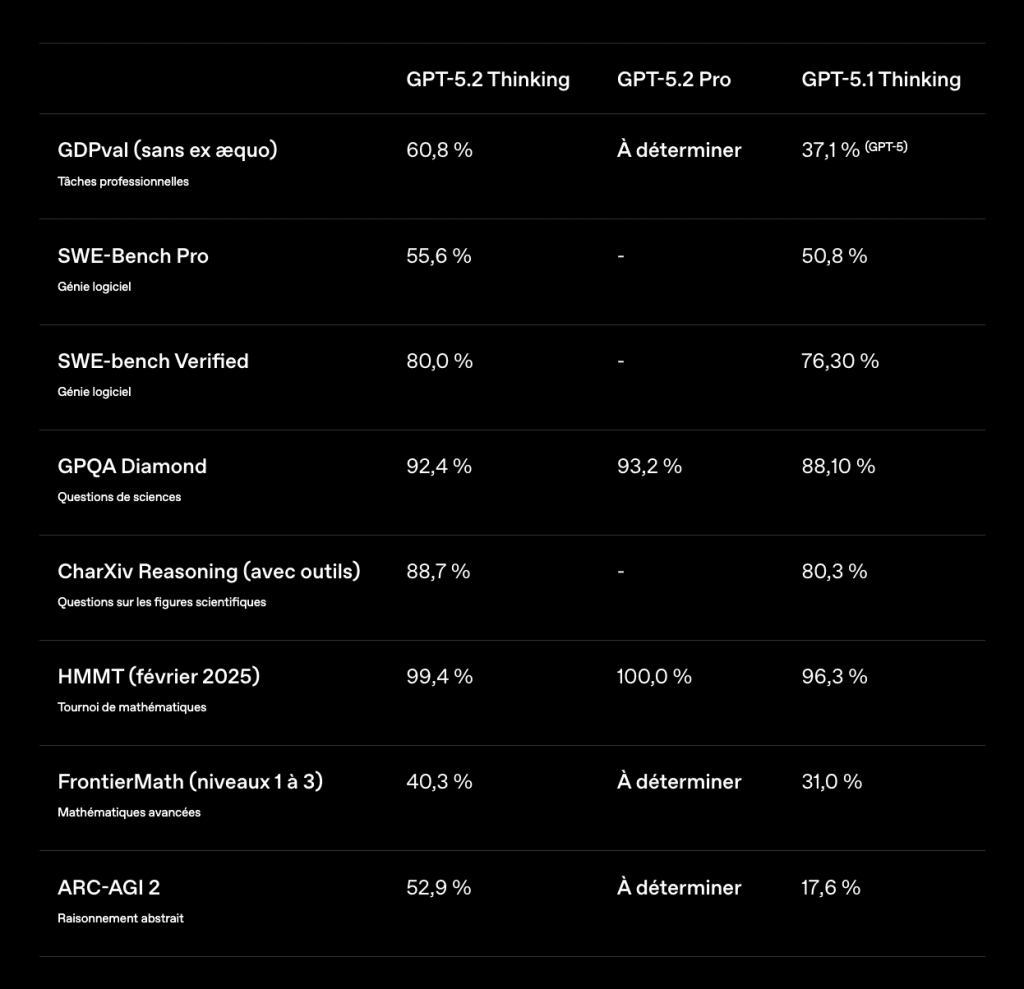
- Retour au sommet : OpenAI revendique de nouveaux records en codage (SWE-Bench Pro) et en mathématiques, dépassant les références actuelles du marché.
- Moins d’erreurs : Les hallucinations sont réduites de près de 40% par rapport à la génération précédente.
Une réponse directe à la concurrence
L’automne 2025 a été rude pour OpenAI. En interne, l’ambiance était à l’alerte rouge : malgré une base de 800 millions d’utilisateurs, la technologie maison commençait à s’essouffler face à la montée en puissance de Google et Anthropic. Gemini 3 Pro avait pris l’ascendant sur la fenêtre de contexte et la multimodalité, tandis que Claude Opus 4.5 était devenu le chouchou des développeurs.
Avec GPT-5.2, OpenAI ne cherche pas seulement à rattraper son retard, mais à redéfinir le standard. L’objectif est clair : offrir une IA capable de s’insérer durablement dans les flux de travail des entreprises, là où la valeur économique se crée réellement.
Une proposition segmentée
Pour répondre à tous les besoins sans sacrifier la performance, OpenAI segmente son offre. Fini le modèle unique à tout faire, place à la spécialisation :
- GPT-5.2 Instant : C’est le moteur du quotidien. Conçu pour être rapide et fluide, il conserve un ton conversationnel chaleureux. Il excelle dans la recherche d’informations, la rédaction simple et l’aide à l’étude. C’est l’outil que vous utiliserez pour une question rapide ou une traduction.
- GPT-5.2 Thinking : C’est la véritable star de cette mise à jour. Destiné aux professionnels, ce modèle prend le temps de “réfléchir” pour structurer ses réponses. Il est optimisé pour gérer des projets en plusieurs étapes, manipuler des outils complexes et analyser de grands volumes de données.
- GPT-5.2 Pro : Le poids lourd. Plus lent et plus coûteux, il est réservé aux tâches où l’échec n’est pas une option. C’est le modèle de prédilection pour la recherche scientifique de pointe, les mathématiques avancées (niveau FrontierMath) et les problèmes de physique complexes.
Le nouveau champion de la productivité
Là où GPT-5.2 “Thinking” impressionne le plus, c’est sur sa capacité à exécuter un véritable travail de bureau. OpenAI a introduit un nouveau benchmark nommé GDPval, qui évalue l’IA sur des tâches réelles issues de 44 professions différentes.
Les résultats sont sans appel : le modèle atteint un niveau de performance “expert” sur la majorité des tâches. Qu’il s’agisse de créer des feuilles de calcul financières complexes (bilans, tableaux de flux de trésorerie), de concevoir des présentations commerciales ou de planifier des effectifs, l’IA rivalise désormais avec des analystes humains qualifiés. Pour les entreprises, la promesse est d’économiser des heures de travail hebdomadaires, certains utilisateurs intensifs rapportant déjà gagner plus de 10 heures par semaine.
Un expert en code et en technique
Les développeurs, qui avaient pu être tentés de migrer vers Claude, ont de quoi revenir. Sur le benchmark SWE-Bench Pro, qui simule des problèmes de génie logiciel réels (et pas seulement du Python scolaire), GPT-5.2 établit un nouveau record à 55,6%.
Concrètement, cela signifie une capacité accrue à déboguer du code en production, à gérer des refontes de bases de code importantes et même à développer des interfaces front-end complexes, y compris avec des éléments 3D. Le modèle ne se contente plus de générer des snippets, il peut agir comme un partenaire d’ingénierie fiable.
Fiabilité et contexte étendu
L’un des talons d’Achille des grands modèles de langage reste l’hallucination. OpenAI affirme avoir fait des progrès substantiels ici aussi. Les réponses comportant des erreurs majeures sont 38% moins fréquentes sur le modèle Thinking par rapport à la version 5.1. Cela rend l’outil beaucoup plus sûr pour l’analyse documentaire ou la prise de décision stratégique.
Côté mémoire, le modèle brille par sa capacité à digérer de longs contextes. Il peut analyser des centaines de milliers de tokens (rapports, contrats, livres entiers) sans perdre le fil, avec une précision quasi parfaite pour retrouver une information précise noyée dans la masse. Bien que Google garde une avance théorique sur la taille absolue de la fenêtre de contexte (1 million de tokens), OpenAI mise sur la pertinence et la qualité de l’analyse plutôt que sur le volume brut.
Disponibilité immédiate
Le déploiement de GPT-5.2 commence dès aujourd’hui pour les abonnés aux formules payantes (Plus, Team, Enterprise) dans ChatGPT. L’accès via l’API est également ouvert pour les développeurs, avec une tarification agressive pour le modèle standard (1,75 $ par million de tokens en entrée), bien que la version Pro soit logiquement plus onéreuse.
C’est une étape importante pour OpenAI qui espère, avec cette démonstration de force, clore un chapitre embarrassant et s’installer de nouveau confortablement sur le trône de l’IA générative.
L’article “GPT-5.2 : OpenAI contre-attaque face à Google avec son IA la plus puissante jamais créée” a été publié sur le site Abondance.