Beaucoup d’entre nous ont l’habitude d’enregistrer un nom de domaine, dès qu’ils ont une idée géniale (ou pas) pour une nouvelle entreprise, un produit, un projet, un blog ou une activité secondaire. Mais ces idées ne restent souvent qu’une idée, et le nom de domaine finira par rester en sommeil dans votre compte pendant des mois, des années, voire des décennies, aux côtés d’une famille croissante d’autres noms de domaine inutilisés.
Bien sûr il existe plein d’autres raisons pour lesquelles vous possédez des noms de domaine inutilisés : vous avez pris votre retraite ou fermé une entreprise, vous avez décidé de ne plus mettre à jour votre blog ou votre site personnel.
Dans ce cas, vous vous demandez probablement si ces domaines ont une valeur pour quelqu’un d’autre et, si oui, comment vous pouvez vendre vos noms de domaine ? Voici comment faire.
Déterminer la valeur du nom de domaine.
Avant de vendre un nom de domaine, vous devez d’abord déterminer la valeur de celui-ci : plus facile à dire qu’à faire tant la valeur d’un nom de domaine peut varier de quelques Euros à des nombres à six, voire sept chiffres. La réponse universelle, c’est qu’un nom de domaine vaut ce qu’un acheteur est prêt à payer pour lui.
Heureusement, il existe certaines techniques d’évaluation qui peuvent vous donner une idée de la valeur potentielle du nom de domaine.
1. Commencez par étudier les ventes comparables
NameBio.com est une ressource pour trouver des ventes récentes de noms de domaine, et rechercher les ventes de noms de domaine similaires à ceux que vous possédez. Ce site offre une base de données historique contenant 1,5 milliard de dollars de ventes, et est mis à jour quotidiennement pour montrer combien de noms de domaine ont été vendus sur un certain nombre de marchés différents. Utilisez-le à votre avantage pour voir comment votre nom de domaine se compare aux ventes récentes. Utilisez des filtres pour la longueur, les mots-clés et bien sûr l’extension (comme .com, .net ou .io) pour réduire la liste des noms de domaine vendus qui sont similaires au vôtre.
2. Utilisez des outils d’évaluation des domaines
Une autre méthode pour obtenir un indicateur de la valeur de votre domaine est d’utiliser un outil d’évaluation de nom de domaine tel que Estibot ou l’outil de GoDaddy. Ces deux sites s’appuient sur des algorithmes pour calculer la valeur d’un nom de domaine, sur la base de nombreux attributs tels que la longueur du domaine, l’extension, le nombre de mots, la prononciation ainsi que des facteurs liés au référencement comme les mots-clés, le nombre de recherches, les recherches mensuelles et le coût par clic. N’oubliez pas que ces évaluations sont automatisées et ne pourront jamais tout prendre en compte, car la valeur d’un domaine n’est pas un absolu scientifique.
3. Demandez l’avis d’un expert
Si les deux méthodes précédentes vous donnent toutes deux une valeur élevée pour votre nom de domaine, vous pouvez envisager de demander une expertise à un courtier en noms de domaine de confiance pour vous assurer que vous avez fixé le bon prix pour votre nom de domaine. Vous pouvez également envisager de partager votre nom de domaine dans la section d’évaluation gratuite des noms de domaine sur NamePros, un forum pour ceux qui achètent et vendent activement des noms de domaine dans le but de réaliser un profit. Préparez-vous à recevoir des commentaires francs, mais gardez à l’esprit que toutes les personnes qui laissent un commentaire ne sont pas nécessairement des experts.
Fixez le prix de votre nom de domaine
Maintenant que vous avez une idée du prix de vente potentiel de votre domaine, il est temps de décider de la bonne stratégie de tarification. A moins que vous n’ayez entre les mains un nom de domaine de premier plan, qui devrait se vendre très cher, il est recommandé de commercialiser le nom de domaine à un prix réaliste.
Les domaines avec un prix d’achat immédiat ont beaucoup plus de chances de se vendre que les domaines avec une mention «Faire une offre» ou un système d’enchères. Un prix d’achat immédiat crée un sentiment d’urgence pour les acheteurs : s’ils n’achètent pas maintenant, quelqu’un d’autre le fera et ils risquent de perdre l’occasion de posséder le nom de domaine.
Si vous possédez un nom de domaine très recherché et que vous aimez le processus de négociation, il y a plusieurs raisons de choisir l’approche « Faire une offre » au lieu de mettre un prix fixe sur votre domaine. Recevoir des offres sur votre nom de domaine vous permettra de faire preuve de diligence à l’égard de la partie intéressée et de découvrir quels sont ses projets pour le nom de domaine et combien elle est potentiellement capable de payer et prête à payer pour acquérir votre nom de domaine.
Placer sur votre nom de domaine une landing page « À vendre ».
Lorsque quelqu’un pense à un nom de domaine et veut savoir s’il est disponible, que fait-il ? Il le tape dans son navigateur. Si votre nom de domaine n’affiche pas clairement le message « ce domaine est à vendre » et que l’acheteur potentiel ne peut pas vous contacter facilement, vous perdez la meilleure occasion de vendre votre nom de domaine.
Une page « À vendre » permet à tout visiteur de savoir immédiatement que votre nom de domaine est disponible à l’achat et de savoir comment entrer en contact avec vous. Il existe plusieurs façons de créer une page « à vendre » pour votre nom de domaine : Si vous avez un site web existant, vous pouvez simplement rediriger chaque nom de domaine que vous possédez et que vous souhaitez vendre vers une page sur ce site, avec un formulaire de demande. Vous pouvez également utiliser une page d’accueil « à vendre » sur le domaine directement.
Attention, lorsque vous vendez votre nom de domaine par l’intermédiaire d’une marketplace, vous devez verser une commission pour la vente, qui peut aller de 10 à 30 % du prix de vente total, même si l’acheteur est venu directement par la page du domaine.
Mettez votre nom de domaine en vente sur les places de marché
Si vous êtes arrivé jusqu’ici, vous avez compris l’importance de capturer les visiteurs directs du nom de domaine avec une landing page, mais cela ne signifie pas que la mise en vente de votre nom de domaine sur les différentes marketplaces n’apportera pas de valeur ajoutée.
La plupart des grandes places de marché ont des acheteurs réguliers, et un réseau de distribution dans lequel elles s’associent à d’autres sites web (tels que des bureaux d’enregistrement) pour mettre votre nom de domaine à disposition d’acheteurs potentiels dans le monde entier. En voici quelques-unes.
Sedo
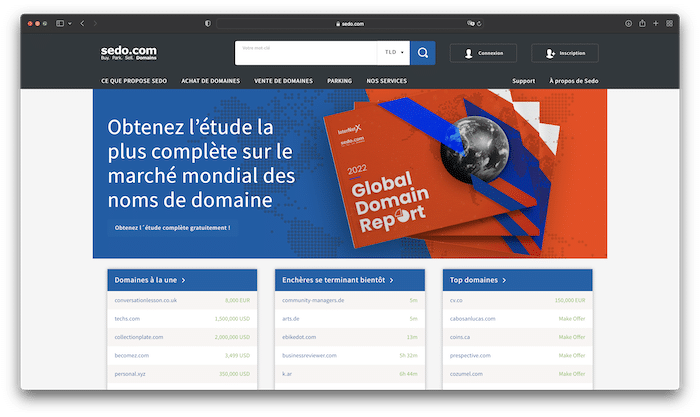
Sedo existe depuis 2001. Avec plus de 18 millions de domaines répertoriés, c’est l’une des plus grandes places de marché de domaines au monde. Le site reçoit environ 2 millions de visiteurs par mois, mais il assure également la promotion de votre nom de domaine sur un grand nombre de sites partenaires. L’inscription de votre nom de domaine est gratuite, mais vous payez une commission de 10 à 20 % lorsque votre nom de domaine est vendu.
Afternic
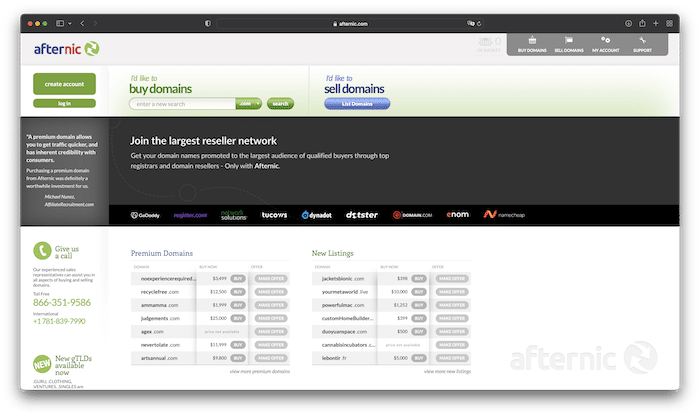
Fondée en 1999, cette plateforme compte plus de cinq millions de noms de domaine disponibles à la vente et plus de 75 millions de recherches de domaines par mois. Cette place de marché est détenue par GoDaddy, ce qui lui confère un avantage considérable par rapport aux sites similaires. Lorsque vous mettez votre nom de domaine en vente sur Afternic, il apparaît comme un domaine premium lorsque les internautes le recherchent sur le site GoDaddy.com. L’inscription d’un nom de domaine sur Afternic est gratuite mais vous payez une commission de 20 % pour une vente réussie.
BrandBucket
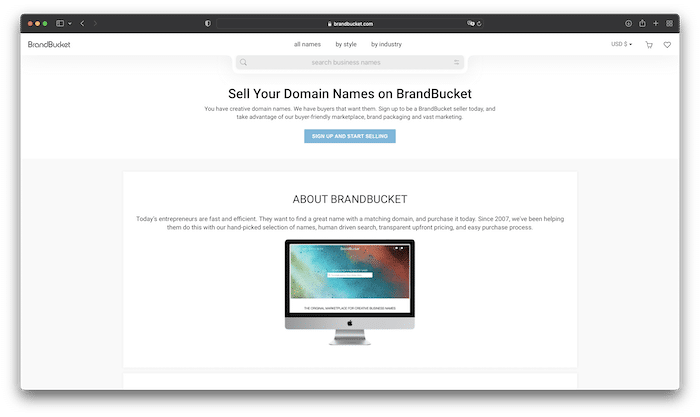
Si vous possédez un nom de domaine qui n’est pas nécessairement descriptif mais qui ferait un bon nom de marque pour une nouvelle entreprise, un nouveau produit ou un nouveau service, BrandBucket pourrait avoir le bon public pour vous aider à trouver un acheteur. Cette place de marché est sélective, chaque nom de domaine doit passer par un processus de soumission et d’approbation. Une fois approuvé, votre domaine est répertorié avec un logo et une description personnalisés qui aident les acheteurs potentiels à se faire une idée. BrandBucket demande une commission de 10$ pour inscrire votre domaine et exige l’exclusivité, ce qui signifie que vous ne pouvez pas vendre votre nom de domaine ailleurs tant qu’il y est inscrit. Avec 30%, la commission est élevée par rapport aux autres places de marché.
Enchères GoDaddy
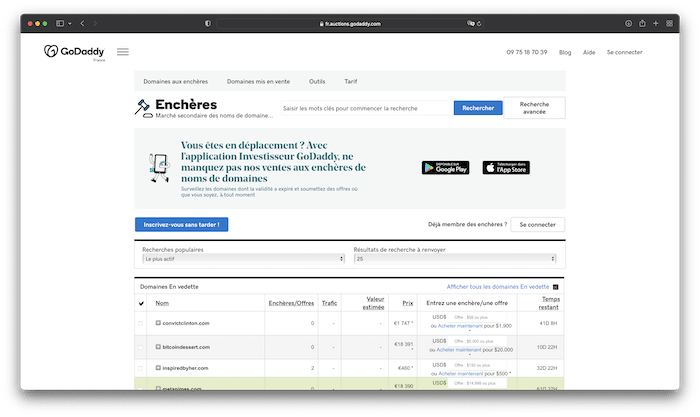
Godaddy Auctions est le site de marché secondaire de GoDaddy pour les domaines. La place de marché est très populaire auprès des particuliers et des entreprises qui recherchent des noms de domaine exclusifs et proches de l’expiration pour enrichir leur portefeuille de noms de domaine. La place de marché est visitée par 900 000 utilisateurs chaque mois et, grâce au statut de GoDaddy de premier bureau d’enregistrement de domaines au monde, vous êtes assuré d’une grande exposition pour votre liste d’enchères si votre nom de domaine a de la valeur. L’adhésion au site est payante (5$ par an) et lorsque vous vendez un nom de domaine, la commission est de 10 à 20 %.
Namejet
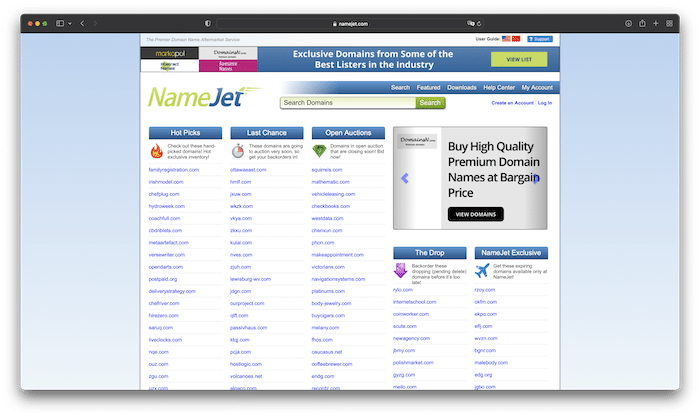
NameJet est une autre entreprise de marché secondaire de noms de domaine, qui exploite une plateforme d’enchères populaire auprès des investisseurs de noms de domaine. Le site compte un grand nombre d’acheteurs et déplace chaque jour un nombre considérable de noms de domaine. Tout le monde ne peut pas mettre des noms de domaine en vente sur NameJet mais le site offre une option en ligne pour soumettre vos domaines pour une prochaine vente aux enchères. Afin de fournir la meilleure qualité de domaines à leurs acheteurs, ils ne mettent pas aux enchères tous les noms soumis ; vos noms sont transmis et examinés par l’équipe de NameJet. Pour soumettre votre nom de domaine, vous devez d’abord avoir un compte actif. La commission sur une vente réussie est de 15%.
Notre astuce pour vendre un nom de domaine
Si vous avez besoin d’aide pour transférer votre nom de domaine, l’acheter ou encore le vendre, n’hésitez pas à faire appel à un développeur web freelance sur Codeur.com.