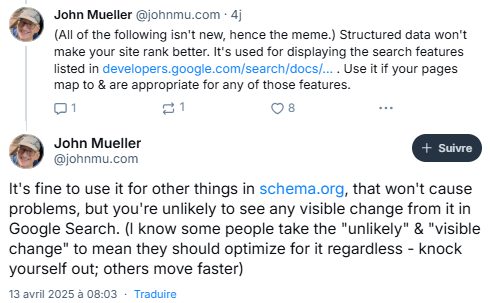
John Mueller from Google recently confirmed it on Bluesky structured data do not have a direct impact on SEO rankings. But then, why do people keep talking about it constantly in SEO discussions? The answer is simple: although structured data won't push your site up the rankings, it plays an essential role in optimizing visibility and engagement.
Key takeaways:
- No direct impact on SEO, but essential for visibility and engagement.
- Rich results increase visibility and clicks in the SERP.
- Helps LLMs quickly extract relevant information.
- Schema.org increases the likelihood of being displayed and indirectly influences SEO authority.
What is Schema.org and why is it so important?
Schema.org is a standardized vocabulary created in 2011 by Google, Microsoft, Yahoo! and Yandex to structure data on the web. It allows developers to mark specific information on their pages (such as products, events or reviews) using tags, which makes it easier for search engines to understand them.
The main goal of Schema.org is to improve the indexing and display of web content by providing structured, easily interpretable data, allowing search engines to better understand and organize information. This improves the visibility of content in search results, notably in the form of rich results, while promoting interoperability between different search engines and applications.
The indirect impact of structured data: more visibility and engagement
Rich results: capture attention with increased visibility
Imagine a user searches for a Made in France product on Google. If your e-commerce site has properly marked up its pages with structured data (price, availability, customer reviews), there is a high likelihood that your product will appear in Google's rich results results. This can include elements such as user ratings, a product snippet, or even a review snippet, which will be visible directly in the SERP, attracting the user's attention and increasing the chances that they will click on your link.
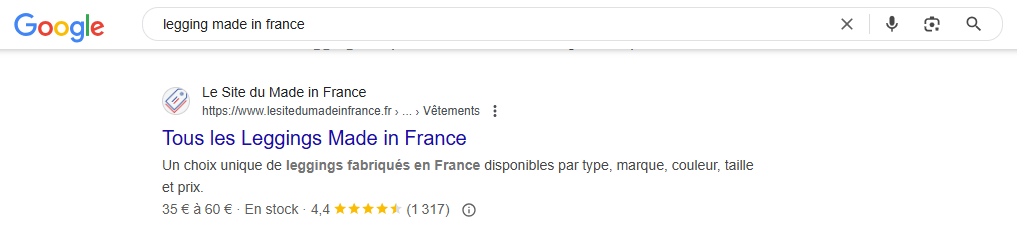
Similarly, if you have a educational video and you have correctly marked it up, Google could display it as arich video snippet, with a preview, the duration and practical details. This lets the user know exactly what they will see before clicking, which increases engagement.
However, it is important to note that even if you implement the structured data and the schemas for Schema.org, it is not guaranteed that your content will always appear as rich results. Several factors, such as the competitionthesite authority, or even theSERP updates, play a role in the display of rich results.
Here is a list of recommended schemas by Google, which, if properly implemented, can potentially lead to rich results:
- Article : Displays an article with a larger title and image.
- Book-related actions : Direct purchase of a book in the search results.
- Breadcrumb trail : Displays the site hierarchy to make navigation easier.
- Carousel : Displays as a gallery for content like recipes, movies, or restaurants.
- Course information : Details about courses, with reviews and prices.
- Course list : List of available courses with their details.
- Dataset : Display of datasets.
- Discussion forum : Discussions displayed in search results.
- Education Q&A : Educational flashcards.
- Overall employer rating : Display of an employer's rating in job results.
- Salary estimate : Display of salary estimates for different occupations.
- Event : Rich results for events such as concerts.
- Fact-checking : Summary of fact checks.
- Frequently Asked Questions : Rich results for an FAQ page.
- Image metadata : Details about the image, such as its creator and usage.
- Job posting : Rich result for job postings.
- Educational video : Rich results for educational videos.
- Local business : Detailed information about a local business.
- Math solver : Results for solving math problems.
- Movie carousel : Carousel results for movies.
- Organization : Information about an organization, including its logo and contact details.
- Practice problem : Results for math and science exercises.
- Product : Rich results for products.
- Product snippet : Product details in a snippet.
- Merchant profile : Information about a merchant.
- Variants : Display of product variants (size, color).
- Profile page : Display of individual or organization profiles.
- Q&A : Questions and answers about a given topic.
- Recipe : Rich results for recipes.
- Review snippet : Display of a user review snippet.
- Software application : Rich results for software applications.
- Speakable element : Results that the Google Assistant can read aloud.
- Special announcement : Important or promotional announcement.
- Subscription content behind a paywall : Indication of content behind a paywall.
- Vacation rental : Rich results for vacation rentals.
- Vehicle listing : Information on vehicles for sale.
- Video : Rich results for videos, with the ability to watch them directly.
It is possible to preview some of these rich results thanks to Google's Rich Results Test. This allows you to see how your tags will appear before they are indexed in search results.
You can also use the Schema.org validation tool but it offers no preview tool.
An indirect impact on SEO ranking
Even though using structured data does not directly influence your SEO ranking, it has an significant impact on user engagement, which can indirectly affect your ranking. Thanks to rich results attractive, users are more likely to click on your link. This increased engagement — especially the time spent on your page after the click — sends positive signals to Google, as confirmed by the algorithm NavBoost.
NavBoost emphasizes the importance of click-through rate in the SERP and on-page engagement to adjust the SEO ranking. For example, if a electronics product site displays a rich review snippet and many users click on it and spend time reading reviews or browsing other products, this can improve thesite authority in Google's eyes. Click-through rate and interaction with content then become important signals for the ranking algorithm.
In short, although structured data does not directly influence the ranking, they play a key role in increasing CTR and engagement on your site, a crucial factor for the NavBoost algorithm.
Schema.org and LLMs: a powerful duo
The LLM (generative language models) such as SearchGPT are able to extract information from web pages, but this process takes time when the data is not well structured. The structured data offered by Schema.org make this task easier by providing a simplified, fast way to read information. This allows the AI to easily find what it's looking for without having to analyze long blocks of untagged text.
Google still recommends using structured data in an AI search world – focusing on those things that are actually visible in SERPs
@JohnMu #sclmadrid twitter-pic/IT3mJrAFFc
— Aleyda Solis

 (@aleyda)
 Let's take the example of a film website that structures data like the director, genre, or the release date of movies with Schema.org. An AI engine will be able to extract this information quickly to provide an immediate answer in search results, such as a summary or practical details (director, release date).
Warning: AI systems do not always have access to most recent information. Thus, although AI can offer quick answers, it is possible that the information is not always up to dateThis is where Google, with its ability to index and update data in real time directly from the web, retains an major advantage over generative AIs that sometimes rely on pre-existing models or historical data (for now...)
Don't neglect structured data in 2025
The structured data are not a direct lever to improve your SEO ranking, but their impact on user engagement is real. They facilitate the understanding of your content by Google and LLM, while increasing your visibility thanks to rich results. If you want to take advantage of theAI and respond more effectively to users' expectations, implementing clear structured data remains essential.
The article "Schema.org: the hidden impact of structured data on your SEO in 2025" was published on the site Abondance.