Un Français sur deux a utilisé l’intelligence artificielle en 2025. Pourtant, dans le monde du travail, l’adoption reste timide, les usages souvent basiques, et la formation quasi absente. Une grande enquête Ipsos bva pour Google dresse un état des lieux complet, et pointe les leviers pour accélérer.
Ce qu’il faut retenir :
- L’utilisation de l’IA a doublé en France en deux ans, mais seulement 9 % des salariés s’en servent quotidiennement au travail.
- 70 % des cadres dirigeants estiment que l’IA a déjà amélioré la productivité de leur entreprise, une conviction que les salariés ne partagent pas encore.
- Les petites structures accusent un retard structurel important, mais leurs dirigeants exploitent l’IA de façon plus créative que la moyenne des salariés.
- Seulement 21 % des salariés ont reçu une formation à l’IA en entreprise, alors que se former multiplie par 2,6 la fréquence d’utilisation.
Une adoption qui s’accélère, mais une compréhension encore relative
La France a rattrapé une partie de son retard sur l’IA grand public. En deux ans, le nombre d’utilisateurs a quasiment doublé.
| Année | Utilisateurs d’IA en France | Moyenne mondiale (20 pays) |
| 2023 | 28 % | 38 % |
| 2024 | 35 % | 44 % |
| 2025 | 51 % | 62 % |
La France se situe devant les États-Unis (40 %), le Japon (42 %) et l’Allemagne (47 %), mais reste en retrait du Royaume-Uni (56 %), de l’Italie (59 %) ou de l’Espagne (64 %).
Utiliser l’IA ne signifie pas la comprendre. Sur ce point, les Français peinent davantage : 59 % déclarent avoir une bonne compréhension de ce qu’est l’IA, contre 66 % aux États-Unis, 64 % au Royaume-Uni et 75 % aux Pays-Bas. L’enquête pointe une explication culturelle : en France, l’IA est davantage abordée sous l’angle de la régulation que des usages concrets.
Les écarts de compréhension varient aussi fortement selon le profil :
| Profil | Bonne compréhension de l’IA |
| Hommes | 67 % |
| Femmes | 51 % |
| Moins de 35 ans | 72 % |
| 50 ans et plus | 45 % |
| Diplômés bac+3 et plus | 66 % |
| Diplômés bac ou moins | 51 % |
Ces disparités ne sont pas anodines : elles se retrouvent, amplifiées, dans les usages professionnels.
Une perception ambivalente : bonne pour l’économie, inquiétante pour la société
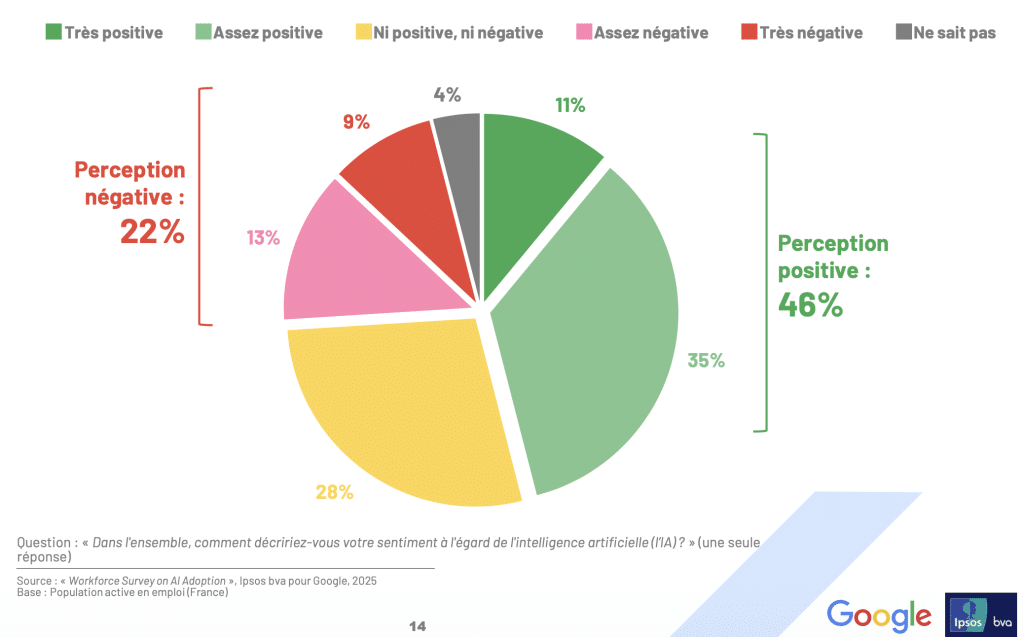
L’image de l’IA s’est améliorée. Près d’un salarié sur deux (46 %) en a désormais une perception positive, contre seulement 22 % qui restent dans une posture négative.
Mais la perception reste fondamentalement duale. Les salariés considèrent l’IA comme une opportunité pour les entreprises (41 %) et pour eux-mêmes à titre personnel (37 %). En revanche, ils sont bien plus sceptiques sur l’impact collectif :
| Impact de l’IA sur… | Opportunité | Menace |
| Les entreprises | 41 % | 22 % |
| Vous personnellement | 37 % | 24 % |
| L’économie du pays | 31 % | 28 % |
| Les travailleurs | 28 % | 34 % |
| La société française | 25 % | 37 % |
| L’environnement | 23 % | 37 % |
Interrogés sur les principaux inconvénients potentiels, les salariés citent en premier la dépendance excessive à l’outil (25 %), puis la perte des interactions humaines (24 %), devant les risques pour la confidentialité des données (23 %) ou la crainte d’être remplacé par l’IA (21 %). La peur du chômage technologique est donc loin d’être le moteur principal des résistances.
Les dirigeants, eux, sont convaincus
Les cadres dirigeants ont une vision radicalement différente. Interrogés sur ce qui aura le plus d’impact positif sur leur organisation dans les cinq prochaines années, 53 % citent les progrès de l’IA en première position, loin devant la transition écologique (28 %) ou l’amélioration des compétences des salariés (23 %).
Leur enthousiasme repose sur des résultats concrets :
- 70 % estiment que l’IA a déjà amélioré la productivité de leur entreprise
- 52 % affirment qu’elle a permis aux salariés de gagner du temps, plus de 3 heures par semaine dans deux tiers des cas
- 76 % ont réaffecté ce temps libéré vers des tâches à plus forte valeur ajoutée
- 64 % ont formé leurs collaborateurs à de nouvelles compétences
- 57 % ont augmenté les salaires de leurs employés suite au déploiement de l’IA
- 75 % ont même recruté de nouveaux collaborateurs pour accompagner ce déploiement
Loin de l’image d’une technologie qui détruirait l’emploi, les dirigeants sont peu inquiets : seuls 5 % envisageraient de réduire les effectifs si des postes pouvaient être confiés à l’IA. Et 80 % jugent probable que leur entreprise utilise davantage ces outils dans l’année à venir.
Dans les équipes, des usages encore trop timides
Malgré cet optimisme au sommet, les usages réels au sein des équipes restent limités.
| Fréquence d’utilisation de l’IA | Au travail | Dans la vie personnelle |
| Au moins une fois par semaine | 35 % | 41 % |
| Tous les jours | 9 % | 10 % |
| Jamais | 37 % | 25 % |
Parmi ceux qui utilisent l’IA au travail, les tâches restent majoritairement basiques :
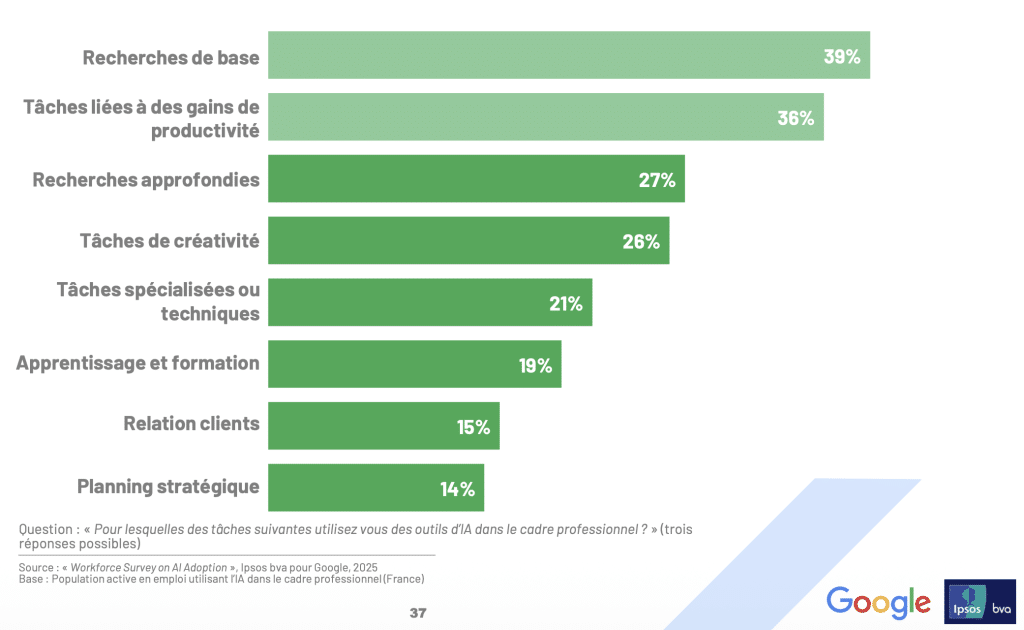
Les usages plus avancés sont surtout le fait des jeunes. Chez les moins de 25 ans, 30 % utilisent l’IA pour de la créativité, 26 % pour se former et 23 % pour des tâches techniques, contre respectivement 24 %, 13 % et 13 % chez les 55-64 ans.
Pourquoi ces usages restent-ils si limités ? Le frein principal est simple : 27 % des non-utilisateurs estiment que l’IA n’est pas pertinente pour leurs tâches. Le manque d’intérêt arrive ensuite (19 %), devant le doute sur la qualité des résultats (15 %) et la difficulté d’intégration dans les processus de travail (13 %). La méconnaissance du potentiel de l’outil est donc le vrai verrou, bien plus que des réticences techniques ou éthiques.
La « Shadow IA » : le signe d’une vraie appétence
Un phénomène révélateur émerge de l’enquête : la « Shadow IA ».
42 % des salariés qui utilisent l’IA au travail y accèdent principalement via leur compte personnel, contre seulement 29 % qui passent par un compte professionnel fourni par leur employeur. Et seuls 14 % des actifs déclarent que leur entreprise a mis en place une politique interne encadrant cet usage.
Les cadres dirigeants en sont conscients : 35 % ont constaté que des employés utilisaient leurs comptes personnels à des fins professionnelles, et 37 % ont noté que des salariés avaient commencé à utiliser l’outil avant même qu’un cadre officiel soit défini.
Ce phénomène est certes un risque en matière de confidentialité des données. Mais il traduit avant tout une envie réelle des salariés d’explorer le potentiel de ces outils, même sans y être encouragés ni formés. Un signal que les employeurs auraient intérêt à entendre.
TPE et auto-entrepreneurs : en retard structurellement, mais pionniers dans les usages
Les petites entreprises représentent plus de 99 % des entreprises françaises et plus d’un tiers des emplois privés. Leur retard est donc une question clé pour la transition IA du pays.
| Taille d’entreprise | Taux d’adoption mensuel de l’IA |
| Grandes entreprises (250+ salariés) | 58 % |
| Moyennes entreprises | 31 % |
| Petites entreprises | 15 % |
Pourtant, à titre individuel, les dirigeants de petites structures s’en sortent mieux que la moyenne des salariés, tant en fréquence d’utilisation qu’en qualité des usages.
| Profil | Utilisation fréquente (plusieurs fois/semaine) | Usage pour des tâches créatives |
| Dirigeants de TPE | 35 % | 35 % |
| Auto-entrepreneurs | 31 % | 37 % |
| Salariés (ensemble) | 25 % | 24 % |
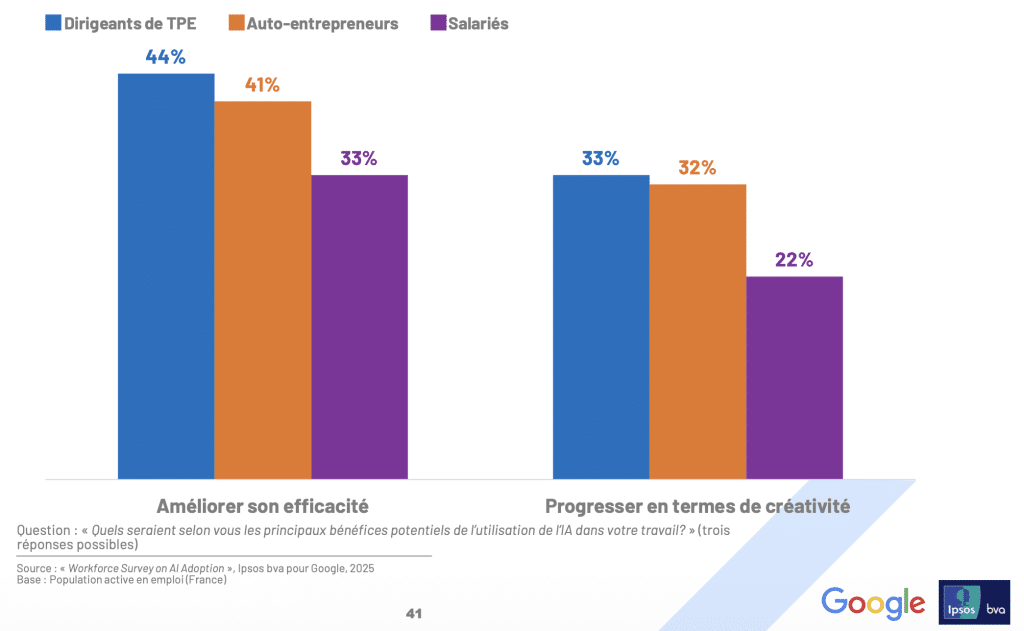
Ils sont aussi plus convaincus des bénéfices : 44 % des dirigeants de TPE et 41 % des auto-entrepreneurs estiment que l’IA peut améliorer leur efficacité, contre 33 % des salariés. L’écart est tout aussi net sur la créativité (33 % et 32 % contre 22 %).
Ces profils ont souvent découvert l’IA par eux-mêmes, de manière autodidacte, et en ont fait un outil de développement commercial concret : création d’identité de marque, calcul de prix de revient, planification stratégique. Des réticences subsistent néanmoins dans certains secteurs, artisanat, restauration, métiers manuels, où le lien entre l’IA et l’activité quotidienne reste difficile à percevoir.
La formation : le levier le plus puissant, et le plus sous-exploité
Les chiffres sur la formation sont parmi les plus frappants de l’enquête.
| Profil | Taux de formation à l’IA |
| Grandes entreprises (ETI/GE) | 30 % |
| PME | 19 % |
| Micro-entreprises (moins de 10 salariés) | 16 % |
| Auto-entrepreneurs | 13 % |
| Ensemble des salariés | 21 % |
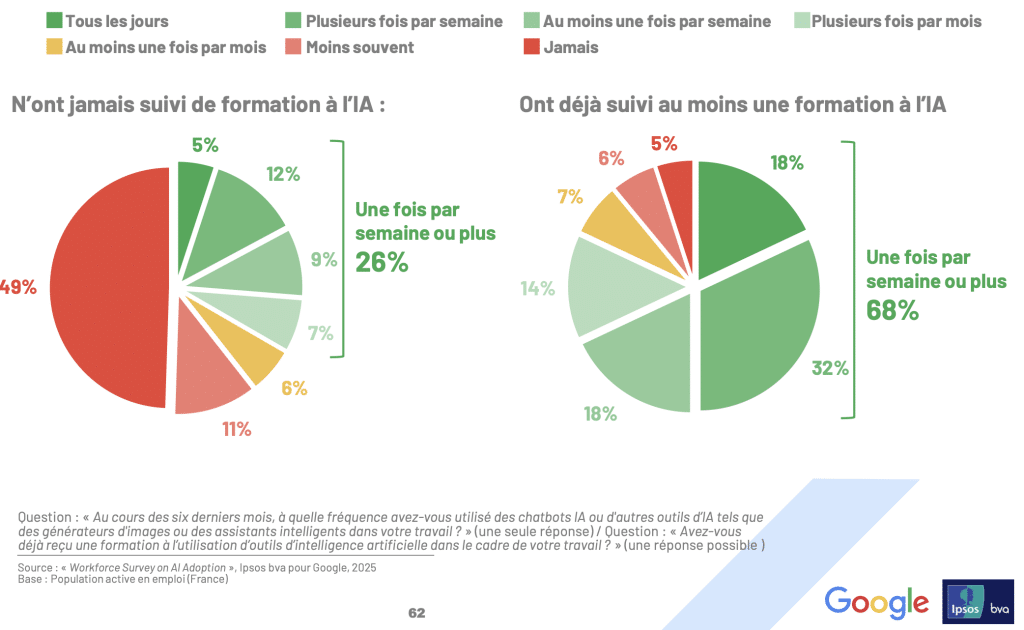
L’impact des formations est pourtant massif. Les salariés formés utilisent l’IA au moins une fois par semaine à hauteur de 68 %, contre seulement 26 % pour ceux qui n’ont jamais été formés. C’est un ratio de 1 à 2,6.
Les formations ont aussi un effet direct sur la confiance et les pratiques :
- 76 % des formés ont identifié de nouveaux cas d’usages grâce à la formation
- 74 % ont gagné en confiance dans l’utilisation de l’IA
- 74 % ont commencé à utiliser l’IA pour de nouvelles tâches
- 67 % ont vu leurs craintes liées à l’IA diminuer
Paradoxalement, 58 % des cadres dirigeants affirment avoir mis en place des formations à l’IA dans leur entreprise, un chiffre très éloigné des 21 % de salariés formés. Ces formations, quand elles existent, ne touchent sans doute pas tous les collaborateurs ou ne sont pas perçues comme suffisamment pertinentes.
Les attentes des salariés sont claires : 62 % souhaitent des formations appuyées sur des études de cas concrets, 61 % veulent des formations pratiques à l’utilisation des outils. La demande de contenu théorique et abstrait est bien plus faible (54 %). L’enjeu n’est pas d’expliquer « ce qu’est l’IA », mais de montrer « comment l’utiliser dans mon métier, au quotidien ».
Pour dispenser ces formations, les salariés font davantage confiance aux entreprises technologiques (27 %) qu’aux employeurs (24 %), aux organismes de formation (22 %) ou aux institutions éducatives (18 %). Les dirigeants de TPE et auto-entrepreneurs s’orientent encore plus vers les acteurs tech (34 % et 32 %).
Enfin, les compétences en IA deviennent un critère d’embauche croissant : 58 % des cadres dirigeants français affirment avoir déjà recruté un candidat en partie pour ses compétences en IA, au-dessus de la moyenne européenne (54 %). Pour les salariés, maîtriser ces outils n’est plus seulement un atout : c’est en train de devenir une condition d’employabilité.
L’article “Étude Google/Ipsos bva sur l’IA : une adoption encore timide en entreprise” a été publié sur le site Abondance.