Comment identifier un texte écrit par ChatGPT ? Certaines expressions récurrentes, comme “crucial”, “essentiel”, ou encore “dans le monde actuel”, trahissent souvent sa patte. Bien qu’utiles, ces termes peuvent parfois rendre les réponses un peu banales. Surtout si vous utilisez l’IA pour assister votre rédaction web…
Heureusement, avec quelques astuces simples, vous pouvez améliorer l’utilisation du chatbot d’OpenAI et éviter ces formulations trop convenues. Découvrons ensemble comment tirer le meilleur parti de ChatGPT, tout en conservant un style unique et personnalisé !
Pourquoi ChatGPT présente-t-il des tics de langage ?
Au cœur du fonctionnement de ChatGPT se trouve un algorithme de prédiction textuelle. Ce dernier puise dans une immense bibliothèque de textes pour assembler des mots de manière logique et stylistique.
Il a tendance à privilégier les termes et phrases qui apparaissent fréquemment dans sa base de données. Ainsi, des mots génériques comme « cela », « ça », « nous devons », « crucial », « captivant », « fondamental », « harmonie”… sont souvent réutilisés. Ce phénomène est souligné par des études, telles que celle publiée par la MIT Technology Review, expliquant l’émergence de certains “tics” de langage dans ses réponses.
Cependant, ChatGPT est capable de diversifier son langage si on lui demande spécifiquement. Il peut ajuster son vocabulaire et le style de ses réponses pour mieux correspondre aux attentes des utilisateurs, afin d’obtenir une interaction plus personnalisée, moins répétitive.
Comment construire un prompt sans tics de langage ?
Pour diversifier le vocabulaire de ChatGPT et éviter ses tics de langage ou expressions « bateaux », voici quelques conseils pour rédiger vos prompts :
- Spécifier vos préférences pour la variété : Avant de poser une question ou de rédiger un prompt, mentionnez votre préférence pour un vocabulaire varié, ainsi que des exemples d’expressions courantes à éviter.
- Demander des réponses dans un style spécifique : Si vous recherchez un certain ton ou style (formel, informel, technique, littéraire, humoristique, etc.), précisez-le. Cette consigne va naturellement conduire à l’utilisation d’un vocabulaire spécifique et donc, moins banal.
- Solliciter des exemples ou des analogies : Si c’est pertinent, demandez à ChatGPT d’illustrer sa réponse avec des exemples ou des analogies. Une telle précision va l’encourager à expliquer un concept de manière imagée et éviter les tics de langage usuels.
- Suggérer des thèmes ou des contextes particuliers : Si votre question touche à un domaine spécifique (comme l’art, la science, la technologie, l’histoire, l’écologie, etc.), précisez-le. ChatGPT va alors utiliser un vocabulaire spécifique à ce secteur, enrichissant ainsi la diversité linguistique de ses réponses.
- Demander des reformulations : Si une réponse donnée utilise des tics de langage, n’hésitez pas à demander une reformulation. ChatGPT devra trouver d’autres manières d’exprimer la même idée.
- Imposer des restrictions créatives : Si certaines expressions ou tournures vous semblent trop répétitives, demandez leur éviction en suggérant des alternatives. De plus, demandez explicitement l’utilisation de synonymes pour certaines expressions ou concepts pour diversifier le vocabulaire et obliger à repenser les formulations habituelles.
- Adopter une perspective spécifique : Indiquez si vous préférez que ChatGPT adopte une posture d’assistant dévoué plutôt que d’expert infaillible. Cette nuance oriente le ton vers plus d’humilité et de souplesse dans les réponses, favorisant une approche moins formelle et potentiellement plus créative.
- Préciser le format désiré : Au lieu de demander un “article” ou un “post LinkedIn”, sollicitez un “texte”. Ce choix de mots plus neutre invite à une rédaction libre de contraintes spécifiques à un genre, permettant une plus grande fluidité et adaptabilité. Pour les contenus destinés aux réseaux sociaux professionnels, préciser que vous souhaitez un “texte adapté à un contexte professionnel” peut aider à affiner le style sans se limiter à une plateforme précise.
- Structurer la demande avec une trame narrative : Décrivez le format souhaité en termes de structure narrative (introduction, développement, conclusion) ou de progression logique.
- Fournir un exemple d’accroche : Proposer un exemple pour donner une direction claire à ChatGPT dès le début. Cette précision établit le ton, le style et l’approche souhaités pour le reste du texte, ce qui le guide efficacement dans la rédaction.
Les exemples de prompts pour éviter les tics de langage de ChatGPT
Après la théorie, passons maintenant à un exercice pratique avec deux exemples de prompts à affiner, pour obtenir un texte naturel et de qualité.
Pourquoi le référencement naturel est important en e-commerce ?
Besoin de rédiger un texte explicatif sur l’importance du SEO pour les boutiques en ligne ? Avec un prompt simplifié : “Pourquoi le référencement naturel est important en e-commerce ?“, vous obtenez un texte juste, mais contenant de nombreuses répétitions avec certains tics de langage inhérents à ChatGPT. Sans compter que l’aspect « liste » n’est pas forcément très engageant.
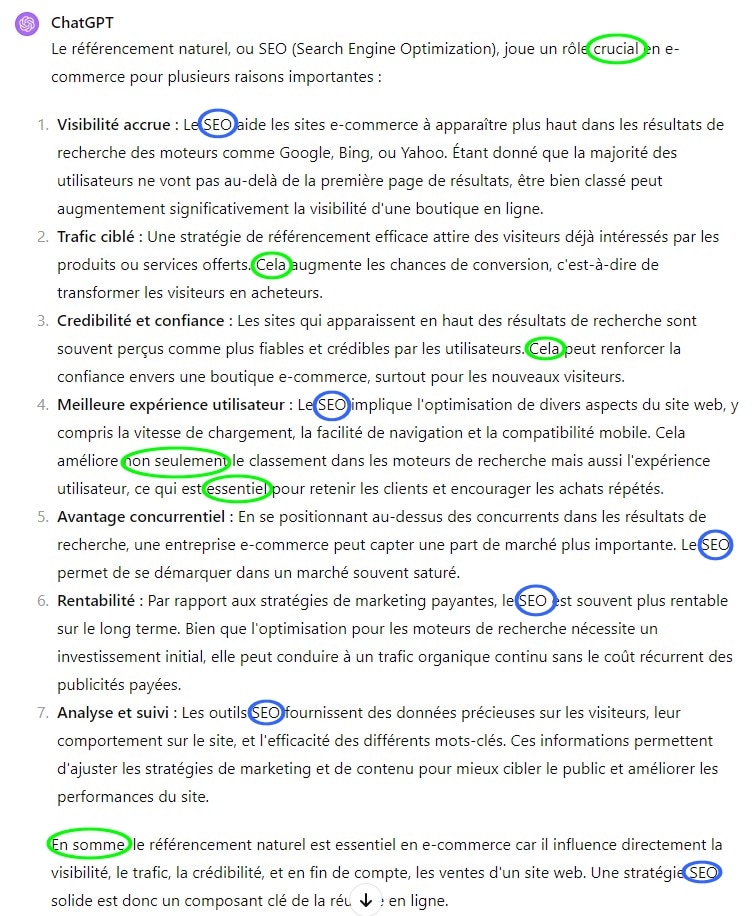
En vert, vous apercevez les tics de langage de ChatGPT et en bleu, la répétition du terme « SEO ».
Pour obtenir un texte enrichi, plus agréable à lire, voici un exemple de prompt à utiliser :
En 200 mots, développer les raisons pour lesquelles le référencement naturel est important pour un e-commerce.

Tenir impérativement compte des consignes suivantes :

# La structure :

- Démarrer par une phrase d’accroche qui annonce un fait sur l’e-commerce qui met tout le monde d’accord.

- Poursuivre en allant dans le détail, au fur et à mesure.

- Préférer un ton légèrement formel, mais accessible et enthousiaste.

- Utiliser le terme « e-commerce » 2 fois maximum, utiliser ensuite des synonymes comme « boutique en ligne » ou « site marchand ».

- Eviter les répétitions des mots « produit », « visibilité », « SEO ».

- Aérer le texte avec des phrases et paragraphes courts qui donnent envie de lire la suite.

- Ne pas utiliser de liste.

# Les contraintes :

- Supprimer les expressions issues des articles de ta base de connaissance comme : « au cœur de », « dans un monde », « dans le monde », « dans l’univers », « à l'ère de », « à l'heure de », « dans le », « dans les », « crucial », « fondamental », « captivant », « nous devons », « en conclusion », « ça », « cela », « cœur battant »…

- Ne pas utiliser le participe présent ni l'impératif.

- Ne jamais utiliser d'adjectifs verbaux (verbes qui se terminent en -ant).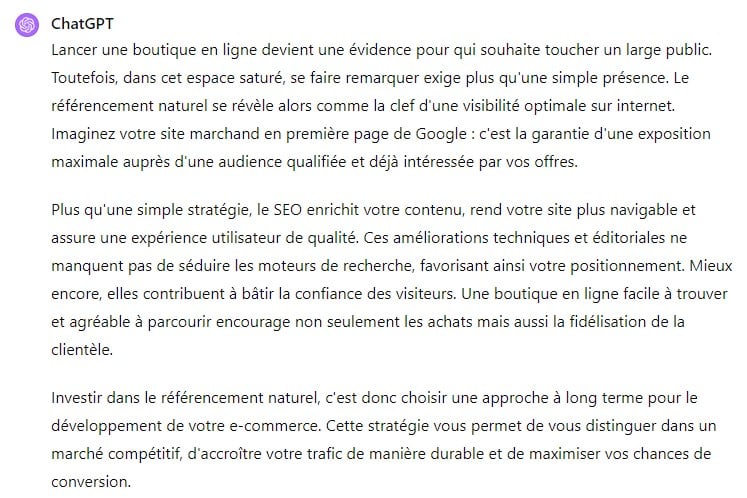
Le texte est plus clair, mieux rédigé, avec quasiment aucun tic de langage. Le champ sémantique est élargi, avec beaucoup moins de répétition.
Publication LinkedIn destinée aux graphistes
Admettons maintenant que vous souhaitiez utiliser ChatGPT pour rédiger un post LinkedIn, destiné aux graphistes en quête d’un nouvel ordinateur portable.
Si vous demandez simplement : « Me rédiger une publication LinkedIn donnant des conseils pour choisir un ordinateur portable quand on est graphiste ».
Vous obtenez un post basique, contenant des répétitions, des tics de langage (en vert) et une syntaxe plutôt linéaire.
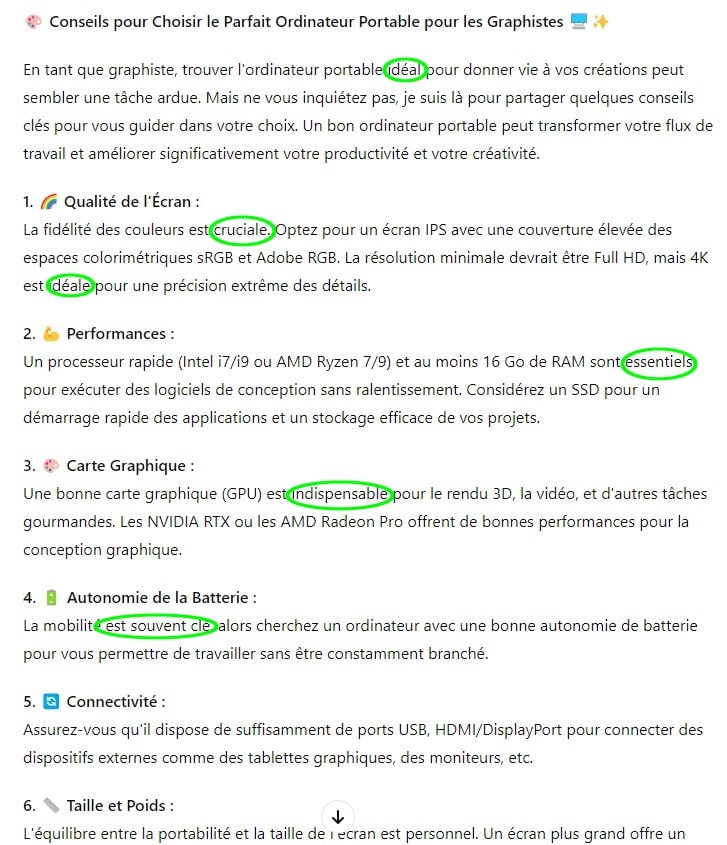
Pour captiver votre audience et obtenir un contenu de plus grande qualité, voici un prompt à tester :
En 200 mots, rédiger une publication LinkedIn donnant des conseils pour choisir un ordinateur portable quand on est graphiste.

Tenir impérativement compte des consignes suivantes :

# La structure :

- Te mettre dans la peau d’un ami serviable, qui souhaite conseiller un autre ami graphiste.

- Démarrer par une phrase d’accroche qui annonce un fait sur le choix d’un ordinateur portable pour le graphisme qui met tout le monde d’accord.

- Poursuivre en allant dans le détail, au fur et à mesure.

- Préférer un ton légèrement formel, mais être ludique, convivial.

- Utiliser une pointe d’humour.

- S’adresser directement aux lecteurs avec le « vous ».

- Aérer le texte avec des phrases et paragraphes courts qui donnent envie de lire la suite.

# Les contraintes :

- Supprimer les expressions issues des articles de ta base de connaissance comme : « au cœur de », « dans un monde », « dans le monde », « dans l’univers », « à l'ère de », « à l'heure de », « dans le », « dans les », « crucial », « fondamental », « essentiel », « indispensable » « nous devons », « en conclusion », « ça », « cela », « cœur battant »…

- Ne pas utiliser le participe présent ni l'impératif.

- Ne jamais utiliser de verbes qui se terminent en -ant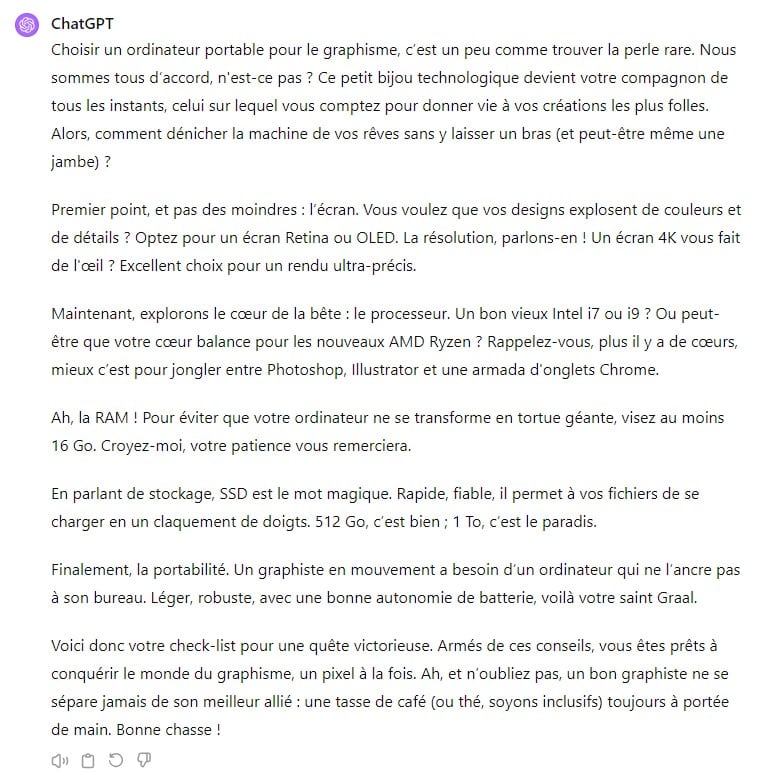
Nous obtenons un texte bien plus agréable à lire, sans répétition, avec un style bien défini. Les conseils sont davantage ciblés envers les graphistes. D’ailleurs, les lecteurs sont régulièrement interpellés, ce qui ajoute une touche d’humanisation à la publication et incite à poursuivre la lecture.
Notre dernier conseil pour éviter les tics de langage de ChatGPT
La clé pour esquiver les tics de langage de ChatGPT réside dans la formulation précise et créative de vos prompts. Encouragez la diversité du vocabulaire, donnez des exemples d’expression à utiliser ou, au contraire, à bannir pour obtenir des réponses sur mesure.
Si vous aspirez à enrichir davantage vos contenus, pourquoi ne pas confier cette mission à un rédacteur web sur Redacteur.com ? Un professionnel saura donner vie à vos idées avec originalité et précision, tout en respectant votre style et la voix de votre marque !
L’article Comment éviter les tics de langage de ChatGPT ? est apparu en premier sur Redacteur.com.