Mis à jour le 15/09/2025.
L’adoption de ChatGPT connaît un tournant majeur. La plus grande étude jamais réalisée sur son utilisation par les consommateurs révèle un large mouvement de démocratisation, un rééquilibrage démographique marqué et des bénéfices économiques concrets tant dans la sphère professionnelle que personnelle. Désormais, l’IA n’est plus juste l’apanage des technophiles : elle est un outil clé pour tous au quotidien !
Ce qu’il faut retenir :
- L’écart entre utilisateurs masculins et féminins s’est pratiquement effacé, avec une adoption qui reflète désormais la population adulte dans son ensemble.
- Près de 75 % des échanges visent la recherche d’informations, l’aide à la rédaction, ou la résolution de problèmes du quotidien, tandis que la programmation et la création artistique restent minoritaires.
- 30 % des usages sont liés au travail, mais la majorité (70 %) concerne la vie privée, ce qui illustre son double rôle dans l’amélioration de la productivité et du bien-être./li>
- Les taux de croissance y dépassent largement ceux des pays riches, preuve d’une accessibilité grandissante pour tous.
Une démocratisation accélérée et un usage transformé
L’étude menée par OpenAI et le NBER analyse près de 1,5 million de conversations, soit le plus grand échantillon jamais utilisé pour comprendre la pratique de l’IA au quotidien. Avec environ 700 millions d’utilisateurs actifs par semaine, ChatGPT s’impose comme le chatbot le plus populaire au monde, devant Gemini et DeepSeek.
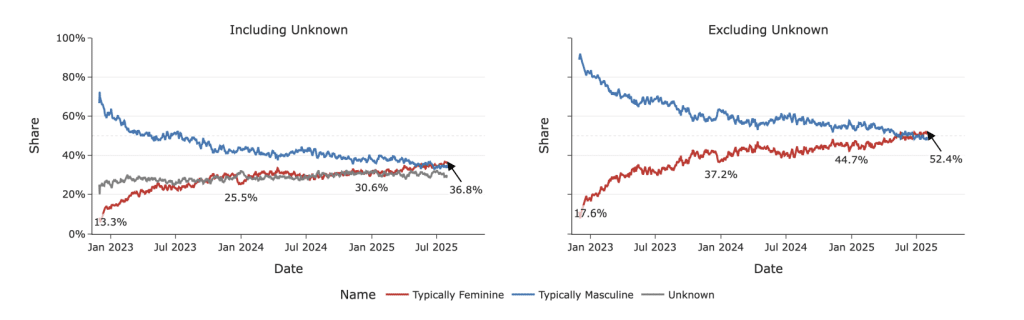
L’un des enseignements majeurs est l’évolution du profil des utilisateurs. Fin 2023, les hommes représentaient une large majorité ; mais au printemps 2025, les femmes forment plus de la moitié des nouveaux utilisateurs, traduisant une adoption massive au sein de la population générale… Mais des usages bien différents !
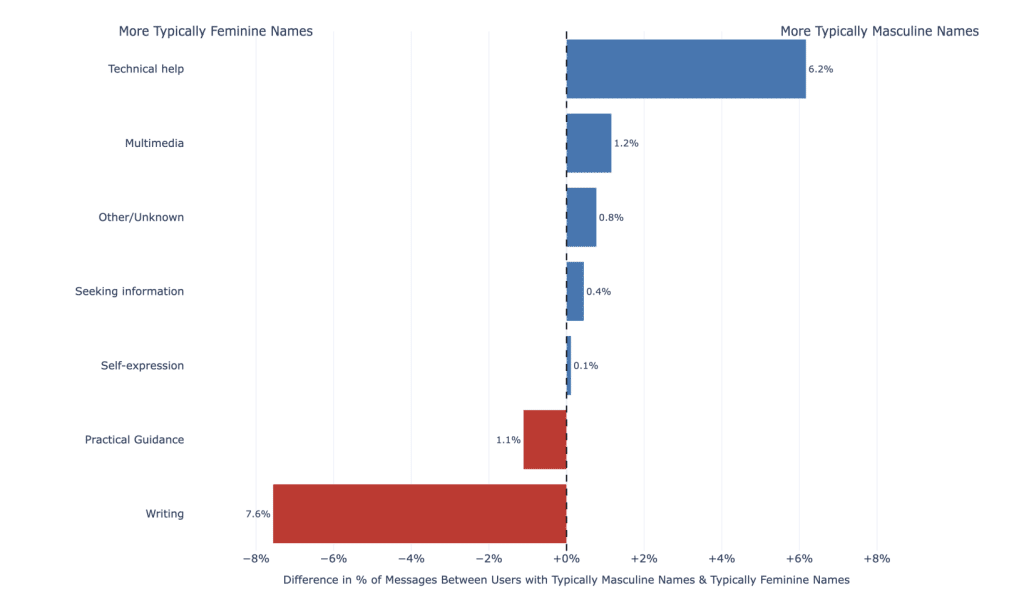
Des usages centrés sur l’action et le conseil
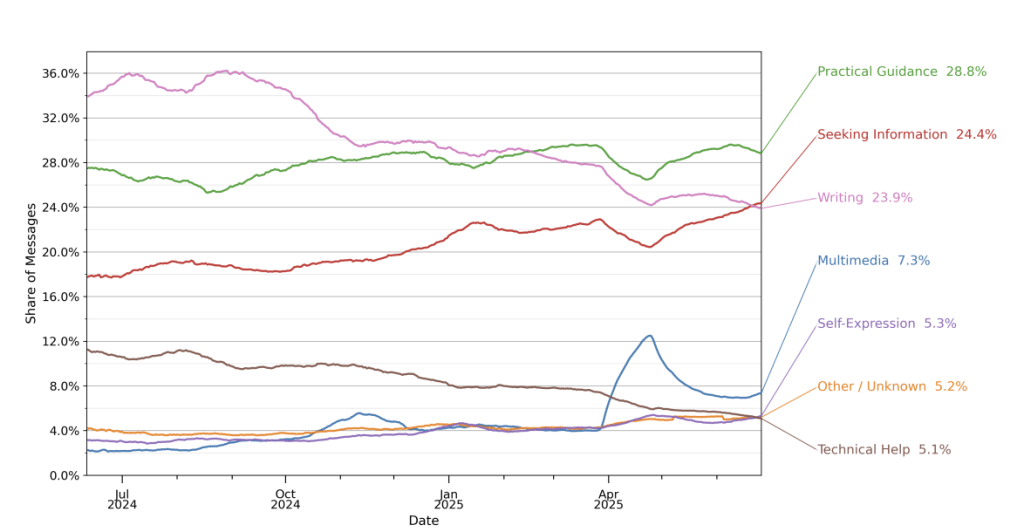
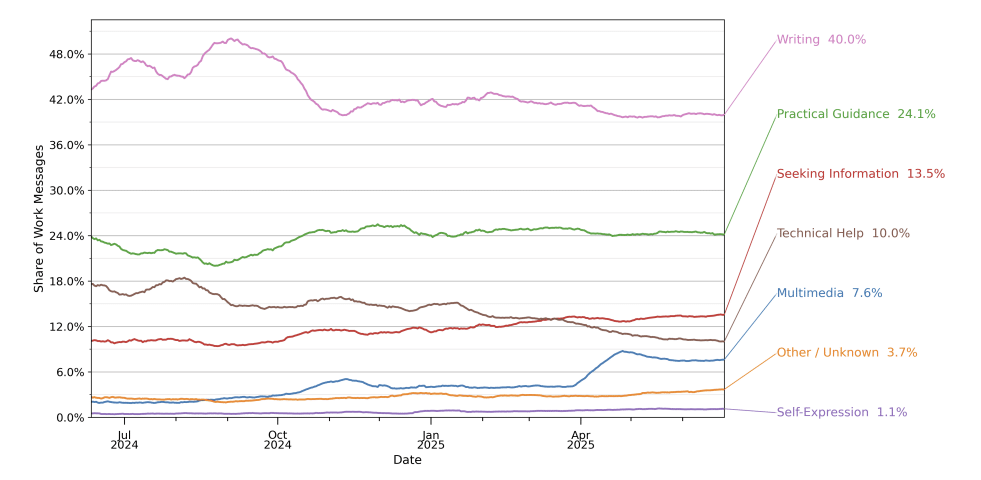
La très grande majorité des interactions (environ 75 %) porte sur des tâches concrètes. Les utilisateurs sollicitent ChatGPT pour obtenir des conseils pratiques, écrire, ou s’informer. L’écriture reste la première fonction dans le cadre professionnel (rédaction de mails, rapport, idées de campagnes…), alors que la programmation et l’expression créative demeurent des usages de niche.
L’évolution de tous les usages :
L’évolution des usages lié au professionnel :
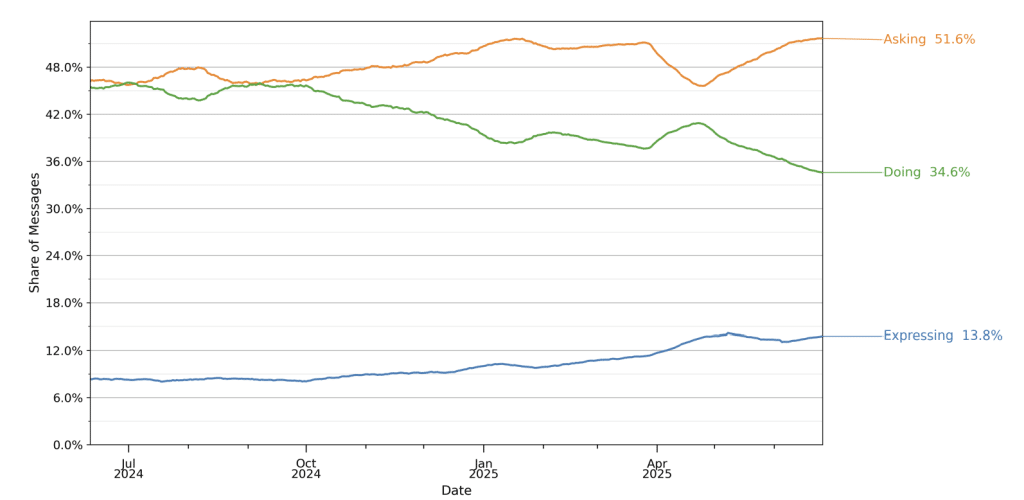
Les trois grands types de comportements :
- « Asking » (49 %) : le recours à ChatGPT comme conseiller pour orienter ses choix et améliorer sa prise de décision.
- « Doing » (40 %) : l’exécution réelle de tâches, qu’il s’agisse de rédaction, d’organisation ou de planification.
- « Expressing » (11 %) : des usages liés à l’expression personnelle, la réflexion ou le jeu.
Ca vous rappelle les intentions de recherche, non ?
Une création de valeur qui devient centrale
L’apport économique concret de ChatGPT devient mesurable. Un tiers des utilisateurs l’exploitent au travail, notamment dans des métiers à haute intensité cognitive où l’IA améliore productivité et jugement. Mais l’essentiel de la valeur produite échappe encore aux statistiques classiques comme le PIB : gain de temps, accès facilité à la connaissance, soutien à la prise de décision.
De plus, l’usage s’intensifie avec le temps, les cohortes d’utilisateurs accroissant leur activité au fil des évolutions du modèle et de la découverte de nouvelles applications.
ChatGPT : une adoption mondiale portée par les pays à revenus modestes
Alors que 20% des Américains utilisent intensivement l’IA au quotidien, l’étude d’OpenAI met aussi en lumière une forte dynamique d’adoption internationale de ChatGPT, en particulier dans les pays à faibles et moyens revenus. L’accès à l’IA générative ne se limite plus aux seules économies avancées : en mai 2025, la croissance de l’utilisation de ChatGPT dans les pays les moins favorisés est plus de quatre fois supérieure à celle relevée dans les pays riches.
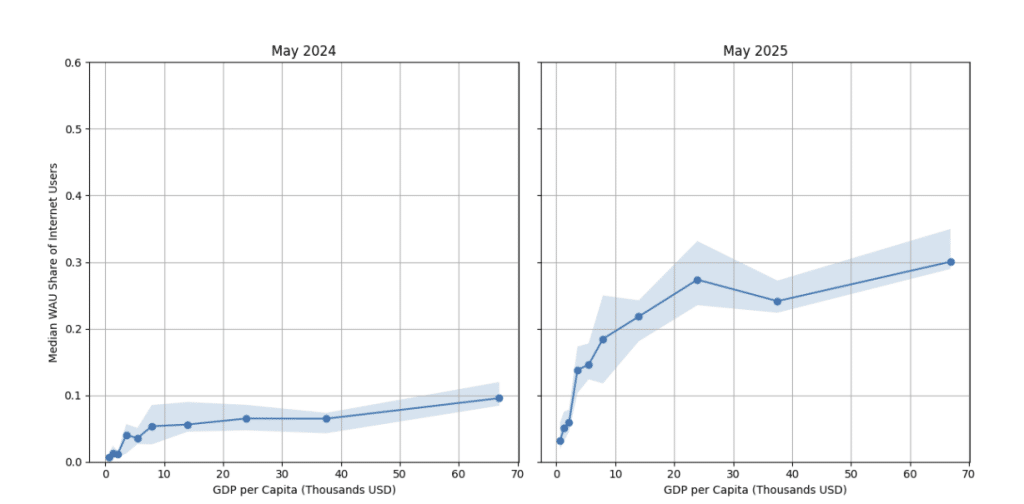
L’adoption de ChatGPT a connu une croissance spectaculaire, mais aussi une croissance disproportionnée dans les pays à revenu faible ou intermédiaire (PIB par habitant compris entre 10 000 et 40 000 dollars).
Ce phénomène s’explique par la grande accessibilité de l’outil, qui permet aux utilisateurs du monde entier de surmonter les barrières économiques traditionnelles. ChatGPT est ainsi devenu un levier essentiel pour élargir l’accès à l’éducation, à l’information et à l’accompagnement professionnel, tout en facilitant la vie quotidienne dans des contextes où les ressources sont souvent limitées.
L’étude insiste sur le caractère universel et inclusif de cette démocratisation : la répartition géographique des utilisateurs évolue rapidement, l’IA prenant racine dans des régions traditionnellement moins exposées à la technologie avancée, ce qui contribue à combler le fossé numérique mondial.
Un usage qui a commencé au travail et qui s’élargit à la sphère personnelle
L’effet de massification observé par l’étude d’OpenAI met en lumière le potentiel de ChatGPT à devenir un droit d’accès fondamental au savoir numérique, quel que soit l’âge ou la condition sociale. Les jeunes restent les plus utilisateurs (près de 60 % des moins de 30 ans aux États-Unis l’utilisent), mais tous les groupes démographiques progressent, avec un impact notable sur la productivité et un usage de plus en plus assumé au sein des entreprises comme des familles.
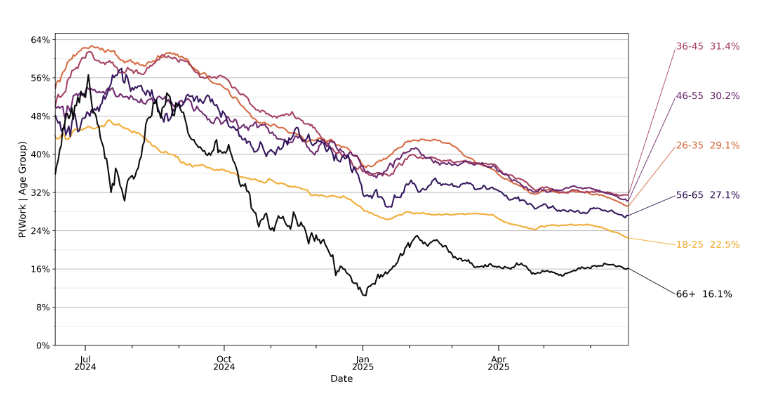
- Parmi ceux qui déclarent eux-mêmes leur âge, environ 46 % des messages de notre ensemble de données proviennent d’utilisateurs âgés de 18 à 25 ans.
- Les messages liés au travail représentaient environ 23 % des messages des utilisateurs de moins de 26 ans, cette proportion augmentant avec l’âge.
- La seule exception concerne les utilisateurs qui déclarent être âgés de 66 ans ou plus, dont seulement 16 % des messages classés sont liés au travail.
Le graphique ci-dessous montre l’évolution de la proportion de messages liés au travail par tranche d’âge. L’utilisation de ChatGPT est devenue moins liée au travail au fil du temps pour les utilisateurs de tous âges.
L’article “Étude IA : Comment les utilisateurs utilisent-ils ChatGPT ?” a été publié sur le site Abondance.