Avez-vous déjà conduit votre voiture sans avoir aucune idée de votre destination finale ? Non, car cela serait une perte de temps et d’argent, puisque le carburant dépensé ne mènerait à rien…
La même chose vous arrive quand vous ne définissez pas de cible pour vos campagnes et votre stratégie marketing en général.
La cible marketing se caractérise par l’audience présentant des caractéristiques communes aux clients de l’entreprise. L’objectif est d’établir le profil type d’une personne susceptible d’acheter votre produit ou service. Une pratique qui vous aide à diviser un large marché en segments pour se concentrer sur un groupe spécifique (et optimiser vos campagnes marketing).
Définir votre audience idéale est donc une étape primordiale. Mais comment définir votre cible marketing ?
1. Réaliser une étude de marché
Commencez par réaliser une étude pour analyser tous les aspects du marché sur lequel vous souhaitez communiquer. Vous pouvez y parvenir en effectuant une analyse SWOT : Strengths, Weaknesses, Opportunities, Threats. En français : Forces, Faiblesses, Opportunités, Menaces.
Classique, mais toujours efficace, cette méthode permet d’identifier :
- L’emplacement de votre cible : local, national ou international
- Les données démographiques : âge, sexe, profession, niveau de revenu, statut matrimonial…
- Les données psychographiques : valeurs, loisirs, style de vie, personnalité, attitude, comportement…
- Les secteurs d’activité : médecine, comptabilité, associations à but non lucratif, industrie…
- Les tendances du marché
- Les changements économiques
- Les habitudes d’achat des clients
- La concurrence
Connaître tous ces facteurs est la première étape pour vous aider à identifier votre cible marketing.

2. Créer des buyers persona précis
Après avoir recueilli toutes ces informations sur votre marché, vous pouvez créer le type d’acheteur idéal. Se demander qui est votre acheteur permet d’analyser et de répondre à un certain nombre de questions de ciblage essentielles, telles que :
- L’âge : à quel groupe d’âge ou à quelle tranche d’âge votre produit ou service s’adresse-t-il ?
- La situation financière : votre segment de marché peut-il se procurer votre offre et à quelle fréquence achètera-t-il votre produit ?
- Le genre : homme, femme, les deux… qui constitue la plus grande partie de votre cible ?
- La profession : comment leur activité professionnelle affecte leurs décisions d’achat ?
- Situations de vie : poste, fonction, employeur (ou taille de l’entreprise), vie de famille, statut marital, lieu de résidence…
Ces données vous aideront à construire des audiences type pour vos campagnes publicitaires sur Google ou les réseaux sociaux. Mais il est nécessaire d’obtenir des éléments qui vous permettront d’élaborer votre message marketing.
Pour ce faire, vous devez aussi déterminer les besoins émotionnels et les valeurs de votre cible. Ce qui nous amène au point suivant…
3. Définir les besoins émotionnels de votre cible marketing
Qu’est-ce que vos clients idéaux potentiels apprécient, trouvent passionnant et intéressant ? Quel est leur comportement dominant ou leur personnalité, quelles sont leurs opinions sur certains événements et certains styles de vie ?
Répondre à ces questions détermine les besoins émotionnels de votre audience, ainsi que ses valeurs.
Une autre question se pose alors : quelle est LA qualité à laquelle votre cible peut s’identifier ?
Répondre à cette question vous aidera à créer des campagnes marketing mémorables, clairement positionnées et reconnaissables par vos prospects.
Par exemple :
- La valeur d’enseignes comme Naturalia et Biocoop est l’écologie
- Une marque comme Redbull valorise l’énergie, le dépassement de soi
- L’image d’Apple se base sur le style, mais aussi l’accessibilité
- Blédina véhicule des valeurs familiales
- Le Slip Français surfe sur le savoir-faire Made in France et le « consommer français »
En trouvant la valeur qui vous relie à vos prospects et clients, vous agirez directement sur leurs émotions, ce qui rendra vos campagnes marketing plus efficaces.
4. Comprendre les points de douleur
La valeur est un élément important lors de la prise de décision, mais il ne faut pas oublier le point de douleur principal du prospect. POURQUOI a-t-il besoin de vos produits ou services ? Qu’allez-vous l’aider à faire ?
Comme tout problème, les points de douleur des consommateurs sont aussi divers et variés que vos clients potentiels eux-mêmes. Cependant, tous les prospects ne seront pas conscients des problèmes qu’ils rencontrent, ce qui peut rendre votre stratégie marketing plus difficile, car vous devez leur ouvrir les yeux sur ce point.
Par ailleurs, les points de douleur ne sont pas toujours des problèmes. Il peut s’agir d’un objectif à remplir ou d’un besoin d’optimisation. On pourrait les regrouper en 4 axes :
- Financier : vos prospects dépensent trop d’argent pour leur prestataire/solution/produit actuel et veulent réduire leurs dépenses.
- Productivité : vos prospects perdent du temps à utiliser leur fournisseur/solution/produit actuel ou veulent utiliser leur temps plus efficacement.
- Gestion : vos prospects veulent améliorer un processus du quotidien, un geste ou une tâche qui leur prend du temps ou qui utilise trop de ressources (financières, organisationnelles ou humaines).
- Soutien : vos prospects ne reçoivent pas l’accompagnement ou le soutien dont ils ont besoin lors de l’utilisation d’une prestation ou dans le cadre d’une stratégie. Ici, on recense également les clients qui trouvent que le bien ou service est trop complexe à utiliser.
En considérant ces « catégories », vous pouvez commencer à réfléchir sur le positionnement marketing de votre entreprise, tout en affinant votre cible.
5. Comprendre les motivations de votre cible
Vos prospects ont un point de douleur, ok. Ils sont donc motivés pour le résoudre. Mais qu’est-ce qui va les motiver à choisir VOTRE entreprise ?
Déterminer un facteur déclencheur, lié à la personnalité de votre cible marketing, va vous aider à les atteindre au cours du processus de décision. C’est essentiel pour rédiger vos pages de vente, vos publicités marketing et même vos descriptifs produits.
Si nous reprenons certaines marques citées plus haut dans cet article, voici les motivations qui poussent leurs consommateurs :
- Naturalia : en plus de ses produits bio ou en vrac, l’enseigne est engagée dans des actions en faveur de l’environnement. Ce qui fait la différence pour les consommateurs les plus engagés.
- Redbull : il existe de nombreuses boissons énergétiques sur le marché, mais Redbull reste celle avec la plus forte exposition dans des événements sportifs. Ses clients la choisissent pour cette image de qualité : si elle est partenaire de sports extrêmes, c’est qu’elle est efficace.
- Apple : lorsqu’un consommateur choisit Apple, c’est pour la qualité haut de gamme reconnue de la marque, ainsi que l’image d’un certain lifestyle qu’elle renvoie. Cela donne un sentiment d’appartenance aux acheteurs.

6. Connaître vos clients existants
L’une des meilleures façons d’identifier la cible marketing de votre entreprise est d’apprendre à connaître vos clients existants. Vous pouvez obtenir les 5 éléments cités précédemment via :
- L’examen de votre site web : cela peut vous aider à connaître le profil des visiteurs, comment ils naviguent et quelles sont les pages les plus consultées. Vous identifiez ainsi les paramètres socio-démographiques, ainsi que les besoins principaux de vos visiteurs.
- L’examen de vos réseaux sociaux : avec les statistiques fournies par les différentes plateformes, vous connaissez également le profil socio-démographique de vos abonnés, ainsi que leurs habitudes de connexion.
- Des enquêtes : vous pouvez en apprendre davantage sur les besoins, les valeurs et les motivations de votre cible marketing en envoyant des questionnaires à vos clients. Par email, via SMS ou même sur les réseaux sociaux, n’hésitez pas à réaliser des enquêtes de satisfaction ou à poser des questions ponctuelles. Vous pourriez obtenir de précieuses données.
- Les avis : que disent les avis de vos clients sur votre site internet ou sur les sites spécialisés ? Là encore, vous pouvez obtenir des feedbacks pertinents pour votre activité.
7. Analyser la concurrence
Si vous n’avez pas encore de clientèle existante (et même si vous en avez une, en fait), regardez ce que font vos concurrents ! Cette pratique vous aidera à comprendre le profil de votre propre audience.
Fouillez dans leur site web, leur blog, leurs pages sur les réseaux sociaux et leurs publicités pour comprendre leur stratégie. Pendant votre enquête, posez-vous les questions suivantes :
- Quelles sont leurs techniques de segmentation ?
- Qui est leur client idéal ?
- Ont-ils un marché cible spécifique ou plusieurs marchés cibles ? Quel(s) marché(s) cible(s) et pourquoi ?
- Comment font-ils la promotion de leurs produits ? Quel langage utilisent-ils ? Quelles caractéristiques produit mettent-ils en avant ?
- Quel est leur calendrier de publication ? À quelle fréquence publient-ils des messages ou envoient-ils des emails ?
Apprenez à connaître vos concurrents comme si vous étiez leur clientèle. Inscrivez-vous à leurs newsletters et suivez-les sur les réseaux sociaux pour obtenir des informations intéressantes.
8. Identifier les opportunités avec le mapping concurrentiel
Une bonne façon d’identifier un marché cible pour votre site web ou votre campagne marketing est d’utiliser le mapping concurrentiel. C’est un diagramme simple qui vous permet d’identifier les lacunes du marché ou de l’industrie dans laquelle votre produit/service/site web opère.
Pour le réaliser :
- Dessinez un axe Y et un axe X perpendiculaire, pour obtenir quatre sections différentes.
- Inscrivez les critères principaux de vos clients sur chaque axe (par exemple, un axe « âge » et un autre « revenu », ou un axe « besoin » et un autre « qualité du produit »).
- Représentez tous vos concurrents sur ce graphique en fonction de leur clientèle.
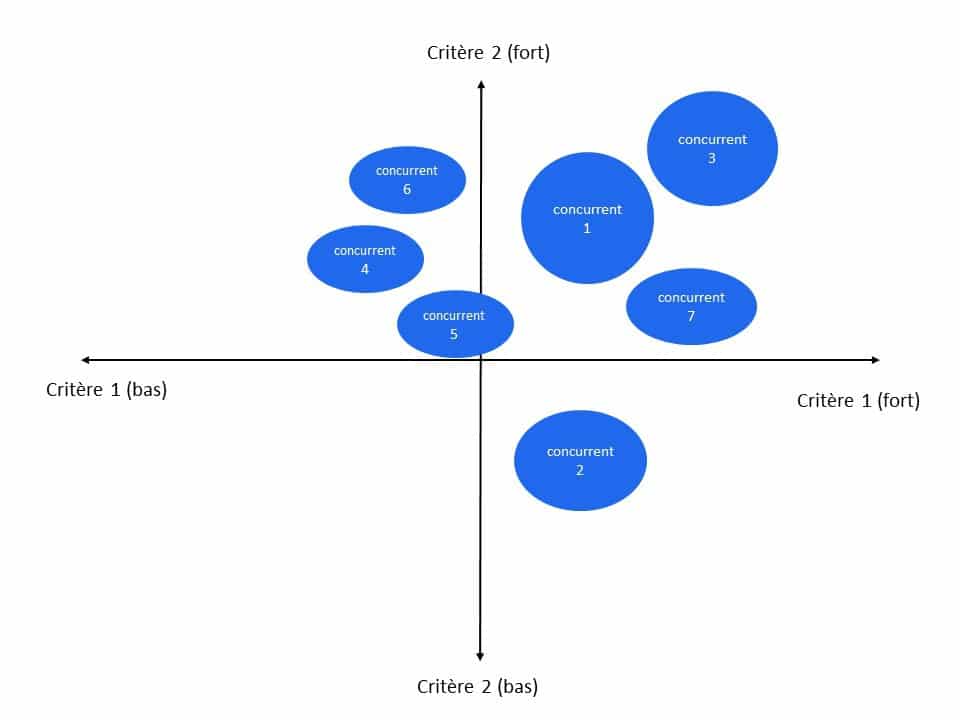
Une fois que vous avez terminé de représenter tous vos concurrents, cherchez les espaces vides sur le graphique. C’est là qu’il y a un vide sur le marché.
Avec cette méthode, vous pouvez facilement trouver votre créneau et identifier votre cible. Par exemple, vous constaterez peut-être qu’il y a beaucoup d’offres destinées aux professionnels formels et expérimentés, mais peu qui s’adressent aux professionnels occasionnels.
Conclusion
Définir votre cible constitue la phase primordiale de toute activité et campagne marketing. Après cette étape, vous pourrez mieux déterminer vos audiences, rédiger votre message, choisir vos visuels et sélectionner les contenus les plus appropriés pour remplir vos objectifs marketing et commerciaux !
Pas le temps de gérer le marketing de votre entreprise ? Besoin de déléguer la création de graphisme, le community management ou la rédaction d’articles de blog ? Tous les freelances dont vous avez besoin sont sur Codeur.com. Postez votre projet gratuitement pour recevoir leurs devis en quelques minutes.