Everyone's talking about AI. Your colleagues are using it. The media cover it every day. And you think you should get started — but where do you begin when you know nothing?
Good news: AI is like cooking. It looks intimidating from the outside. But once you understand the basics — the right ingredients, the right technique, the right timing — anyone can make something excellent.
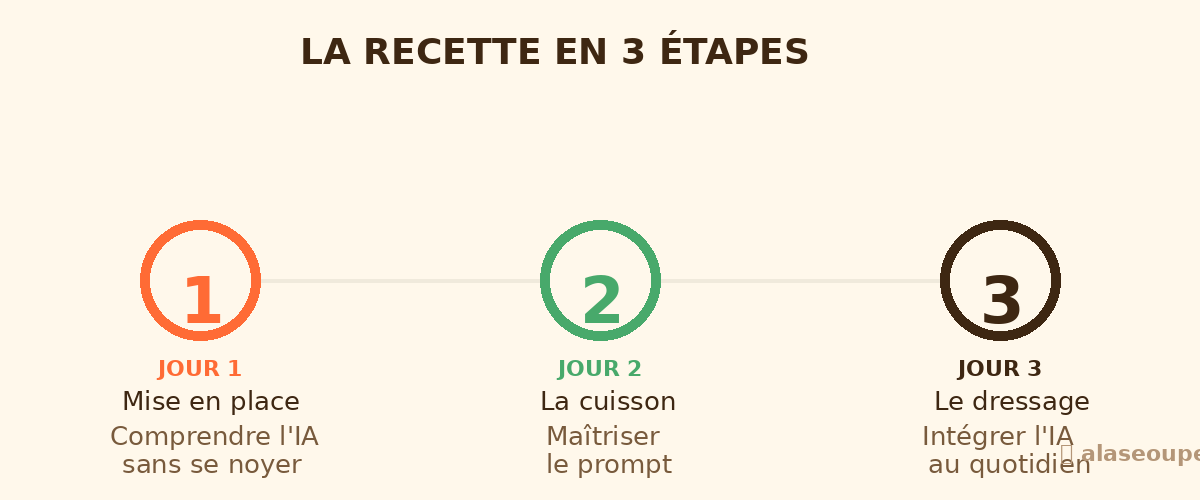
This challenge is your AI cooking class. Three days, about 1 hour per day, practical exercises at each step. No code. No math. Just hands-on practice with free tools, accessible immediately from your browser.
By the end of Day 3, you'll know:
— What AI really is (without the jargon)
— How to use the best AI tools for free
— How to save time on your daily tasks using AI
— How to avoid common beginner mistakes
Bookmark this page. Let's get into the kitchen.
Challenge ingredients
Before you start, here's what you need in your kitchen:
- A computer or a smartphone with internet access
- A Google account (free) — you probably already have one
- 1 hour per day for 3 days
- No prior computer knowledge
That's it. The work surface is ready.
DAY 1 — Setup: understanding AI without getting overwhelmed
What great chefs do before cooking: they understand their ingredients.
Duration: 45-60 minutes
What is AI, really?
Forget science-fiction robots. In the reality of 2026, artificial intelligence is mostly about programs capable of learning from data to perform tasks — analyzing a text, generating an image, answering a question, translating a document.
What your brain does naturally (recognize a face, understand a sentence, write an email), AI can learn by processing billions of examples. Like an apprentice cook who watches thousands of dishes before instinctively understanding flavors.
The big revolution since 2022: generative AI. These AIs no longer just analyze — they create. Text, images, code, music. And they have become accessible to everyone, for free.
The 3 Main Categories of AI Tools
1. Text AIs (LLMs)
They understand and generate text. It's the core tool — the most versatile and useful one for everyday use.
→ ChatGPT (OpenAI), Claude (Anthropic), Gemini (Google)
2. Image AIs
They generate images from a written description. The pastry chef robot.
→ Ideogram, DALL-E, Feed
3. Productivity AIs
Built into tools you already know: Google Docs, Word, Canva, Notion... The condiments already in your pantry.
For this challenge, we focus on text AIs — they are the most versatile and the most immediately satisfying.
Day 1 Exercise: Your First Real Conversation with an AI
Step 1: Create a ChatGPT account
Go to chat.openai.com. The free version (GPT-4o mini) is a great stove to start with.
Step 2: These 5 warm-up questions
Copy and paste each of these questions into ChatGPT and read the answers. Don’t try to do anything useful yet — the goal is to taste, not to cook.
- "Explain to me what artificial intelligence is as if I were 10 years old"
- "What are your limits? What can't you do?"
- "Give me 5 concrete ways a non-technical person can use AI daily"
- "Can you make mistakes? Give me an example of a situation where you might give a wrong answer"
- "What has happened in the AI world in the past 12 months?"
Step 3: Note down your observations
What surprised you? Disappointed you? This tasting is important to calibrate your expectations before tomorrow’s real cooking.
Day 1 Summary (Key Takeaways)
✅ Text AI is a very fast, very knowledgeable assistant available 24/7 — but it can make mistakes.
✅ AI doesn’t “think.” It predicts the next most likely word based on what you tell it. Hence the importance of phrasing your requests well — that’s called a prompt, and it’s tomorrow’s recipe.
✅ The quality of your answer depends on the quality of your question. Bad ingredients = bad dish.
DAY 2 — Cooking: mastering the art of prompting
A good cook doesn’t toss ingredients into the pot at random. They follow a method.
Duration: 50-70 minutes
The Prompt: Your Recipe for Talking to AI
A prompt, it’s the instruction you give an AI. It’s your recipe. The quality of the result depends directly on the quality of the recipe.
Compare these two commands:
❌ “Write an email”
→ Result: bland, generic, unusable. Like asking a chef “make me something to eat” without giving any details.
✅ “You are an assistant for a small plumbing business. Write a professional follow-up email to a client who hasn’t responded to a quote sent 10 days ago. Your tone is warm but professional. Maximum 150 words.”
→ Result: a complete dish, ready to use.
The Recipe for a Good Prompt (5 Ingredients)
| Ingredient | Role | Example |
|---|---|---|
| The role | Who is the AI? | "You are an SEO expert..." |
| The context | What is the situation? | "I have a cooking blog with 500 visitors/month..." |
| The task | What do you want? | "Generate 10 article ideas..." |
| The format | How would you like the answer? | In a numbered list |
| Constraints | Limits to observe | 200 words max, in French, no jargon |
You don’t need all 5 every time. But the more precise your recipe, the better the dish.
Day 2 Exercise: 6 Recipes to Try Now
Test each one in ChatGPT, Claude, or Gemini. Adapt them to your real situation — that’s where the cooking becomes personal.
Recipe 1: Summarize a long document
"Here is an article I copied. Summarize it into 5 key points, in simple French, in 100 words maximum: [paste your text here]"
Recipe 2: Write a difficult email
"Help me write an email to politely decline an invitation to a meeting without hurting the recipient. I am already overloaded this week. Tone: professional but human, 100 words max."
Recipe 3: Prepare for an interview or a meeting
"I will have an interview for a [your position] role. Give me the 10 most likely questions and for each, one tip to answer well."
Recipe 4: Correct and improve a text
"Here is a text I wrote. Correct the mistakes, improve the style to make it more professional, and keep the same meaning: [your text]"
Recipe 5: Generate ideas
"I want to start an Instagram account on the theme [your theme]. Give me 20 original post ideas for the first 4 weeks."
Recipe 6: Learn quickly
"Explain how a blockchain works in 5 simple points, with a daily-life analogy for each point. I have no technical knowledge."
Cooking Mistakes to Avoid
Too vague
"Write something about marketing" — without context, the AI cooks blind.
Forget the format
If you want a list, say so. A table? Say so. AI doesn't guess your preferences.
Failing to taste and adjust
If the first answer isn't perfect, adjust the seasoning. Say: "It's good but too formal — make it more relaxed" or "Shorten part 2".
Believing everything without checking
AI can be wrong — especially about recent facts, numbers, or proper names. Always verify before serving.
Map of Free AI Tools
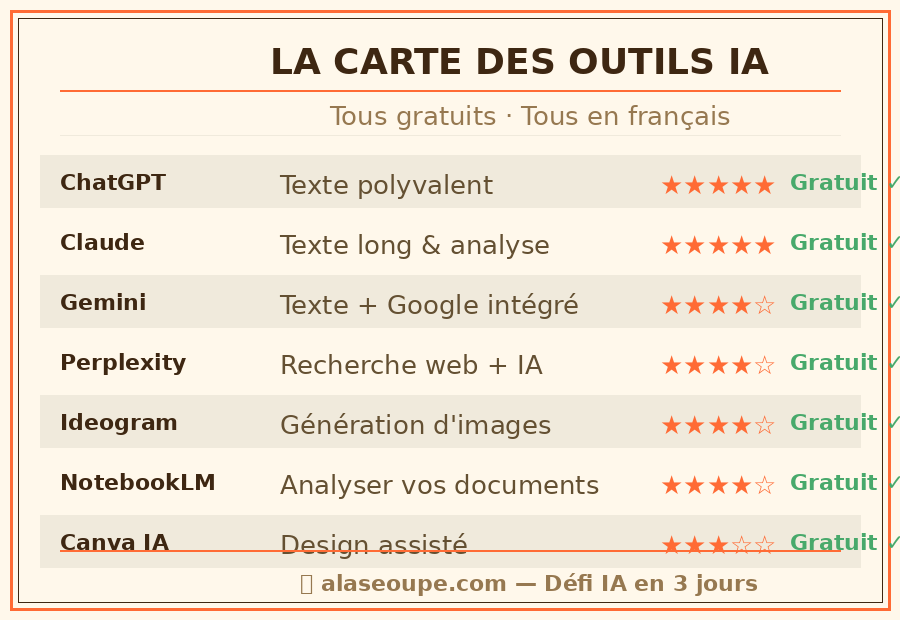
You don't need a big budget to cook well with AI. Here are the best free tools:
- ChatGPT — the universal chef's knife
- Claude — excellent for long texts and detailed analyses
- Gemini — perfect if you are already in the Google ecosystem
- Perplexity — to search the web with an AI that cites its sources
- Google NotebookLM — to analyze your own documents
- Ideogram — to generate images without a subscription
Our recommendation to get started: ChatGPT + Gemini. Free, in French, and they cover 90% of needs.
Day 2 Summary
✅ A good prompt = role + context + task + format + constraints.
✅ AI is an iterative tool. The first answer isn't always the best dish — taste, adjust, rephrase.
✅ Never serve a dish without tasting it yourself. Verify important facts.
DAY 3 — Plating: integrating AI into your daily routine
Top chefs don't cook one-off dishes. They have core recipes they master perfectly.
Duration: 45-60 minutes
Why Most People Give Up After a Week
They use AI from time to time, without a routine. Result: they forget it exists, or find it "too long to re-explain" for each new request. Like a cookbook you leaf through once and then put away.
The solution: identify YOUR 3 recurring recipes and note them in a document. Template prompts that you reuse, refine, and improve over time.
Day 3 Exercise: Build Your AI Cookbook
Step 1: List your 5 most repetitive tasks
Common examples:
– Answering emails
– Writing meeting minutes
– Researching a topic
– Preparing presentations
– Writing product descriptions
– Managing social media
Step 2: Choose the 3 where AI saves you the most time
For each, create a template prompt in a document (Notion, Google Docs, whatever). Example recipe sheet:
📌 RECIPE: Sales follow-up email
"You are my sales assistant. Write a follow-up email for a prospect who hasn’t replied for [X days]. Context: [situation in 2 sentences]. Product/service: [short description]. Tone: warm and professional. Length: max 120 words."
Step 3: Test each recipe on a real case today
The 5 Golden Rules of a Good AI Chef
1. AI is a brigade, not the chef
It amplifies what you give it. A poor brief yields a poor dish. Your expertise remains the master recipe.
2. You are always the head chef
Proofread, adjust, personalize. Nothing leaves your kitchen without you tasting it.
3. Never put secret ingredients in the recipe
No confidential client data, no company secrets in your prompts. That information can circulate.
4. Always specify the language
If you want an answer in French, write your prompt in French or state it explicitly.
5. Compare the kitchens
ChatGPT and Claude don't always serve the same dish. For important topics, ask both and keep the best.
What AI will never cook for you
Let's be honest about the limits of AI cooking:
- It doesn't know your context — you still have to provide the ingredients.
- It doesn't always have fresh ingredients — it may lack recent data.
- It doesn't really create — it recombines what it's learned, like a cook who only knows the dishes they've already tasted.
- It has a short memory — by default, each new conversation starts from scratch.
- It is not responsible — if you serve a bad dish, your kitchen is to blame.
Next on the menu: go further
You now master the basics. Here are the next dishes to explore:
Week 2: Image AIs (Ideogram, Flux) — create visuals for your social networks without being a graphic designer.
Week 3: Google NotebookLM — upload your documents and ask questions about them. Ideal for analyzing reports, contracts, and course materials.
Week 4: Perplexity — an AI-enhanced search engine that cites its sources. Perfect as a replacement for your usual Google.
In 1 month: AI agents — AIs capable of chaining multiple tasks automatically. The molecular gastronomy of AI.
The 3-Day Challenge Review
| What you learned | ✅ |
|---|---|
| What AI is and how it works | ✅ |
| The difference between major AI tools | ✅ |
| Writing a good prompt (the basic recipe) | ✅ |
| 6 concrete recipes tested and tried | ✅ |
| Your 3 personal recipes identified | ✅ |
| Cooking Mistakes to Avoid | ✅ |
| The honest limits of AI | ✅ |
FAQ — Frequently Asked Questions from the Kitchen
Will AI replace my job?
AI replaces tasks, not entire jobs. People who use it to work faster and better have an advantage over those who refuse to step into the kitchen. The right attitude: learn to work with AI, not against it.
Do you need to pay to use AI effectively?
Not at first. Free ChatGPT, free Claude, free Gemini — you have a full stove without spending a euro. Paid versions unlock more powerful models and more generous limits, but that's for later.
ChatGPT or Claude, which should you choose?
Both are worth trying. ChatGPT has a broader ecosystem. Claude is often more nuanced with long texts and analyses. Try both and see which suits you.
Does AI remember my conversations?
By default, conversations may be used to improve the models (this can be turned off in settings). ChatGPT offers a “Memory” feature that retains certain information from one conversation to the next — like a chef who remembers your allergies.
Does AI understand French well?
Yes. Large models (ChatGPT, Claude, Gemini) are excellent in French. For everyday use, language is not an obstacle.
How can you tell if an AI response is reliable?
Always verify facts, figures, and dates with an external source. AI can confuse data or invent it — this is called "hallucinating." Taste before serving.
Conclusion
In 3 days and 3 hours of practice, you've gone from "I don't understand AI at all" to "I know how to use it in practice." AI cooking no longer holds secrets for you — at least the basics.
The recipe for success:
— A good prompt = well-measured quality ingredients
— Iteration = adjusting the seasoning
— Routine = your favorite recipes, mastered and repeated
Come back in 2 weeks. See how much time you've saved. And tell us which dish AI helped you prepare.
Did you like this challenge? The cooking continues:
– I create my website in 3 days → (coming soon)
– I do my SEO audit in 3 days → (coming soon)
– The complete SEO guide for beginners →
– SEO glossary: 55 terms explained →
Last updated: April 2026 — 🍲 À la SEOupe