Apprendre la programmation informatique peut paraître intimidant. Déjà rien que le terme « programmation informatique » est impressionnant !
Longtemps, le métier de programmeur était considéré comme celui d’experts ou de geeks super talentueux. Pourtant, acquérir des compétences dans ce domaine est désormais à la portée de toutes et tous. Surtout que de telles connaissances offrent plusieurs opportunités sur le marché de l’emploi, que vous soyez freelance ou en recherche d’un contrat salarié.
Apprendre la programmation informatique s’avère aussi utile si vous gérez une entreprise et que vous souhaitez développer vous-même vos outils digitaux. Tout ce dont vous avez besoin pour accéder à ce savoir, c’est de la volonté, de la persévérance… et des bonnes ressources. Et tout commence par la lecture de cet article !
Pourquoi apprendre la programmation informatique ?
La programmation consiste à concevoir et développer des applications ou logiciels destinés à un usage informatique. Ce processus comprend plusieurs tâches telles que l’analyse, le codage et la génération d’algorithmes. Au final, vous obtenez une fonction qui sera exécutée par un ordinateur.
Pourquoi ajouter cette corde à votre arc ?
Pour trouver un emploi ou des missions
Presque toutes les entreprises ont besoin de programmeurs informatiques pour écrire, mettre à jour, modifier et dépanner leurs principaux outils ou applications. Ce n’est pas un hasard si, en 2021, 88 % des entreprises ont recruté des profils tech.
S’il y a un bien domaine dans lequel les offres de missions ou d’emplois pullulent, c’est bien celui de l’informatique et des technologies.
Pour transmettre son savoir-faire
Même si vous n’occupez pas un poste de codeur, il peut être utile d’apprendre la programmation informatique. Vous travaillez dans un laboratoire de recherche ? Vous pourrez participer au développement d’applications pour votre entreprise, ainsi que pour d’autres organismes privés et gouvernementaux.
De même, un psychologue qui sait coder peut créer une application mobile pour aider les patients à surveiller leurs symptômes de dépression et d’anxiété.
Pour améliorer les compétences liées à son activité
Pour un content manager ou un rédacteur web, la programmation informatique aide à maîtriser le langage HTML, essentiel pour mettre en forme vos articles. Les spécialistes SEO et SEA peuvent aussi avoir besoin de cette compétence pour réaliser des audits de sites web plus poussés, afin d’améliorer le référencement naturel de leurs clients.
Pour affûter son esprit d’analyse
Demandez aux développeurs, ils vous confirmeront qu’apprendre la programmation informatique stimule les capacités cérébrales. En plus de connaître la logique cachée derrière un langage codé (qu’il s’agisse de Java, Javascript, HTML ou de Python), vous appréhendez le fonctionnement des algorithmes.
Ce qui vous aide à affûter votre esprit d’analyse, ainsi que votre capacité à trouver des solutions logiques à vos problèmes. De nouvelles compétences bien utiles pour analyser vos stratégies actuelles (marketing, financières, commerciales…) et les améliorer de manière continue.
Les différents types de langages de programmation
Un langage de programmation se caractérise par un ensemble d’instructions écrites pour communiquer avec les ordinateurs ou les smartphones. Son rôle est de permettre l’exécution d’une tâche spécifique via un outil informatique.
Les langages de programmation se retrouvent dans tous les sites web, applications et logiciels que vous utilisez au quotidien. Ils sont variés, avec chacun leurs spécificités.
Présentons les langages les plus connus ci-dessous :
Python
Python représente le premier langage de programmation vers lequel se tournent de nombreux codeurs débutants. La raison est simple : sa syntaxe simplifiée le rend facile à maîtriser.
Python est doté de plusieurs modules de support et d’une intégration avec les services web. Il sert à développer le côté serveur ou le backend d’une application. Vous pouvez l’utiliser pour construire des outils de deep et de machine learning.
Java
Java est le second langage de programmation populaire après Python. Plus de 3 milliards d’appareils exécutent des applications conçues avec ce type de code. On le retrouve également sur le back-end de plusieurs sites web populaires, tels que Google, Amazon, Twitter et YouTube.
Il constitue une excellente introduction à la programmation. C’est aussi l’un des langages les plus recherchés par les entreprises de toutes tailles.
JavaScript
Si vous souhaitez apprendre la programmation informatique, JavaScript est le langage parfait pour rendre votre site web ou votre application plus interactif. Il permet de coder des animations (comme les hovers, par exemple) et des jeux. Plutôt pratique si vous utilisez la gamification dans votre stratégie marketing (ou si vous voulez proposer cette stratégie à vos clients).
Plutôt complexe à utiliser, il reste cependant intuitif, flexible et facile à maîtriser une fois que vous avez compris les bases.
HTML et CSS
Techniquement parlant, le HTML et le CSS ne sont pas des langages de programmation. Cependant, si vous vous intéressez au développement web, ce sont les deux premiers éléments de code que vous devrez apprendre. Vous ne pouvez rien construire sur le web sans connaissances en HTML.
Le HTML permet de coder le contenu et la structure des pages web. Le CSS définit le style de la page. Vu que ces 2 langages ne contiennent pas la partie “programmation”, ils restent faciles à maîtriser.
C et C++
C reste le langage de programmation le plus ancien. Il est à l’origine d’autres langages de programmation tels que Java et JavaScript.
C++ est une version améliorée du langage C. De nos jours, de nombreux développeurs font l’impasse sur l’apprentissage de ce dernier, tandis que d’autres pensent qu’il offre une base indispensable pour la maitrise du C++. C’est donc un choix personnel, qui découle de votre temps… et de vos objectifs.
En effet, les deux langages sont utilisés pour le développement d’applications où la performance représente un facteur critique, comme les applications client/serveur, les produits commerciaux et les jeux vidéo.
Comment apprendre la programmation informatique ?
Pour une année de formation en programmation informatique, vous devez dépenser entre 5 000 et 8 000 euros. Ce type de formation s’avère utile si vous voulez en faire votre métier à plein temps ou vous positionner sur des projets d’envergure, comme le développement de jeux vidéo, par exemple.
Si vous souhaitez plutôt maîtriser les bases, affûter votre esprit d’analyse ou ajouter une corde à votre arc de digital freelance, il existe des moyens gratuits pour apprendre à coder.
Choisir son langage de programmation
Nous venons de vous présenter les différents langages de programmation et leurs spécificités. À vous de choisir celui qui correspond à vos besoins.
Par exemple, en tant que débutant, Python est facile d’accès. Cependant, si vous souhaitez améliorer vous-mêmes votre site internet, il faudra absolument maîtriser le HTML et le CSS.
Suivre des cours en ligne
Il existe des milliers de cours en ligne qui couvrent tous les aspects de la programmation : du HTML de base aux structures de données, en passant par les algorithmes complexes.
Assurez-vous que votre premier cours présente les bases d’un langage, contient des modules interactifs, ainsi que des exercices, pour guider votre apprentissage. Il doit aussi être bien organisé pour vous permettre d’assimiler les connaissances dans le bon ordre.
Nous vous proposons une liste de sites pour apprendre à coder, un peu plus bas dans cet article.
Regarder les tutoriels vidéo
Si les cours en ligne sont parfaits pour acquérir une expérience pratique, les vidéos en ligne peuvent compléter votre apprentissage et satisfaire votre curiosité.
Leur avantage ? Elles vous aident à progresser étape par étape : de l’installation d’un IDE à l’analyse d’un code source, en passant par la définition des concepts de base des langages existants.
Concentrez-vous sur les termes communs à tous les langages :
- Types de données
- Variables
- Fonctions
- Tableaux ou listes
- Instructions If
- Boucles
- Classes et objets
- Gestion d’exceptions
Construire un projet
Une technique efficace pour apprendre la programmation informatique est de lancer un projet. Même si celui-ci reste privé. Le but est de vous entraîner.
Si vous aimez les jeux vidéo, essayez de coder un petit jeu similaire à Tetris, Pong ou le jeu de morpion. Vous pouvez aussi créer un site web présentant votre portfolio ou parlant d’une de vos passions (sans passer par un CMS, bien sûr !).
5 sites pour apprendre à coder gratuitement
Pour vous aider à apprendre la programmation informatique gratuitement, voici 5 sites offrant des cours gratuits.
1. freeCodeCamp
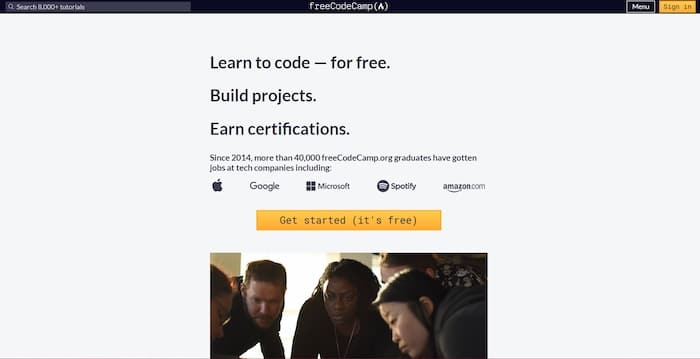
freeCodeCamp est une organisation à but non lucratif qui propose des contenus et des ressources bénéfiques pour les programmeurs et les développeurs. Elle fournit des articles, des guides et du matériel pour permettre aux débutants de pratiquer et maîtriser les compétences en codage.
Vous pourrez vous exercer au développement web de langages de programmation tels que HTML, CSS et JavaScript. Il existe de nombreux exercices et questions pratiques sur lesquels vous pouvez travailler.
2. Codecademy
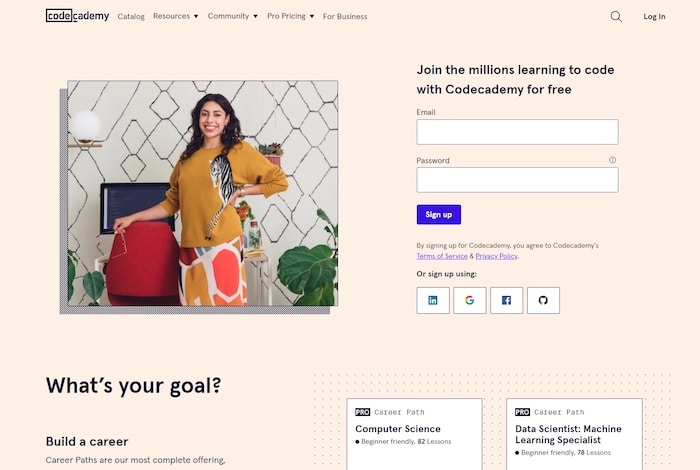
Codecademy propose des sessions interactives dans 12 langages de programmation différents, dont Python, Java, Go, JavaScript, Ruby, SQL, C++, C#, Swift et Sass, ainsi que les langages de balisage HTML et CSS.
Il dispose d’une plateforme pour apprendre à coder, avec un ensemble de tâches à accomplir pour passer à l’étape suivante. Vous pouvez choisir le langage de programmation de votre choix et travailler jusqu’à obtenir les résultats souhaités.
Vous recevez des feedbacks instantanés, pratiques pour corriger vos erreurs et améliorer rapidement vos compétences.
3. W3Schools
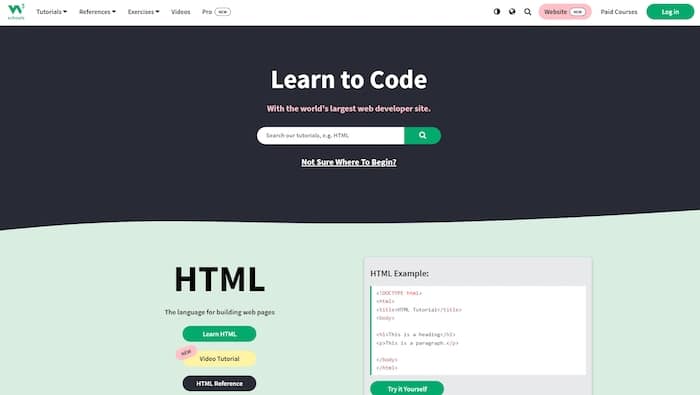
W3Schools est un site de formation pour apprendre la programmation informatique gratuite. Il propose des tutoriels sur les langages HTML, CSS, JavaScript, JSON, PHP, Python, AngularJS, React.js, SQL, Bootstrap, Sass, Node.js, jQuery, XQuery, AJAX, XML, Raspberry Pi, C++, C# et Java.
Vous disposez également d’exercices et de cours auxquels d’autres développeurs ou utilisateurs peuvent participer pour améliorer leur vitesse d’apprentissage.
4. Apprendre-à-coder.com
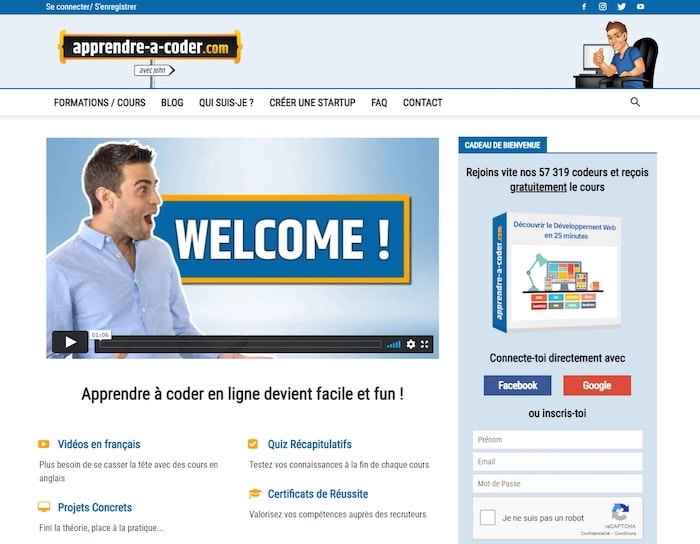
Apprendre-a-coder utilise principalement la vidéo pour offrir des cours de programmation informatique. L’avantage ? Les cours sont exclusivement en français et dispensés sous la forme de tutoriels faciles à comprendre. Vous évoluez rapidement, en toute autonomie !
5. Khan Academy

Khan Academy est aussi plateforme éducative à but non lucratif proposant des cours en vidéos et des exercices pour acquérir des compétences en JavaScript, HTML, CSS et SQL. Tous les cours restent entièrement gratuits, vous permettant ainsi de développer facilement des compétences complémentaires !
Notre astuce
Optez pour une plateforme d’apprentissage avec une communauté engagée pour vous permettre d’obtenir des réponses à vos questions.
Vous préférez une formation personnalisée pour apprendre la programmation informatique ? Postez une annonce sur Codeur pour trouver un formateur en développement web !