Le Net Promoter Score (NPS) est un indicateur permettant d’estimer :
- La fidélité de vos clients ;
- Leur satisfaction à l’égard de vos produits ;
- Leur propension à faire du bouche-à-oreille autour de votre marque.
Tout cela en leur posant une seule question simple…
Le calcul du NPS passe donc par la réalisation d’une enquête auprès de votre clientèle – pour cela, vous pourriez avoir besoin d’un outil pour créer un questionnaire en ligne.
Mais qu’est ce-que le Net Promoter Score ? Comment le calcule-t-on concrètement ? Comment l’interpréter ? Comment l’améliorer ? Voici toutes les réponses.
Qu’est-ce que le Net Promoter Score ?
Le Net Promoter Score (NPS) indique si les clients sont satisfaits de vos produits et de votre service-client. Plus ce score est élevé, plus vos clients sont susceptibles de promouvoir activement votre e-commerce et de devenir des défenseurs de la marque.
À l’inverse, un NPS faible vous avertit que vous devez changer certaines de vos pratiques commerciales ou revoir votre SAV.
Le NPS repose, comme évoqué plus tôt, sur une question simple : « Recommanderiez-vous l’entreprise X à un ami ou un collègue ? »
Les répondants doivent y répondre à l’aide d’une échelle allant de 0 à 10, 0 signifiant « Totalement improbable » et 10 voulant dire « Tout à fait probable ».

Source : Net Promoter Network
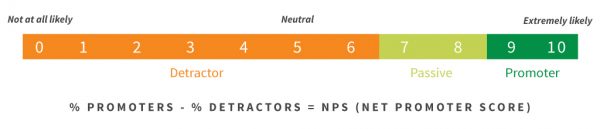
En fonction des réponses, on distingue trois types de clients :
- Les promoteurs, qui attribuent un score de 9 ou 10 ;
- Les détracteurs, qui répondent de 0 à 6 ;
- Les clients neutres, qui choisissent quant à eux 7 ou 8.
L’idée clé du Net Promoter Score est de comparer les deux « extrêmes » (promoteurs et détracteurs) pour en déduire un score de satisfaction client.
6 outils pour calculer votre NPS
Pour connaître ce précieux indicateur, il est recommandé d’utiliser un logiciel capable de mener des enquêtes et d’analyser les résultats. C’est parti ! Voici 6 logiciels NPS pour mesurer la satisfaction de vos clients.
1. Promoter.io
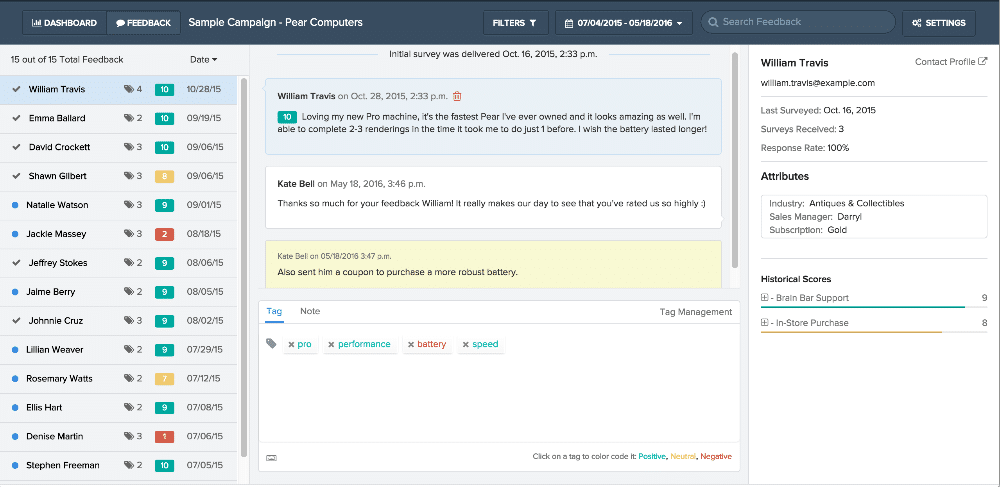
Très complet, Promoter.io vous aide à comprendre l’engagement du client. Conçu pour stimuler la croissance et la fidélisation, l’outil combine des centaines de sources pour analyser la satisfaction des clients.
Promoter.io envoie automatiquement les enquêtes NPS selon un calendrier quotidien. L’objectif est que votre liste soit sondée à des périodes différentes pour des résultats plus précis.
Par ailleurs, cet outil est capable de définir des tendances concernant le comportement de vos clients. Pratique pour affûter votre stratégie marketing !
En bonus, il s’intègre aux plateformes de e-commerce BigCommerce et Shopify, ainsi qu’au CRM Salesforce ou à l’application de travail collaboratif Slack.
2. Hotjar
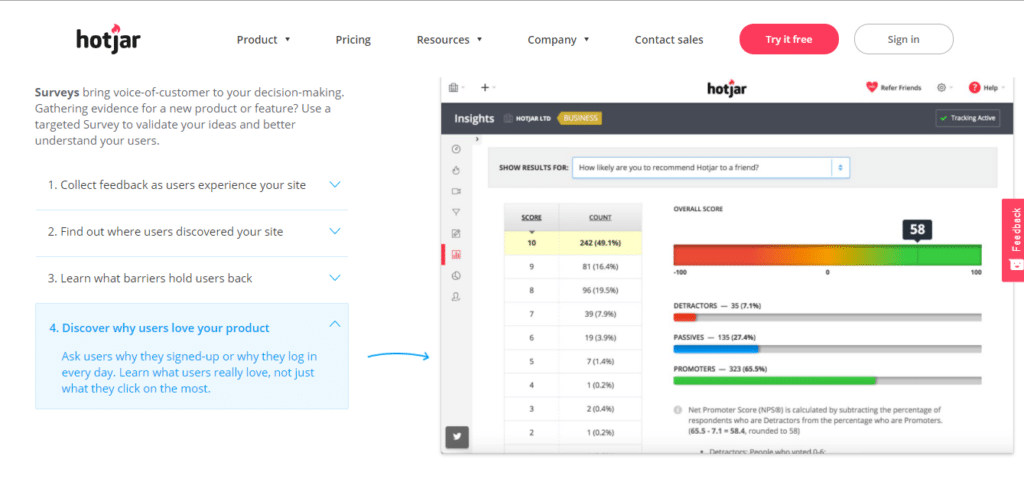
Avec Hotjar, vous pouvez mettre en place une enquête NPS directement sur votre boutique, pour récolter des avis clients en temps réel, ou envoyer votre sondage par email, après une commande.
Le logiciel permet également de stocker les résultats du sondage, de suivre les changements et les fluctuations du score, et d’obtenir un retour pertinent des clients sur ce qui doit être amélioré. Vous pouvez également poser des questions de suivi, en fonction des réponses initiales de vos clients, afin d’obtenir des réponses approfondies.
3. Zonka
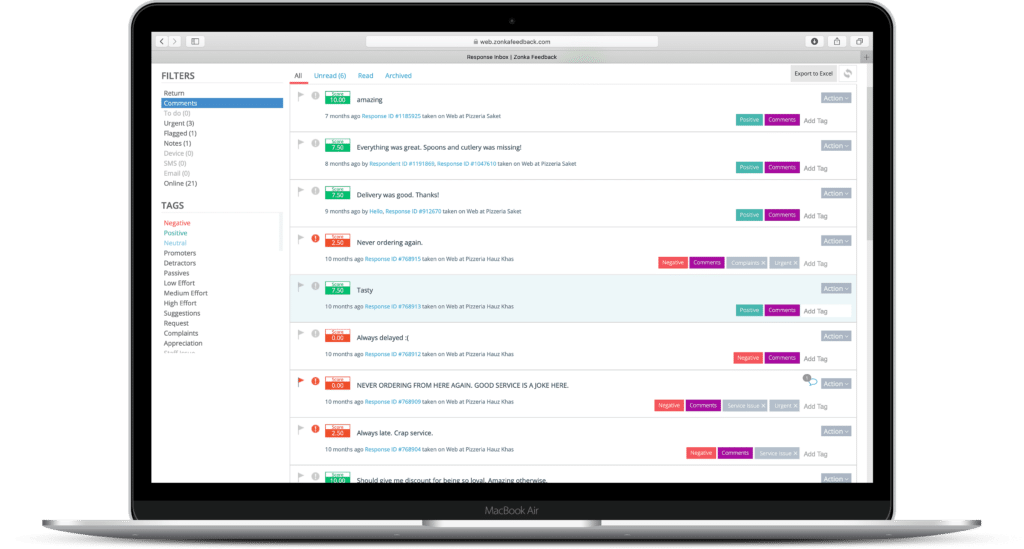
Zonka recueille le feedback des clients et des employés grâce à des enquêtes CSAT, CES et NPS. Il capture les expériences et les commentaires à tous les points de contact : hors ligne via les QR Codes, sur votre e-commerce, par email, par SMS, etc.
Ce logiciel permet de personnaliser vos enquêtes NPS. Vous pouvez ajouter un arrière-plan, des couleurs et des éléments propres à votre marque sans avoir à coder.
Vous recevez des alertes en temps réel par email et SMS pour tous les retours négatifs. Ce qui vous permet de prendre des mesures immédiates pour résoudre les questions et parler aux clients mécontents.
Zonka vous permet également de convertir chaque commentaire client en tâche pour collaborer avec votre équipe et résoudre les problèmes SAV plus facilement.
4. Delighted
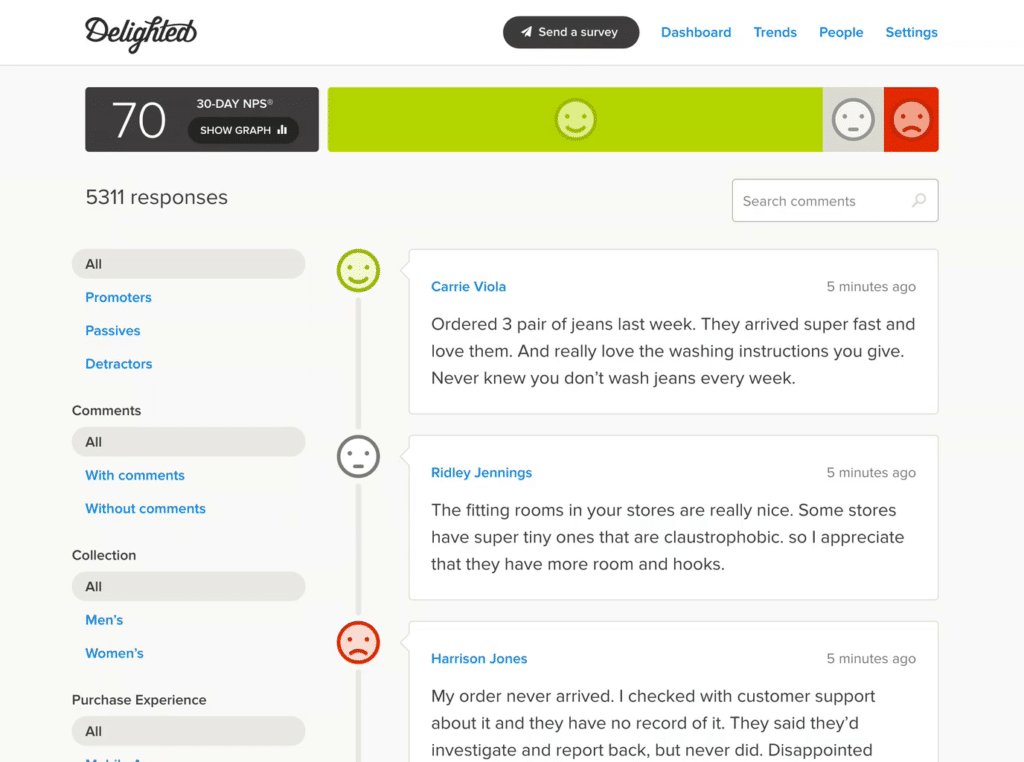
Delighted se vante d’être le moyen le plus rapide et le plus facile pour recueillir des informations concrètes auprès de vos clients. Il utilise le Net Promoter System pour capter des commentaires honnêtes de vos acheteurs en quelques minutes.
Rapide et intuitif, Delighted permet d’envoyer une seule question à vos clients par email, SMS ou via un lien (à partager suite à une conversation sur les réseaux sociaux, par exemple).
Vous pouvez également interroger les visiteurs directement sur votre site marchand. Ces derniers ont la possibilité d’évaluer votre produit/service et de laisser un avis. Le feedback apparaît instantanément dans votre tableau de bord, vous permettant d’analyser votre NPS en temps réel.
5. Wootric
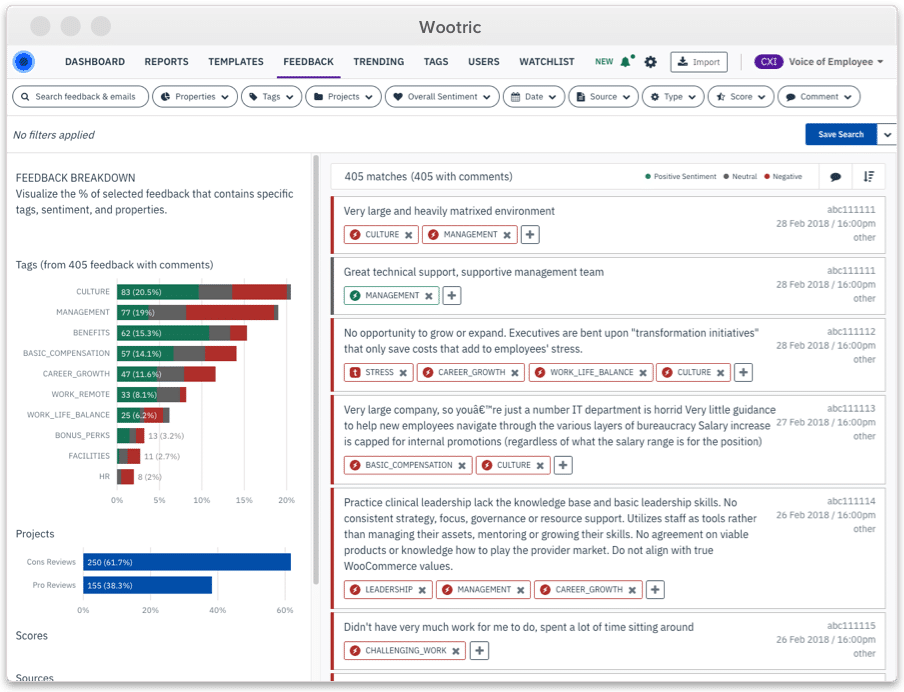
Vous pouvez utiliser Wootric pour recueillir des commentaires aux meilleurs moments ! Concentrez-vous sur les points critiques du parcours qui font ou défont la fidélité des clients.
Wootric propose des modèles d’email NPS qui vous permettent d’envoyer des enquêtes directement depuis votre outil emailing (Mailchimp, Campaign Monitor…), votre solution de marketing automation (Hubspot, Marketo…) ou votre CRM (Salesforce, Zoho…). Les résultats apparaissent directement dans le tableau de bord de l’outil synchronisé.
Une autre option intéressante de Wootric est l’intégration d’enquêtes NPS directement dans votre application mobile.
Les sondages in-app atteignent généralement des taux de réponse beaucoup plus élevés que ceux transmis par emails. Cependant, les répondants sont plus susceptibles de laisser des commentaires qualitatifs dans une enquête par email. L’idéal est donc d’utiliser Wootric sur ces deux canaux !
6. NPS by LoyaltyLion
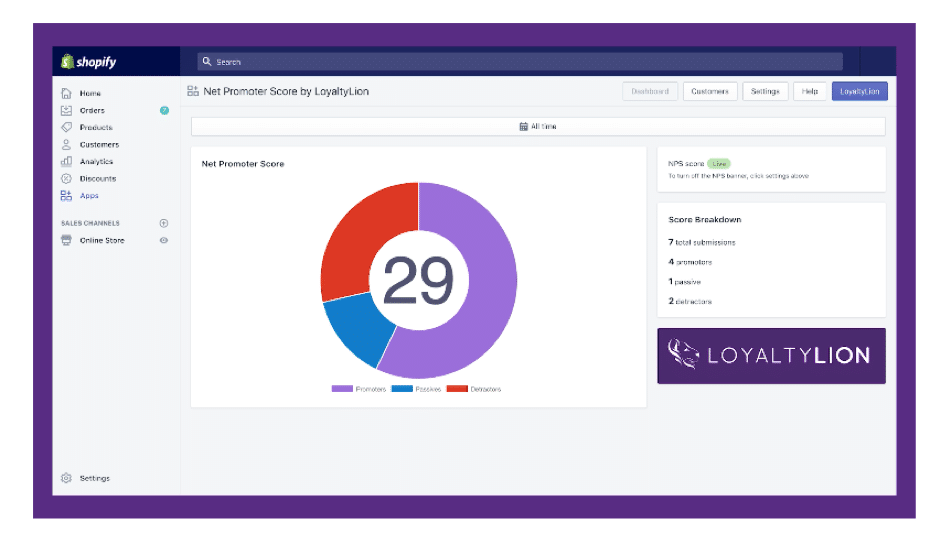
LoyaltyLion est une application gratuite pour les boutiques Shopify. Vous pouvez l’utiliser pour calculer le NPS et mesurer la probabilité que les clients vous recommandent à leurs amis et à leur famille.
Comme son nom l’indique, LoyaltyLion vous aide à mettre en œuvre un programme de fidélité afin d’augmenter la satisfaction client.
Comment calculer le Net Promoter Score ?
Le calcul du NPS est assez simple.
Une fois votre enquête réalisée auprès d’un certain nombre de clients – pour l’exemple, nous imaginerons que 500 ont été interrogés – il vous faut calculer les pourcentages de détracteurs et de promoteurs.
Sur 500 clients interrogés :
- 320 ont répondu 9 ou 10, soit 64 % de promoteurs ;
- 150 ont répondu de 0 à 6, soit 30 % de détracteurs ;
- 30 ont répondu 7 ou 8, soit 6 % de neutres.
Ensuite, il suffit de soustraire le pourcentage de promoteurs et le pourcentage de détracteurs pour obtenir le Net Promoter Score – précisons que l’on préfère arrondir les pourcentages à l’entier pour obtenir un score « rond ».
Avec 64 % de promoteurs et 30 % de détracteurs, le NPS vaut :
- 64 – 30 = 34
Comment interpréter le NPS ?
Comme souvent avec ce type d’indicateur, il est moins difficile de calculer le NPS que de comprendre sa véritable signification.
Commençons par quelques généralités :
- Un score positif (donc supérieur à zéro) peut être considéré comme « bon », dans la mesure où il signifie que votre entreprise possède plus de promoteurs que de détracteurs ;
- Un score NPS dépassant 50 est toutefois bien plus significatif, puisqu’il démontre qu’une majorité de vos clients sont « fans » de votre marque ;
- Un Net Promoter Score encore supérieur (approchant des 100) est synonyme d’une satisfaction exceptionnelle (mais une telle notation est rarissime).
Toutefois, l’appréciation d’un score dépend largement du contexte de l’entreprise.
Le site NPS Benchmarks, qui recense les NPS de milliers d’entreprises, met en évidence la variation du Net Promoter Score moyen d’un secteur d’activité à l’autre :
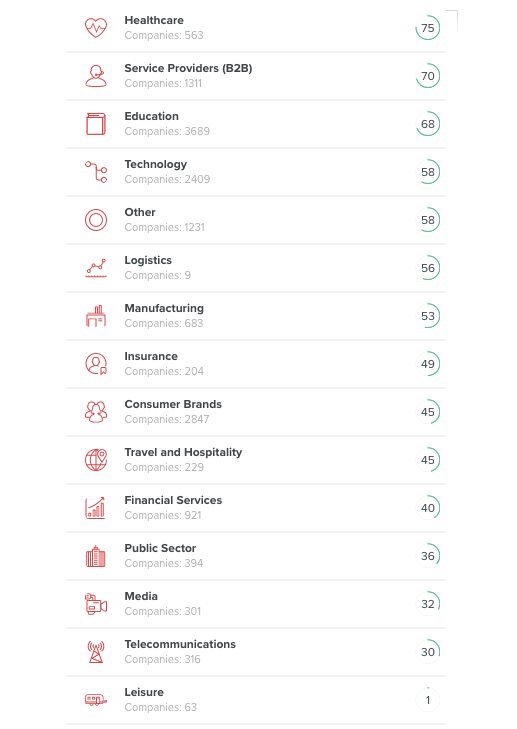
Si le secteur de la santé arbore fièrement un NPS de 75, les télécommunications, les médias ou encore les loisirs ne peuvent pas en dire autant, avec des notes tournant autour des 30-40.
Ainsi, il est important d’interpréter votre Net Promoter Score en vous replaçant dans le contexte de votre secteur d’activité.
Les données ci-dessus nous apprennent par exemple qu’un score de 40 est passable dans le domaine des services financiers, mais plus inquiétant dans la logistique ou l’éducation.
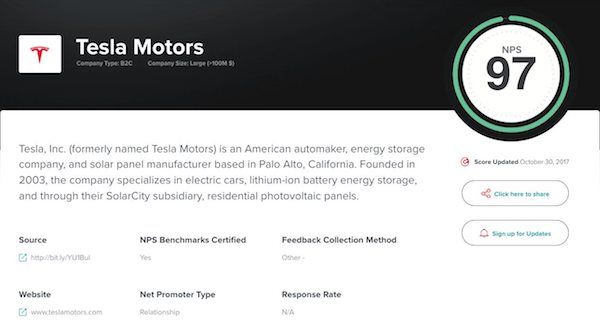
Ne vous évertuez donc pas à courir après un NPS très élevé : les scores approchant des 100 (comme celui de Tesla) font de toute manière figure d’exceptions.

Source : NPS Benchmarks
Comment améliorer votre Net Promoter Score ?
Le NPS seul ne suffit pas toujours pour vous drainer vers la croissance. Il a besoin d’autres éléments pour mesurer entièrement les facteurs de votre réussite commerciale.
Voici 5 conseils pour améliorer votre Net Promoter Score et mieux jauger le succès de votre entreprise.
1. Préférez un échantillon restreint
Les statistiques fiables sont essentielles pour repérer les changements dans la vie de votre entreprise.
Au moment de lancer des enquêtes de satisfaction, préférez un petit échantillon de 100 personnes à des milliers de prospects. De plus, faites plusieurs études à intervalles réguliers plutôt qu’une grande enquête une fois par an.
Pensez aussi à intégrer une estimation de la marge d’erreur et ce, peu importe la taille de votre échantillon. Cela vous permettra de mesurer efficacement l’exactitude des données.
2. Utilisez vos équipes pour améliorer les taux de réponse
Bien souvent, les entreprises proposent des cadeaux à ceux qui participent aux enquêtes (bon d’achat, participation à un tirage au sort, réduction…). Ces mesures incitatives faussent les résultats et, à terme, poussent les clients à rejeter vos nouvelles demandes.
Ce que vous devez faire pour pallier ce problème est d’impliquer vos équipes de première ligne comme le service client, les commerciaux, le community manager… et tous vos collaborateurs en contact régulier avec les consommateurs.
Ainsi, ils pourront les informer à l’avance pour le sondage et leur expliquer son importance. Vous gagnerez des réponses plus sincères et fiables.
3. Créez des reportings réguliers
Un seul rapport NPS ne suffit pas. Il en faut plusieurs pour assurer une comparaison objective de vos données. Alors, faites-en un tous les 2 mois, au minimum. Autrement, vos prises de décisions seront tronquées !
Par ailleurs, il est essentiel de savoir si le score augmente, baisse ou stagne.
Un processus cohérent de collecte des données qui s’appuie sur l’automatisation vous aidera à lutter contre l’inertie et à respecter les délais.
4. Mettez en lumière vos conducteurs de score
Sur quels critères les clients jugent vos produits ou services ? En enquêtant sur la satisfaction de vos consommateurs, vous observerez que certains éléments sont responsables de votre excellent score. On les appelle les conducteurs de score.
Ce sont les facteurs phares sur lesquels vous appuyer pour maintenir votre Net Promoter Score dans la bonne direction. Ces derniers peuvent être une ou deux fonctionnalités spécifiques à votre produit, un service annexe, une qualité singulière, un coloris, une matière…
Pour faciliter le succès du processus, analysez et listez ces éléments phares. Vous pourrez toujours recueillir des commentaires annexes et posez des questions après-vente pour découvrir les conducteurs auxquels vous n’aviez pas pensé au début.
5. Tenez compte des saisons
Le Net Promoter Score se calque généralement sur l’évolution du marché en fonction des saisons. Une fluctuation normale que vous pouvez difficilement contrer.
Par exemple, si vous vendez des équipements pour sport d’hiver, il est normal d’avoir un meilleur score entre octobre et février, que durant les mois d’été !
Par contre, vous pouvez identifier ces tendances pour les comparer d’une année sur l’autre. Peut-être que certaines mesures peuvent être prises pour accroître ce scoring, même si la saison ne se prête pas à la vente de vos produits/services ?
Conclusion
Essentielle à la survie de votre e-commerce, la satisfaction client doit être au cœur de vos préoccupations. Le Net Promoter Score est un indicateur utile pour mesurer la satisfaction de votre clientèle, sa fidélité et sa capacité à générer du bouche-à-oreille autour de votre marque.
Il s’agit toutefois d’un chiffre à prendre avec des pincettes et à contextualiser pour pouvoir l’exploiter pleinement – comme tout indicateur, d’ailleurs.
Pour savoir ce que vos clients pensent de vos produits et de vos services, en général, il est important de calculer le NPS de manière régulière. Avec les outils listés ci-dessus, vous profiterez de commentaires et avis indispensables à l’amélioration du service client (et donc, à l’optimisation de votre chiffre d’affaires !).
Intégrez également nos conseils dans votre Net Promoter Score et il deviendra un outil de prise de décision encore plus précieux.
Non seulement vous irez de l’avant avec l’amélioration continue des processus, mais vous pourrez le faire en toute confiance, en interprétant et en appliquant vos données avec une précision totale.
Vous n’avez pas assez de ressources en interne pour améliorer la satisfaction de vos clients ? Des freelances peuvent vous aider. Décrivez votre besoin sur Codeur.com et recevez les devis de nombreux experts.