Vous faites rédiger des articles par un rédacteur SEO pour améliorer le référencement de votre site ? Organisez la production de vos contenus avec une roadmap SEO bien structurée.
Dans cet article, nous vous guidons à travers les principales étapes pour réaliser une roadmap SEO en 8 points, afin de vous aider à optimiser votre stratégie de référencement de manière efficace.
Découvrez comment formaliser, mettre en œuvre et faire évoluer votre feuille de route SEO pour atteindre vos objectifs.
Roadmap SEO : organisez votre stratégie de référencement
La mise en place d’une roadmap SEO est une étape essentielle pour planifier et organiser votre stratégie de référencement sur les moteurs de recherche.
Elle vous permet de définir clairement vos objectifs, de prioriser vos actions et de suivre l’évolution de vos résultats afin d’optimiser votre présence en ligne.
En structurant votre approche SEO, vous optimisez les chances d’atteindre vos buts et d’améliorer la visibilité de votre site web.
Qu’est-ce qu’une roadmap SEO ?
La feuille de route SEO est un document de planification qui établit les étapes clés nécessaires pour atteindre les objectifs de notoriété d’un site web. Elle intègre les différents éléments du SEO que sont l’expérience utilisateur, le contenu et les liens.
Pourquoi mettre en place une roadmap SEO ?
Mettre en place une roadmap SEO est important pour structurer et prioriser les actions à mener afin d’améliorer la visibilité de votre site. Elle vous aide à suivre l’évolution de vos efforts, à mesurer leur impact et à ajuster votre stratégie en fonction des résultats obtenus, optimisant ainsi votre présence en ligne.
Dès lors, une feuille de route SEO bien structurée vous permet d’organiser efficacement votre stratégie de référencement et d’optimiser votre présence sur les moteurs de recherche, en particulier sur Google.
8 étapes pour réaliser une roadmap SEO
La réalisation d’une roadmap SEO efficace nécessite une approche structurée et méthodique. Découvrons les 8 étapes clés pour créer et mettre en œuvre une feuille de route SEO réussie.

1. Réaliser un audit pour faire un état des lieux
Un audit SEO complet est la première étape pour comprendre la situation actuelle de votre site web en termes de référencement. Cet audit doit englober l’analyse de la structure de votre site, la qualité du contenu, la performance technique, les backlinks et la présence sur les réseaux sociaux.
Les résultats de cet audit vous permettront d’identifier les points forts et les faiblesses de votre site, ainsi que les opportunités d’amélioration à exploiter pour optimiser votre visibilité.
2. Définir vos besoins (techniques, humains, opérationnels, organisationnels)
Après avoir réalisé l’audit, il est important de déterminer les ressources nécessaires pour atteindre vos buts SEO. Ces ressources peuvent inclure des compétences techniques pour optimiser votre site, des rédacteurs pour créer du contenu de qualité, ou encore des outils pour suivre et analyser vos résultats.
Pensez également à définir les processus opérationnels et organisationnels pour faciliter la mise en œuvre et le suivi des étapes SEO.
3. Planifier les optimisations techniques
Les optimisations techniques sont essentielles pour améliorer la performance de votre site et assurer une expérience utilisateur optimale.
Identifiez les améliorations à apporter, telles que la réduction du temps de chargement des pages, l’optimisation de l’architecture du site, la résolution des problèmes de duplication de contenu ou encore l’implémentation de balises méta appropriées.
Planifiez ces étapes dans votre chantier SEO, en tenant compte de leur priorité et des ressources disponibles.
4. Sélectionner les mots-clés à travailler
La sélection des mots-clés est une étape cruciale de votre feuille de route SEO, car elle détermine le type de contenu à produire pour votre site. Identifiez les mots-clés pertinents pour votre audience cible et analysez leur potentiel en termes de volume de recherche et de concurrence.
Basez-vous sur ces informations pour définir les mots-clés sur lesquels vous concentrer et les intégrer dans votre stratégie de contenu.
5. Réaliser un planning éditorial
Un planning éditorial vous permet de planifier la production de contenus optimisés pour les mots-clés sélectionnés. Définissez les sujets à aborder, les formats de contenu (articles de blog, vidéos, infographies, etc.) et la fréquence de publication.
Assurez-vous que votre planning éditorial est cohérent avec votre stratégie SEO et qu’il est suffisamment flexible pour s’adapter aux évolutions du marché et aux retours de votre audience.
6. Produire les contenus

La production de contenus de qualité est essentielle pour améliorer votre référencement et attirer du trafic vers votre site. Collaborez avec des rédacteurs compétents pour créer des articles, des vidéos, des infographies ou d’autres formats de contenu qui répondent aux besoins de votre audience et sont optimisés pour les mots-clés sélectionnés.
Veillez à ce que les contenus respectent les bonnes pratiques SEO, comme l’utilisation de balises méta, de liens internes et externes, et une structure rédactionnelle claire.
7. Suivre l’évolution des actions SEO mises en place
Le suivi des actions SEO est indispensable pour mesurer leur impact et ajuster votre stratégie en conséquence. Utilisez des outils d’analyse, tels que Google Analytics, Google Search Console ou des logiciels spécialisés, pour suivre les indicateurs clés de performance (KPI) (trafic organique, position des mots-clés, taux de conversion, temps passé sur le site…).
Analysez régulièrement ces données pour évaluer l’efficacité de vos étapes et identifier les opportunités d’optimisation.
8. Ajuster la roadmap en fonction des résultats
Il est essentiel d’adapter votre roadmap SEO en fonction des résultats obtenus et des évolutions du marché.
Les algorithmes des moteurs de recherche évoluent constamment. Dès lors, il est important de rester informé des dernières tendances et mises à jour pour ajuster votre stratégie en conséquence.
Prenez également en compte les retours de votre audience et les performances de vos contenus pour affiner votre approche et continuer à améliorer votre notoriété.
Faire évoluer sa roadmap SEO
Il est important de considérer votre roadmap SEO comme un document évolutif qui doit être régulièrement ajusté pour s’adapter aux changements du marché, aux performances de vos actions et aux retours de votre audience. Voici quelques conseils pour faire évoluer votre feuille de route SEO de manière efficace :
- Analysez les performances : surveillez les indicateurs de performance clés (KPI) tels que le trafic organique, les positions des mots-clés et le taux de conversion pour évaluer l’efficacité de vos actions et identifier les opportunités d’amélioration.
- Restez informé des tendances SEO : les algorithmes des moteurs de recherche évoluent constamment. Assurez-vous de suivre les dernières tendances et mises à jour pour adapter votre stratégie en conséquence.
- Adaptez votre planning éditorial : en fonction des retours de votre audience et des performances de vos contenus, ajustez votre planning éditorial pour proposer des sujets et des formats de contenu plus pertinents et engageants.
- Réévaluez vos priorités : selon les résultats obtenus et les évolutions du marché, réévaluez les priorités de votre feuille de route SEO pour vous concentrer sur les mesures les plus impactantes et les opportunités les plus prometteuses.
En faisant évoluer votre feuille de route SEO régulièrement, vous optimisez votre stratégie de référencement et vous travaillez à améliorer votre présence en ligne.
Comment formaliser la roadmap SEO ?
Pour assurer le succès de votre roadmap SEO, il est crucial de la formaliser de manière claire et accessible.
Choisir un format adapté
La roadmap SEO peut être présentée sous différents formats, tels qu’un document texte, un tableur ou un diagramme visuel. Choisissez le format qui vous convient le mieux et qui facilite la compréhension et le suivi des mesures à mener.
Utiliser un outil de gestion de projet
Pour vous accompagner dans la mise en place de votre roadmap SEO n’hésitez pas à vous appuyer sur des outils de gestion de projet : Asana, Monday, Trello ou ClickUp… Ils servent à organiser et à planifier votre feuille de route SEO. Ces outils offrent également des fonctionnalités de collaboration, de suivi des tâches et de gestion des ressources, facilitant la mise en œuvre et le suivi des actions SEO.
Créer un diagramme de Gantt
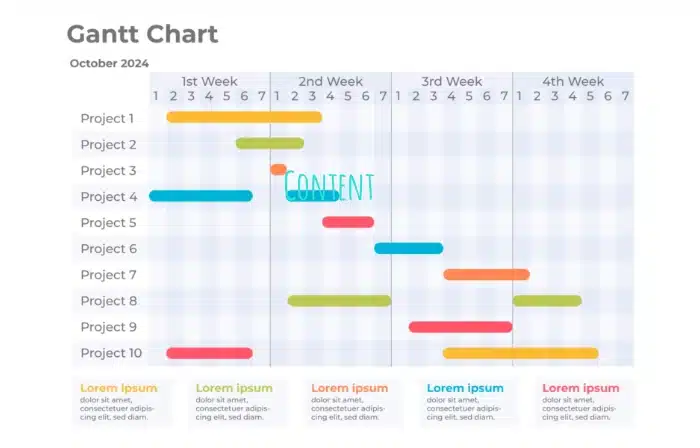
Le diagramme de Gantt est un outil visuel qui permet de représenter les différentes étapes de votre feuille de route SEO selon une timeline. Il facilite la compréhension des délais, des responsabilités et des interdépendances entre les actions, ce qui est particulièrement utile pour coordonner les efforts de votre équipe.
Définir des objectifs et des indicateurs de performances
Pour chaque étape de votre feuille de route SEO, définissez des objectifs précis et quantifiables, ainsi que des indicateurs de performance pour mesurer leur impact. De cette façon, vous allez pouvoir suivre l’évolution de votre stratégie et ajuster votre approche en fonction des résultats obtenus.
Favoriser la communication et la collaboration entre les parties prenantes
La réussite de votre roadmap SEO dépend notamment de la collaboration entre les différentes parties prenantes, telles que les rédacteurs, les développeurs web, et les responsables marketing.
Veillez à ce que tout le monde soit informé des missions, des responsabilités et des délais. Il est également important que chacun puisse disposer des ressources nécessaires les missions qui leur incombent.
Mettre à jour régulièrement la roadmap SEO
Les tendances et les exigences du SEO évoluent constamment. De ce fait, il est important de mettre à jour régulièrement votre feuille de route SEO pour tenir compte des nouvelles opportunités, des retours de votre audience et des performances de vos actions.
Le fait de formaliser votre feuille de route SEO de manière claire et structurée facilite sa mise en œuvre et le suivi des étapes, et améliore la collaboration entre les parties prenantes. Il en résulte une meilleure optimisation de votre stratégie de visibilité et des objectifs atteints plus efficacement.
Notre astuce pour réaliser une roadmap SEO
Une roadmap SEO bien structurée et évolutive est la clé pour optimiser votre stratégie de référencement.
En suivant les 8 étapes décrites dans cet article et en vous appuyant sur des professionnels compétents, vous serez en mesure de planifier, mettre en œuvre et ajuster votre feuille de route SEO pour atteindre vos objectifs de visibilité en ligne.
Alors, n’hésitez plus et commencez dès aujourd’hui à élaborer votre propre roadmap SEO en faisant appel à un rédacteur sur la plateforme de rédaction Redacteur.com.
L’article Réaliser une roadmap SEO en 8 étapes est apparu en premier sur Redacteur.com.