OpenAI vient de franchir un cap décisif dans l’évolution de ChatGPT. L’entreprise a officiellement ouvert son App Directory, un magasin d’applications intégré directement dans son interface conversationnelle. Cette initiative marque un tournant stratégique : ChatGPT répond non seulement à vos questions, mais il devient aussi une plateforme capable de centraliser vos services numériques et d’agir concrètement sur d’autres applications.
Ce qu’il faut retenir :
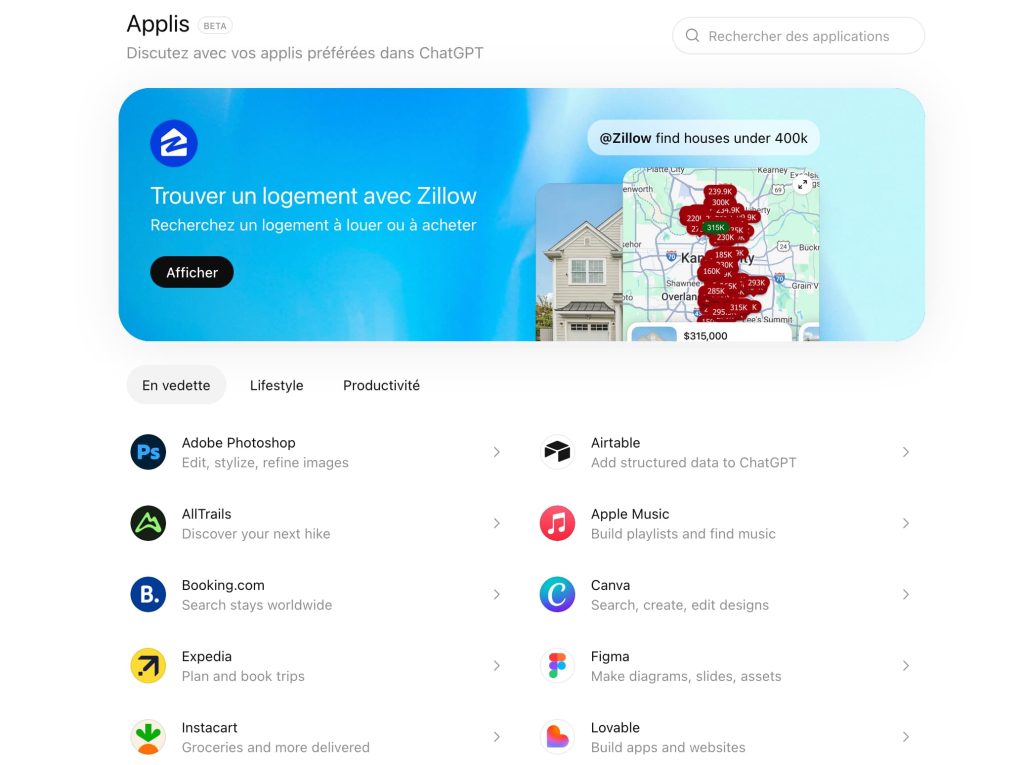
- OpenAI lance son App Directory accessible depuis chatgpt.com/apps, permettant d’installer des applications tierces directement dans l’interface conversationnelle.
- Les développeurs peuvent désormais créer leurs propres apps via un SDK ouvert basé sur le protocole MCP (Model Context Protocol).
- Les premiers partenaires incluent Apple Music, Spotify, DoorDash, Uber Eats, Photoshop et d’autres services majeurs.
- Le modèle économique reste flou : OpenAI n’a pas encore détaillé sa stratégie de monétisation ni de partage des revenus avec les développeurs.
Un écosystème applicatif qui prend forme
L’App Directory représente bien plus qu’une simple mise à jour technique. OpenAI repositionne ChatGPT comme une super application, capable d’héberger des dizaines de services tiers sans jamais quitter l’interface de discussion. Les utilisateurs peuvent désormais parcourir un catalogue d’applications et les activer selon leurs besoins.
Concrètement, vous pouvez invoquer ces services de deux manières. Soit en les mentionnant directement avec un « @ » dans votre conversation (par exemple @apple-music ou @uber-eats), soit en laissant ChatGPT suggérer automatiquement l’outil le plus pertinent selon le contexte de votre demande. Si vous discutez de rénovation immobilière, l’IA pourrait spontanément vous proposer d’ouvrir l’application Zillow pour consulter des annonces.
Des intégrations étendues
Les premiers partenariats révèlent l’ambition d’OpenAI. L’intégration d’Apple Music permet aux abonnés de gérer leur bibliothèque musicale, de rechercher des morceaux ou de générer des playlists directement depuis la fenêtre de discussion. Les tests réalisés montrent que l’IA peut créer des sélections personnalisées en combinant plusieurs critères : style musical, période, tonalité, présence d’artistes spécifiques. Une fois créée dans ChatGPT, la playlist apparaît automatiquement dans l’application Apple Music avec son titre et sa description.
Spotify bénéficie d’une intégration similaire, désormais étendue au Royaume-Uni, en Suisse et dans toute l’Union européenne après une phase de test en octobre. L’expansion géographique progressive suggère une stratégie de déploiement prudente pour valider le fonctionnement avant une ouverture mondiale.
Pour la livraison de repas, DoorDash et Uber Eats transforment l’expérience utilisateur. Vous pouvez demander une idée de menu, obtenir une recette détaillée, puis convertir instantanément la liste d’ingrédients en panier de courses prêt à être livré. Cette fluidité entre l’intention, la décision et l’action concrète illustre parfaitement la vision d’OpenAI : faire du chatbot une interface universelle pour tous vos besoins numériques.
Une refonte terminologique pour simplifier l’offre
OpenAI a profité de ce lancement pour simplifier son vocabulaire. Les anciens « connecteurs », qui permettaient de lier des services comme Google Drive ou Dropbox au chatbot, sont désormais rebaptisés « apps ». Cette harmonisation vise à rendre l’expérience plus intuitive en regroupant tous les services tiers sous une même bannière.
Les chat connectors deviennent des apps avec recherche de fichiers, les deep research connectors se transforment en apps de recherche approfondie, et les synced connectors prennent le nom d’apps synchronisées. Au-delà du simple changement sémantique, cette évolution reflète une volonté de structurer l’écosystème selon des catégories claires.
Un SDK ouvert aux développeurs tiers
L’autre annonce majeure concerne l’ouverture du kit de développement. Tous les développeurs peuvent désormais créer des apps pour ChatGPT et les soumettre à la boutique. Ce SDK, actuellement en version bêta, s’appuie sur MCP (Model Context Protocol), le protocole imaginé par Anthropic qui s’est imposé comme un standard dans le domaine de l’IA générative, et que Google a récemment adopté.
Pour l’instant, ces applications reposent exclusivement sur des services web et du JavaScript. Il n’est pas encore question de proposer des apps qui fonctionnent localement sur votre machine, contrairement à ce que permet Claude avec son intégration MCP. Cette limitation pourrait évoluer dans les prochains mois selon les retours des développeurs.
OpenAI a publié un guide de démarrage rapide et des exemples de code sur GitHub pour faciliter la prise en main. Les développeurs intéressés doivent respecter des règles strictes de soumission, avec notamment une interdiction des contenus pour adultes, suivant un modèle proche de l’App Store d’Apple. Les premières applications créées par des développeurs tiers et validées par OpenAI devraient être mises en ligne début 2025.
Un catalogue déjà fourni de services reconnus
Au-delà d’Apple Music et Spotify, l’App Directory compte déjà plusieurs intégrations notables. Adobe Photoshop rejoint le catalogue aux côtés de Canva et Figma pour la création graphique. OpenTable permet de réserver une table au restaurant, TripAdvisor et Booking.com gèrent les réservations d’hôtels, Expedia s’occupe des voyages, et Instacart facilite la livraison de courses.
Cette diversité de services couvre déjà un large spectre de besoins quotidiens. Cependant, certaines limitations existent. Les tests montrent par exemple qu’Apple Music n’accorde pas l’accès aux statistiques personnelles d’écoute, ce qui empêche de créer des playlists basées sur vos morceaux les plus écoutés. Ces restrictions dépendent des autorisations accordées par chaque développeur partenaire, qui garde le contrôle sur le niveau de partage de données avec OpenAI.
La question sensible de la confidentialité
Face aux inquiétudes sur la protection des données, Sam Altman tente de rassurer. Chaque application soumise sera examinée manuellement avant publication dans l’annuaire. L’entreprise promet également que l’utilisateur conservera le contrôle : il faudra approuver explicitement chaque partage de données avec un service tiers, et la déconnexion d’une app sera immédiate sur simple demande.
Toutefois, OpenAI précise dans sa documentation que pour les utilisateurs des forfaits Free, Plus, Go et Pro, certaines informations peuvent servir à entraîner ses modèles d’IA si l’option « améliorer le modèle pour tout le monde » reste activée. Ce point soulève des questions légitimes sur la frontière entre amélioration du service et exploitation commerciale des données personnelles.
Les applications peuvent également exploiter les informations stockées dans la mémoire de ChatGPT lorsque cette fonctionnalité est activée. Cette capacité à contextualiser les interactions en se basant sur l’historique conversationnel améliore certes la pertinence des suggestions, mais elle intensifie aussi les enjeux de confidentialité.

Un modèle économique encore mystérieux
Si la stratégie produit se dessine clairement, le volet économique reste dans le flou. OpenAI n’a communiqué aucun détail concret sur la monétisation de cet écosystème applicatif. Pour l’instant, l’entreprise ne prélève pas de commission directe : les applications renvoient vers des sites externes pour finaliser les transactions de biens physiques.
La vente de biens numériques directement dans l’interface conversationnelle est à l’étude mais n’arrivera que dans un second temps. OpenAI promet d’améliorer progressivement sa boutique, notamment pour permettre aux développeurs de générer des revenus via leurs apps dédiées à ChatGPT. Mais les modalités précises, comme le partage des revenus, les commissions sur les ventes ou les abonnements premium enrichis, n’ont pas été dévoilées.
Cette absence de clarté interroge sur la viabilité à long terme du modèle. Comment OpenAI compte-t-il financer le développement et la maintenance de cette infrastructure sans ponctionner les développeurs ou augmenter les tarifs d’abonnement ? La réponse à cette question déterminera en grande partie le succès de cette transformation.
Une disponibilité progressive selon les plateformes
L’App Directory est accessible depuis un navigateur web ou l’application iOS de ChatGPT. En revanche, l’application macOS n’y a pas encore accès. Cette disponibilité partielle suggère un déploiement par étapes, avec probablement une extension à toutes les plateformes dans les semaines à venir.
Les utilisateurs peuvent dès maintenant se rendre sur chatgpt.com/apps pour parcourir le catalogue et activer leurs applications préférées. Dans une conversation, il suffit de taper @nomdelapp ou de laisser l’IA suggérer l’outil pertinent selon le contexte. Cette simplicité d’utilisation constitue un atout majeur pour l’adoption de ces nouvelles fonctionnalités.
L’article “OpenAI dévoile son App Directory et transforme ChatGPT en plateforme applicative universelle” a été publié sur le site Abondance.