La publicité programmatique consiste à acheter de manière automatisée des espaces publicitaires.
Très efficace, à condition de bien choisir sa plateforme et les paramètres de départ, elle peut donner un véritable coup de pouce commercial et marketing à votre entreprise.
Petit tour d’horizon de cette pratique très tendance !
Qu’est-ce que la publicité programmatique ?
La publicité programmatique, très utilisée dans le monde du digital, s’appuie sur un système d’enchères en temps réel.
Elle utilise des algorithmes complexes qui détectent les correspondances entre les données fournies par les entreprises sur leur public cible, et les espaces publicitaires proposés par différents médias, à un moment précis. En d’autres termes, il s’agit d’un système semi-automatique où l’espace publicitaire est acheté par le biais d’enchères.
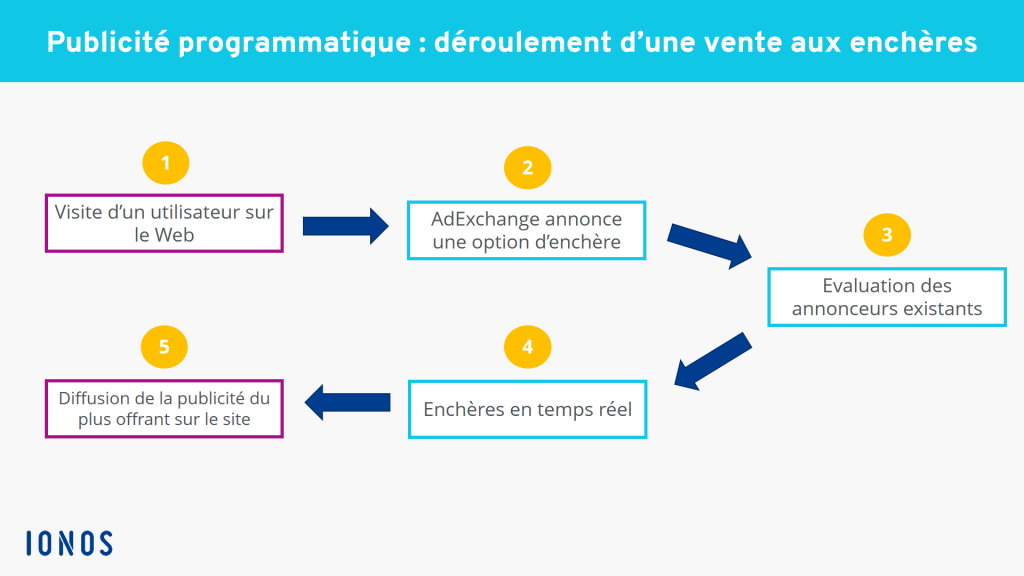
Ainsi, lorsqu’un internaute visite une page web ou utilise une application, une impression publicitaire est alors mise aux enchères sur une place de marché.
L’annonceur le plus offrant, et dont le profil de l’internaute correspond à sa cible, verra sa publicité s’afficher.
Bien entendu, tout est automatisé. L’annonceur n’est pas réellement derrière son ordinateur pour « acheter » l’espace. Tout fonctionne via des paramètres configurés au préalable.
La technologie au cœur de la publicité programmatique
La publicité programmatique est devenue possible grâce aux grandes avancées technologiques et à l’avènement du Big Data, qui nous permet de mieux connaître et de suivre le comportement des internautes.
Tout commence avec les Supply-Side Platform (SSP) qui permettent de vendre l’espace publicitaire des éditeurs. Et par l’intermédiaire des plateformes Demande-Side (DSP), ces espaces sont achetés par des annonceurs, via un système d’enchères.
Entre les deux, nous trouvons un Ad Exchange, une sorte de « marché » qui fonctionne comme une bourse aux annonces. Cet espace fournit l’environnement où cet achat est optimisé, mais aussi automatisé.
En effet, les éditeurs fixent des enchères minimales pour déterminer un prix de départ concernant leurs encarts publicitaires disponibles. Les annonceurs eux, définissent également des critères d’enchères (maximales, cette fois), ainsi que des formats et éléments de ciblage.
La plateforme d’Ad Exchange s’occupe, en temps réel, de matcher la demande avec la meilleure offre.
Cette infographie proposée par Ionos explique clairement comment fonctionne la publicité programmatique :
Les méthodes de ciblage de la publicité programmatique
La publicité programmatique fonctionne selon plusieurs modèles de ciblage distincts, que vous pouvez utiliser en fonction de vos besoins ou objectifs. Voici les 4 méthodes les plus utilisées :
Le ciblage par mot-clé
En tant qu’annonceur, vous déterminez des termes et mots-clés spécifiques, utilisés par vos prospects et clients, ou en lien avec votre activité. Ainsi, lorsque ces expressions apparaissent sur un site internet proposant des encarts dynamiques, votre publicité s’affichera auprès de leur audience.
Le ciblage sémantique
Si le ciblage par mot-clé vise des termes précis, le ciblage sémantique (ou contextuel) prend en compte le vocabulaire associé. L’algorithme programmatique étendra l’affichage de vos publicités sur des sites internet comprenant des synonymes aux mots-clés spécifiés.
Le ciblage comportemental
Dans cette méthode de ciblage, la publicité programmatique s’affiche auprès d’une audience qui a pris une action que vous aurez prédéterminée. Par exemple, vous pourrez cibler les visiteurs de votre site internet, ceux qui ont interagi avec une de vos publications Facebook ou qui ont consulté des sites / blogs concurrents.
Le ciblage géolocalisé
Comme son nom l’indique, ce modèle cible l’audience en fonction de sa localisation. Une stratégie pertinente si vous avez des succursales ou des commerces de proximité. Vous pourrez toucher les personnes susceptibles de se rendre dans vos établissements.
Les chiffres de la publicité programmatique
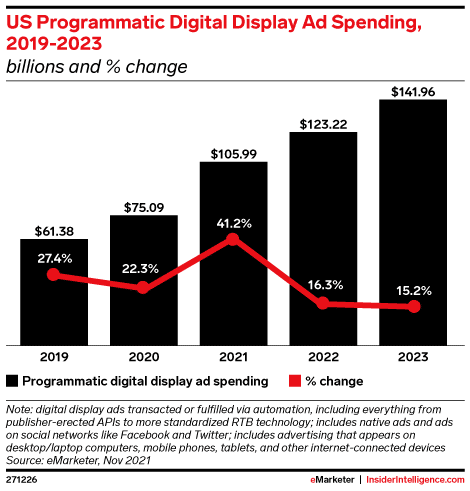
D’après un rapport d’eMarketer, les annonceurs américains ont dépensé 41,2% de plus dans les publicités programmatiques en 2021, qu’en 2020. C’est la plus forte augmentation annuelle depuis 2016. Et même si la croissance s’annonce moins forte en 2022 et 2023, elle reste quand même très présente, avec des investissements records, comme le montre ce graphique :
Bon à savoir : parmi les tendances qui vont marquer 2022 et 2023, on peut citer la vidéo. Ce format va tenir une place prépondérante dans la publicité programmatique. En effet, toujours d’après le même rapport, la vidéo représentera 51.1% de toutes les dépenses liées au display automatisé.
Environ 90 % de l’ensemble des dépenses publicitaires vidéo seront effectués de manière programmatique d’ici 2025.
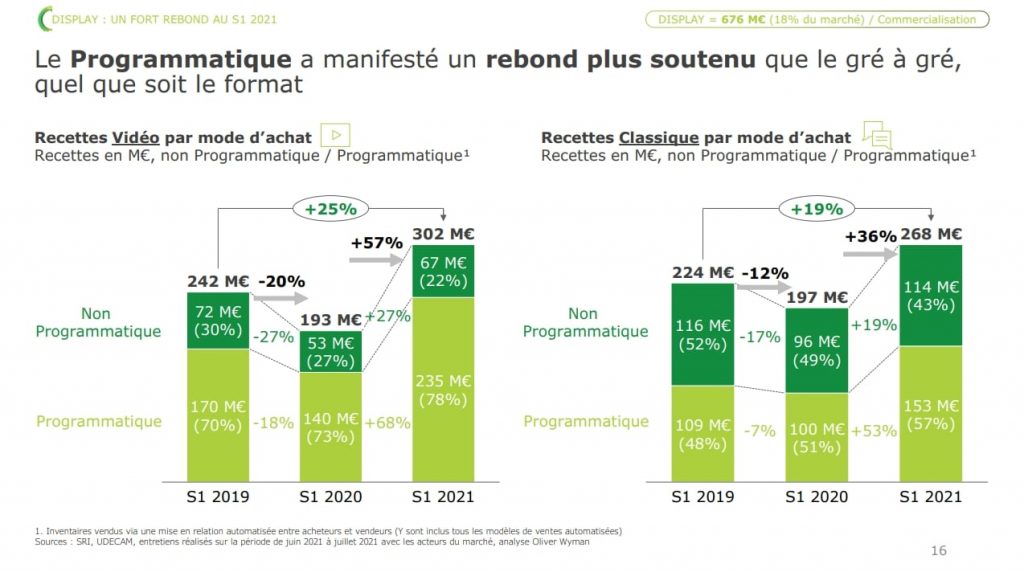
Et en France ? D’après la 26ème édition de l’Observatoire de l’e-pub, menée par le SRI et l’UDECAM, la publicité programmatique connaît aussi une belle progression chez nous ! Cette dernière présente une croissance de 56 % entre le premier semestre 2020 et le premier semestre 2021. Elle passe de 245 millions d’euros de recettes (2020) à 382 millions d’euros de recettes (2021) !
Par ailleurs, la publicité programmatique est de plus en plus plébiscitée par les entreprises, puisque sa part dans le Display et le Social représente 84% (elle était de 81% en 2020).

Et tout comme aux États-Unis, la vidéo a le vent en poupe ! En France, les recettes des publicités programmatiques vidéos ont bondi de 68%, passant de 140 millions d’euros en 2020 à 235 millions en 2021.
Qu’est-ce qui explique ce succès ?
On peut citer, en premier lieu, l’opération séduction des marchés privés. Aussi connus sous le nom de Private Deals, offrent des audiences très ciblées aux annonceurs. Ils sont souvent en capacité de faire accéder les entreprises à des marchés de niche.
Ces marchés privés séduisent de plus en plus les publicitaires qui y voient une opportunité de mieux maîtriser leur budget et de s’assurer de la qualité de l’audience proposée.
Parmi les Private Deals les plus importants, nous pouvons citer Lagardère, Boursorama, France Télévisions, TF1 Publicité Digital ou encore Caradisiac.
Mais ce n’est pas tout ! La publicité programmatique présente d’autres avantages pour les entreprises, que nous allons passer en revue tout de suite.
Les 5 principaux bénéfices de la publicité programmatique
La publicité programmatique offre un certain nombre de bénéfices pour votre entreprise, ainsi que des avantages par rapport à la publicité traditionnelle. Examinons ses 5 principaux atouts :
1. Un potentiel d’affichage infini
L’un des plus grands avantages de la publicité programmatique est que, grâce à la technologie et à l’Intelligence Artificielle, il est possible de placer vos annonces dans un nombre infini de médias, sites web, blogs, etc.
Ce qui était auparavant difficile, voire impensable ! Là, en quelques clics, une audience composée de millions d’internautes qualifiés s’ouvre à vous.
2. Un ciblage précis
Le Big Data a permis la collecte de nombreuses données sur les utilisateurs. Résultat : de nombreux critères de ciblage ont fait leur apparition, vous permettant de lancer des campagnes publicitaires auprès d’une audience ressemblant trait pour trait à vos buyers persona.
Là où la publicité traditionnelle vous offre un panel d’internautes prédéfinis (et parfois hétéroclites), la publicité programmatique vous aide à cibler uniquement vos potentiels clients.
Et les critères d’audience sont multiples : type d’utilisateur, le lieu où il se trouve, ses intérêts, son comportement en ligne, ses précédentes visites ou recherches, etc.
3. Une plus grande capacité d’optimisation
Contrairement à la publicité traditionnelle, où le coût est fixe et invariable, même si le trafic change, la publicité programmatique s’adapte au marché en temps réel. Les annonceurs peuvent suivre les performances de leurs campagnes, connaître le coût par clic ou conversion, mais aussi visualiser la moyenne des prix du marché.
Avec ces informations, il est possible de rapidement optimiser certaines publicités et d’en abandonner d’autres.
4. Un affichage plus naturel, qui améliore l’expérience utilisateur
Grâce à la publicité programmatique, vous pouvez pratiquement personnaliser chaque annonce, afin que les utilisateurs ne reçoivent que des pubs qui les intéressent. Un tel niveau de personnalisation réduit considérablement le rejet des annonces en ligne et améliore l’expérience des utilisateurs.
Et qui dit meilleure expérience, dit plus de chances de conversion.
5. Un gain de temps et d’efficacité
La publicité programmatique est entièrement automatisée. Via un processus durant lequel vous avez défini des critères de ciblage et d’enchères, la plateforme Ad Exchange met en relation différents agents interconnectés, sans votre intervention. Une fois le paramètre de base effectué, vous n’avez plus rien à faire pour profiter d’une grande audience qualifiée.
Ce qui vous fait gagner beaucoup de temps… et d’argent !
3 conseils pour optimiser votre publicité programmatique
Que vous choisissiez un marché ouvert ou privé, il existe des bonnes pratiques pour optimiser vos campagnes automatisées :
Définir des objectifs
La publicité programmatique offre tellement de possibilités que les annonceurs s’y perdent facilement.
Qu’attendez-vous de vos campagnes : Des ventes ? De la notoriété ? Du trafic sur votre site ?
En déterminant clairement vos objectifs et les indicateurs qui s’y rattachent, vous pourrez ensuite prendre les mesures pour améliorer vos campagnes.
Tester plusieurs plateformes
En interne, prenez le temps d’étudier les différentes options qui se présentent à vous et de choisir les solutions et les plateformes les plus adaptées. Sélectionnez 3-4 marchés pour commencer, afin d’en analyser les retombées. Vous pourrez restreindre ce nombre par la suite, ou en tester d’autres.
Se focaliser sur le client
Ne vous concentrez pas sur les avantages de la publicité programmatique pour votre entreprise, mais demandez-vous comment améliorer l’expérience de votre client.
La clé de la réussite consiste dans votre capacité à capter son intérêt pour lui apporter de la valeur ajoutée.
Notre astuce
La publicité programmatique est idéale pour améliorer la visibilité et la rentabilité de votre entreprise. Grâce à la qualification de l’audience, vous serez en mesure d’optimiser votre ROI. Réfléchissez-y !
Si vous souhaitez de l’aide pour créer vos premières campagnes, postez votre annonce sur Codeur.com !