C’est parti pour le premier top 20 des langages de programmation de l’année ! Janvier est l’occasion idéale pour faire le point sur les grandes tendances de l’index TIOBE, afin de préparer vos futurs projets web.
D’ailleurs, si vous avez besoin d’aide pour créer un site web, un jeu vidéo ou une application mobile, faites appel à un développeur freelance sur Codeur.com.
Cet article se penchera sur l’ascension spectaculaire de C#, sacré langage de l’année 2023, et examinera l’émergence de COBOL, Fortran et Kotlin. L’occasion de prendre de bonnes résolutions en programmation !
Le classement des langages de programmation de janvier 2024
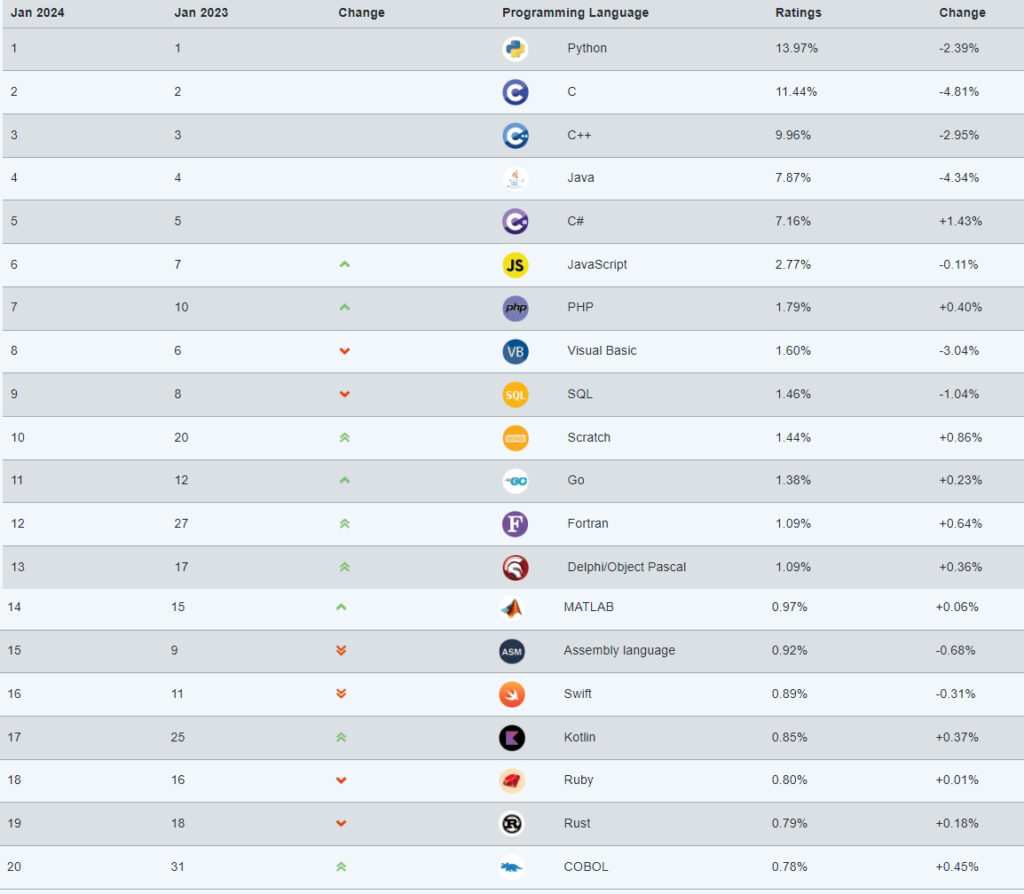
Que nous réserve le classement TIOBE sur ce premier mois de l’année ? Découvrez la progression des différents langages de programmation sur l’année écoulée :
- Python : 13.97% (=)
- C : 11.44% (=)
- C++ : 9.96% (=)
- Java : 7.87% (=)
- C# : 7.16% (=)
- JavaScript : 2.77% (+1)
- PHP : 1.79% (+3)
- Visual Basic : 1.60% (-2)
- SQL : 1.46% (-1)
- Scratch : 1.44% (+10)
- Go : 1.38% (-1)
- Fortran : 1.09% (+15)
- Delphi/Object Pascal : 1.09% (+4)
- MATLAB : 0.97% (+1)
- Assembly language : 0.92% (-6)
- Swift : 0.89% (-5)
- Kotlin : 0.85% (+8)
- Ruby : 0.80% (-2)
- Rust : 0.79% (-1)
- COBOL : 0.78% (+11)
C# : élu langage de programmation de l’année 2023
En 2023, C# a marqué un tournant historique en remportant le titre de langage de programmation de l’année selon l’index TIOBE.
Cette reconnaissance inédite s’explique par une augmentation notable de 1,43 % de sa popularité, détrônant ainsi C++ et marquant son empreinte dans le top 10 depuis plus de deux décennies. La montée de C# est particulièrement évidente dans les domaines dynamiques des applications web et des jeux vidéo, où il se positionne comme un concurrent sérieux de Java.
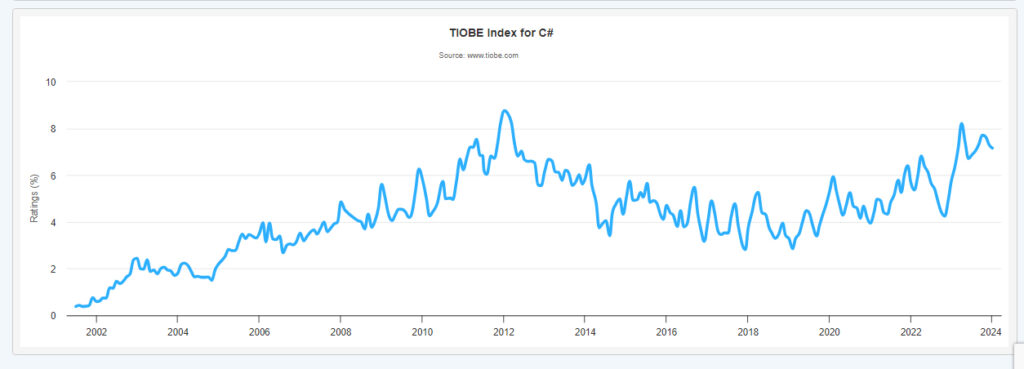
L’attrait de ce langage de programmation réside dans sa gratuité et son évolution constante, avec des mises à jour régulières et enrichissantes. Cette amélioration continue assure à C# une place prépondérante dans l’avenir de la programmation.
La réussite de C# en 2023 reflète également les tendances actuelles du secteur, mettant en lumière un intérêt croissant pour des langages flexibles et en développement constant.
Grâce à ses performances remarquables et à une adoption en hausse, C# est en bonne voie pour dépasser des poids lourds comme Java, consolidant ainsi sa présence influente dans le panorama technologique mondial.
Entrée de COBOL dans le top 20 de l’index TIOBE
L’apparition de COBOL dans le top 20 de l’index TIOBE en janvier 2024 illustre des tendances significatives en technologie et programmation. Cette remontée met en lumière la pertinence durable de COBOL, un langage datant des années 1950, toujours central dans les secteurs financier et gouvernemental.
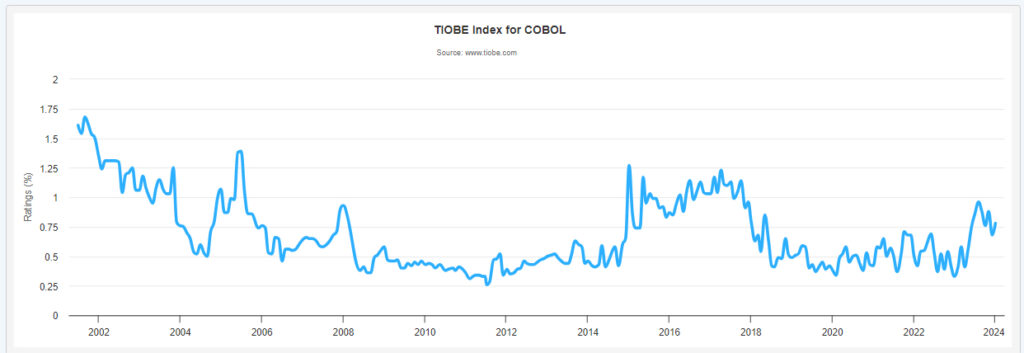
Cette résurgence dans le classement TIOBE peut également refléter une pénurie de compétences en COBOL dans l’industrie, exacerbée par le départ à la retraite de nombreux programmeurs expérimentés dans ce langage. Cela a probablement accru la demande pour des experts COBOL, influençant ainsi les critères d’évaluation de TIOBE.
Ce retour en force dans l’index TIOBE rappelle l’importance des technologies anciennes dans la programmation et souligne que les langages plus âgés peuvent à nouveau gagner en pertinence dans le paysage informatique actuel.
Les autres évolutions importantes de l’index TIOBE de janvier
Parmi les autres évolutions notables en 2024, Fortran et Kotlin ont fermement pris place dans le top 20 de l’index TIOBE, éclipsant des langues comme R et Perl, dont la popularité décline.
Fortran, réputé pour son efficacité en calculs numériques et ses bibliothèques fournies, reste privilégié dans les domaines universitaires et scientifiques. De son côté, Kotlin, souvent considéré comme une alternative moderne à Java, se distingue par sa simplicité d’apprentissage et de codage.
En ce qui concerne les leaders du classement, Python, C et C++ maintiennent leur suprématie en occupant les trois premières places.
Enfin, des mouvements significatifs ont été observés pour Scratch, qui a fait un bond de la 20e à la 10e place ; et Delphi/Object Pascal, grimpant de la 17e à la 13e position, illustrant leur croissance en popularité.
Comment choisir ses langages de programmation en 2024 ?
En 2024, choisir un langage de programmation implique de peser soigneusement plusieurs facteurs clés :
La popularité
La popularité d’un langage est primordiale. Par exemple, Python, reconnu pour sa large communauté, offre d’excellentes opportunités d’emploi et de nombreuses ressources pour les développeurs. La facilité d’apprentissage est aussi un critère important ! Des langages comme JavaScript et Python se présentent comme des choix accessibles pour les débutants.
En consultant l’index TIOBE chaque mois, vous pourrez déterminer la popularité et notoriété d’un langage de programmation !
Le domaine d’application
Pour le développement web, des langages comme JavaScript et Ruby sont souvent privilégiés, tandis que Swift et Kotlin s’avèrent plus pratiques pour le développement mobile.
Dans les domaines de l’intelligence artificielle et du traitement de données, Python avec ses bibliothèques telles que TensorFlow et PyTorch, est particulièrement performant.
Avant de choisir un langage, vérifiez la compatibilité d’un code avec vos besoins spécifiques.
Les mises à jour
L’évolution et le support continu d’un langage sont importants. Des langages comme Java et C# bénéficient du soutien de grandes entreprises, garantissant des mises à jour régulières.
Enfin, la compatibilité et l’intégration avec d’autres outils restent aussi des critères à prendre en compte. Par exemple, Rust, connu pour sa sécurité et ses performances, s’intègre bien dans des systèmes complexes.
Notre astuce pour utiliser l’index TIOBE
L’indice TIOBE, qui évalue la popularité des langages depuis 2001, se base sur des critères variés tels que le nombre d’ingénieurs qualifiés, la disponibilité de formations et la visibilité sur des moteurs de recherche comme Google, Bing, Yahoo et Wikipédia. Cette méthodologie complète permet à TIOBE de fournir une analyse précise et globale des tendances actuelles en programmation.
Ce classement indique, aux entreprises et développeurs web, un potentiel de croissance et d’innovation, utile pour les projets web avant-gardistes.
Besoin d’un développeur compétent pour donner vie à vos idées ? Postez dès maintenant votre projet sur notre plateforme de freelances, Codeur.com.