On ne le répétera jamais assez, intégrer un blog à sa stratégie SEO est devenu quasi-indispensable. Aujourd’hui, nombreuses sont les raisons qui poussent les chefs d’entreprise à ajouter un blog à leur site internet.
Pour booster votre visibilité ou pour vous démarquer de la concurrence, il est primordial de communiquer sur votre entreprise, sur vos produits et/ou sur vos services.
Dans cet article, nous allons voir pourquoi le blog est un outil de choix pour tous ceux souhaitant augmenter leur trafic et générer davantage de leads.
Qu’est-ce qu’un blog SEO ?
Le Blog est l’abréviation d’un mot composé anglais « Web log », qui signifie « Journal ». Il est utilisé pour décrire la publication périodique d’articles sur un support digital.
Le blog a rapidement rencontré un franc succès grâce à son caractère innovant et intuitif. Utilisé à bon escient, il permet de communiquer sur votre entreprise et sur votre activité de façon efficace. Il offre une grande liberté éditoriale et une interaction avec les visiteurs, grâce à la possibilité de poster des commentaires sur chaque article. Le blog permet de publier des articles instantanément ou de les programmer pour une publication ultérieure.
Devenu un allié incontournable des chargés de marketing et communication, le blog a encore de beaux jours devant lui et fait désormais partie intégrante d’une stratégie SEO efficace.
Quelle est la différence entre un blog et un site web ?
Trop d’entreprises se contentent d’un site web qui n’optimise pas assez leur visibilité.
Considérant qu’un site web est un ensemble de ressources accessibles via une adresse web, appelée URL, qu’il est hébergé sur un serveur web et qu’il permet de publier des contenus textuels et multimédia, un blog est un site web.
Le blog est un type de site internet, dans lequel il est possible de publier des articles, aussi appelés billets, de manière chronologique.
Initialement réservé aux blogueurs professionnels, les entreprises l’utilisent désormais pour communiquer sur leur activité. Storytelling, publications d’actualités, communication produit… Tout est possible avec un blog. Naturellement, le blog peut être intégré aux sites marchands comme aux sites vitrine.
Vous l’aurez compris, le blog d’entreprise est un levier SEO à ne pas négliger !
Besoin d’accroître votre visibilité ?
Faites appel à Guillaume Guersan, consultant SEO et SEA pour vous aider dans la mise en place de votre blog.

Pourquoi créer un blog SEO ?
La création d’un blog présente de nombreux avantages, selon moi les principaux étant :
- Optimiser son référencement naturel : en effet, via un blog on peut travailler de nombreux mots clés
- Générer du trafic qualifié : en plus de générer du trafic, l’on va pouvoir attirer les visiteurs que l’on souhaite cibler
- Convertir le trafic en leads : le blog est l’endroit parfait pour générer des leads, notamment via la mise en place d’une stratégie d’Inbound Marketing
- Booster la notoriété : qui dit trafic dit notoriété, forcément !
- Améliorer l’image de marque : le blog, s’il est associé à une bonne stratégie de contenu va permettre d’améliorer son image de marque
- Attirer de nouveaux clients
- Fidéliser les clients
Je pourrais citer d’autres avantages, selon moi la création d’un blog pour une entreprise ne se discute pas : c’est une obligation !
Voyons maintenant en détails les 5 principaux avantages à la création d’un blog.
1. Le blog améliore votre visibilité
Créer un blog d’entreprise est une excellente manière d’optimiser sa visibilité sur les supports digitaux. Figurant en bonne place sur la liste des actions à engendrer pour booster son référencement naturel ; le blog est devenu une plus-value intéressante et, de surcroît, facile à mettre en place.
La création de contenu pertinent est le point clé numéro 1 de toute stratégie SEO qui se respecte. Créer un blog vous permettra de publier du contenu de qualité et d’utiliser des mots-clés correspondant à votre secteur d’activité. Les mots-clés correspondent à des requêtes, cherchées par les internautes.
Pour bien choisir ses mots-clés, plusieurs outils existent sur le web. Le blog permet d’obtenir du trafic qualifié et durable qui à terme, permettra de générer davantage de chiffre d’affaires.
2. La génération de backlinks
Avoir un blog travaillé et optimisé, c’est l’assurance de voir son trafic augmenter. Grâce à la création de nouvelles pages de qualité d’une part, mais aussi grâce à la génération de backlinks.
Les backlinks sont des liens d’un site A pointant vers un site B et permettent d’augmenter l’autorité d’un site web, et donc sa visibilité.
Si vos articles sont intéressants, vous obtiendrez des liens entrants de manière spontanée vers votre site. Les backlinks permettent aux bots de Google de constater la pertinence d’un site web.
Optimisez votre blog pour le SEO
Guillaume Guersan, expert en SEO, peut vous aider à mettre en place une stratégie de référencement pour augmenter votre visibilité.
3. Une plus-value pour le client
La création d’un blog ne s’inscrit pas seulement dans un enjeu SEO. Elle a également une véritable valeur ajoutée pour vos clients.
Véritable vitrine de votre activité, le blog est utile pour montrer le côté humain d’une entreprise et pour donner corps à une société. A l’instar des réseaux sociaux, le blog véhicule les valeurs de l’entreprise et permet de créer une véritable relation de confiance avec les clients et futurs clients.
Il permet également de répondre aux questions fréquemment posées et, de ce fait, d’aider le client dans son parcours de navigation. Les articles de blog d’entreprise sont considérés comme du contenu de marque à forte valeur ajoutée.
Grâce au blog, l’entreprise peut démontrer son expertise à ses clients et se constituer une image de marque solide.
4. Améliorer son maillage interne grâce à son blog d’entreprise
Le maillage interne consiste à créer des liens internes, c’est-à-dire créer des liens vers des pages stratégiques de votre site internet.
Ces liens doivent être créés de manière la plus naturelle possible, pour éviter d’être pénalisé par Google. Pour cela, rationnalisez le nombre de liens par page et varier les ancres au maximum.
Un bon maillage interne doit permettre de donner du jus aux pages les plus importantes de votre site. Sur votre blog, vous pourrez faire des liens pointant vers des produits ou des catégories de produits que vous voulez pousser.
5. Renforcer son image grâce à un contenu pertinent et optimisé
Le blog est une source d’acquisition de trafic très intéressante. Plus son contenu est dense, plus de pages du site seront affichées dans les résultats de recherche (SERP). Pour autant, pas question de poster pour poster !
Google est doté d’un algorithme puissant qui lui permet de détecter le contenu de mauvaise qualité ainsi que les entreprises qui « trichent ». Les techniques visant à tromper les bots – dites techniques « black hat SEO » – sont de plus en plus vite repérées par le plus grand moteur de recherche, bien que de nouvelles fleurissent chaque jour.
En créant du contenu dense, pertinent et optimisé, vous augmentez significativement vos chances de générer plus de trafic et plus de leads sur le long terme.
Comment optimiser votre blog pour le SEO ?
Comme nous venons de le dire, le blog est un vecteur de trafic important. Cependant, pour attirer de nombreux visiteurs qualifiés, il est important de respecter plusieurs règles SEO. Alors, voici 7 conseils pour mieux positionner vos articles de blog dans les moteurs de recherche !
1. Exploiter le cluster thématique
Dans le passé, le référencement s’est principalement concentré sur l’optimisation des articles de façon individuelle. Bien que cela soit important, vous pouvez booster le SEO de votre blog en utilisant des « topics clusters » (ou clusters thématiques).
Le principe est simple : vous sélectionnez un sujet pilier, lié à votre activité principale, ainsi qu’un mot-clé cible. Ensuite, vous déterminez des sous-thèmes (entre 7 et 10), reliés à votre sujet principal, comprenant chacun un mot-clé plus spécifique, souvent de longue traîne.
Ainsi, vous définissez directement plusieurs idées d’articles, afin les relier entre eux via le maillage interne. Cela aura 3 avantages :
- Offrir, à vos visiteurs, une vision complète et éclairée du sujet.
- Conserver les internautes plus longtemps sur votre site internet (un signal important pour le référencement).
- Aider les robots des moteurs de recherche à mieux parcourir et comprendre votre contenu, ce qui renforce son positionnement dans les résultats.
Pour trouver des contenus thématiques autour d’un mot-clé ou d’un sujet, vous pouvez utiliser des outils comme Semrush ou AnswerThePublic.
Autre astuce : tapez votre requête principale sur Google et regardez les propositions en bas de page, dans les « Recherches associées ». Voici un exemple à partir du mot-clé « gérer ses émotions » :

2. Écrire pour les Featured Snippets
Les « Featured Snippets » apparaissent en haut des résultats organiques de Google. Ils se présentent souvent sous la forme de listes à puces, d’encart avec une définition, d’une FAQ ou même de tableau comparatif.
Les extraits en vedette fournissent des réponses rapides aux recherches les plus courantes, commençant souvent par « qui, quoi, où, pourquoi et comment ». Voici un exemple de Featured Snippets lorsqu’on tape la requête « les meilleurs outils de facturation » :

Pour en savoir plus, nous vous invitons à lire notre article : SEO : les différents types de Featured Snippets.
Comment créer du contenu optimisé pour apparaître sous forme d’extraits enrichis ?
- Posez des questions dans les titres et sous-titres, puis répondez de manière courte et concise.
- Utilisez les listes à puce ou numérotées dès que possible.
- Ciblez l’intention de recherche pour mieux rédiger les titres.
- Optez pour des mots-clés de longue traîne.
3. Veiller à la lisibilité des articles
La lisibilité est un facteur SEO important pour les moteurs de recherche. Les articles agréables à lire, ergonomiques et correctement structurés sont souvent mieux classés.
Comment améliorer la lisibilité des articles ?
- Utilisez des phrases courtes.
- Pensez aux mots de transition pour fluidifier la lecture.
- Ajoutez des sous-titres pour structurer le texte.
- Faites des paragraphes courts (3-4 lignes maximum).
- Aérez le texte.
- Préférez la voix active à la voix passive.
- Relisez-vous pour éviter les fautes d’orthographe, de grammaire et de syntaxe.
4. S’aider de plug-in SEO
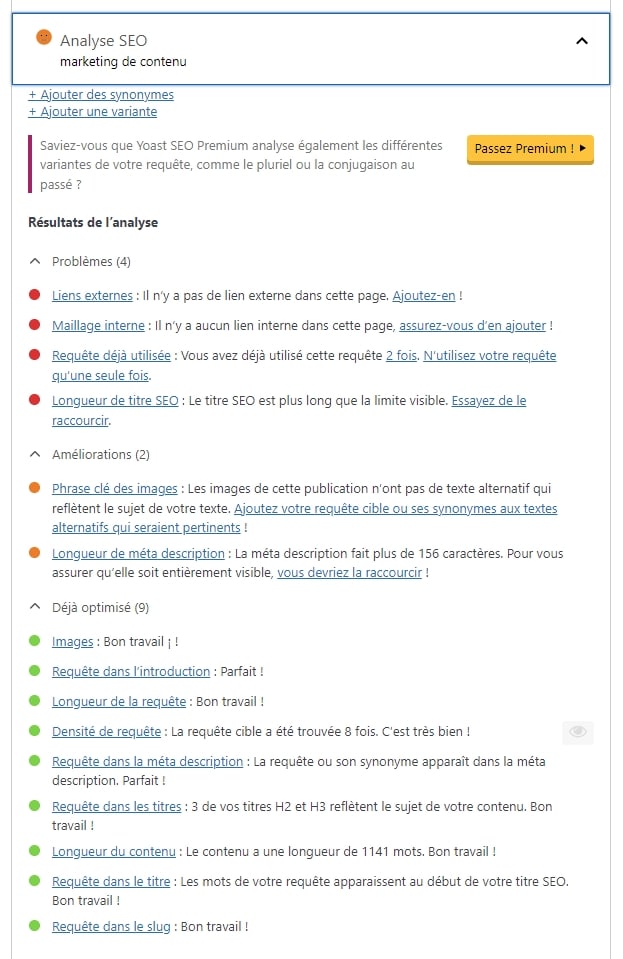
Vous utilisez un CMS comme WordPress, Joomla ou Prestashop ? Il existe des extensions qui vous aident à optimiser vos articles de blog. Ces dernières vous indiquent généralement un score, ainsi qu’une checklist des bonnes pratiques. Vous visualisez rapidement les points forts et les points à améliorer, pour mieux référencer votre billet. Pratique !
Ci-dessous, un exemple avec le plugin WordPress Yoast SEO :
5. Rédiger des articles longs et complets
D’après une étude de Backlinklo datant de 2020, les contenus qui se placent dans le top 10 des résultats Google contiennent 1 447 mots, en moyenne. D’après une infographie réalisée par CoSchedule, les billets de blog qui fonctionnent le mieux font environ 2 500 mots.
Ces chiffres s’expliquent facilement : un contenu long est souvent détaillé et illustré par des exemples concrets. Il dispose de nombreux mots-clés, ce qui aide les robots des moteurs de recherche pour son indexation.
Par ailleurs, les visiteurs vont rester plus longtemps dessus. Or, le temps passé sur une page compte comme facteur de classement ! Si les internautes y restent plusieurs minutes, Google va juger que votre article est pertinent, et donc le remonter dans les résultats.
6. Ajouter des visuels sur votre blog SEO
Les moteurs de recherche apprécient les éléments visuels. De plus, ces derniers ont du potentiel pour votre référencement ! Les images et les vidéos apparaissent sur la page de résultats des moteurs de recherche. Google propose même une rubrique dédiée à la recherche d’images.
Dans vos articles, pensez à ajouter des éléments visuels pour aérer le texte et transmettre des informations complémentaires.
Photos, graphiques, infographies, tableaux, schémas… Ces éléments améliorent la lisibilité de l’article tout en vous offrant de nouvelles opportunités SEO. En effet, les titres, la balise alt, le texte alternatif et la description sont autant d’endroits où placer vos mots-clés pour optimiser votre référencement naturel.
7. Personnaliser vos URL
La structure de votre URL est un facteur de classement important. Évitez les URL générées automatiquement qui ne sont pas toujours optimisées. Prenez soin d’y intégrer votre mot-clé principal afin que les robots de Google indexent vos pages sur des requêtes pertinentes.
Vous pouvez même créer des répertoires par thème, dans lesquels vous compilerez vos 7 à 10 articles sur le sujet. Cela vous permet d’ajouter un mot-clé commun (et principal) à toutes vos URL.
Par exemple, si vous avez un blog sur l’alimentation et que vous voulez rédiger des articles sur la diversification alimentaire, ajoutez un sous-répertoire. Vos billets de blog auront une URL construite ainsi :
Votrenomdedomaine.fr/diversification-alimentaire/mot-cle-de-larticle
Conclusion
Vous l’aurez compris, la création d’un blog est devenue quasi-indispensable dans une stratégie SEO et possède également une dimension commerciale et marketing.
Améliorer le référencement, renforcer la relation avec les clients et véhiculer une image de marque positive sont autant de choses dont le blog d’entreprise est capable.
Aussi, le référencement naturel est un travail de longue haleine. Si vous êtes rigoureux et que vous alimentez régulièrement votre blog avec un contenu de qualité, vous constaterez les bienfaits sur le trafic de votre site dans les mois suivants. Patience !
Et si vous avez besoin de rédacteurs web pour rédiger vos articles de blogs ou de consultants SEO pour mieux les référencer, n’oubliez pas que ces freelances sont disponibles sur Codeur.com ! Postez un projet dès aujourd’hui pour recevoir gratuitement leurs devis.