Vous souhaitez créer un site e-commerce avec Shopify, mais vous ne savez pas quoi choisir entre les formules Shopify et Shopify Plus ? Les offres de base de Shopify constituent une excellente option pour les indépendants et les petites entreprises qui souhaitent vendre en ligne. Mais si vous êtes une grande entreprise, réalisant déjà de nombreuses ventes via des points de vente et/ou un e-commerce, la formule Shopify Plus vous intéressera davantage.
Cette dernière propose de nombreuses fonctionnalités et services d’accompagnement pour booster votre croissance.
Cap sur les principales différences entre Shopify et Shopify Plus !
Qu’est-ce que Shopify Plus ?
Shopify et Shopify Plus appartiennent à la même plateforme. Et même si les formules semblent radicalement différentes, elles comportent plusieurs points communs :
- Elles sont construites avec la même technologie.
- Elles utilisent les mêmes thèmes.
- Elles offrent une interface similaire et toutes les fonctionnalités de base d’un e-commerce.
La différence se résume aux fonctions “d’entreprise” qui sont débloquées lorsque vous utilisez le plan Shopify Plus. Ces dernières ouvrent l’accès à plus d’intégrations (d’API et de vos outils tiers), au code sous-jacent de votre boutique, à des options d’assistance dédiées, etc.
Alors que Shopify joue sur la mise à disposition de sa plateforme, Shopify Plus propose un ensemble de services d’accompagnement pour les entreprises. Cette dernière s’adresse aux groupes qui ont besoin de :
- Plus de personnalisation et de contrôle.
- Capacités d’automatisation plus importantes.
- Fonctions multicanales et omnicanales améliorées.
- Vitesses plus rapides.
- Capacité de gérer de manière fiable d’énormes quantités de trafic et de ventes.
Ce n’est pas un hasard si, parmi les utilisateurs de Shopify Plus, nous retrouvons des marques comme Tesla, So Shape, Kylie Cosmetics, Solendro, Heinz…
Les principales différences entre Shopify et Shopify Plus
Qu’est-ce qui distingue Shopify et Shopify Plus ? Passons en revue les principaux critères qui différencient ces offres…
Les tarifs
La première grande différence entre Shopify et la formule Shopify Plus réside dans les tarifs.
Pour les TPE, PME et jeunes entrepreneurs, Shopify offre 4 formules évolutives, aux coûts mensuels différents :
Offre Starter
Pour 5€ par mois, vous pouvez vendre sur des marketplaces, les réseaux sociaux ou via WhatsApp. Par contre, vous ne disposez pas de votre propre boutique en ligne.
Offre Basic
À 27€ par mois, cette formule s’adresse aux débutants qui veulent rapidement se lancer dans la vente en ligne, à moindres frais. L’offre comprend également des frais de transaction :
- 8% + 0,25€ pour les paiements européens.
- 3% + 0.25€ pour les règlements internationaux (ou via American Express).
- 2% pour les transactions effectuées en dehors de la plateforme Shopify Payments.
Offre Shopify
La formule Shopify reste la plus utilisée ! À 79€ par mois, elle vous permet de profiter de l’automatisation e-commerce pour gagner du temps dans votre gestion quotidienne.
Les frais de transaction sont également moins élevés :
- 1.6% + 0,25€ pour les paiements européens.
- 2.9% + 0.25€ pour les règlements internationaux (ou via American Express).
- 1% pour les transactions effectuées en dehors de la plateforme Shopify Payments.
Offre Advanced
À 289 € par mois, cette formule se distingue par des fonctions analytiques avancées qui vous aident à booster la croissance de votre boutique en ligne.
Les frais de transaction sont également atténués :
- 1.4% + 0,25€ pour les paiements européens.
- 2.7 % + 0.25€ pour les règlements internationaux (ou via American Express).
- 0.5% pour les transactions effectuées en dehors de la plateforme Shopify Payments.
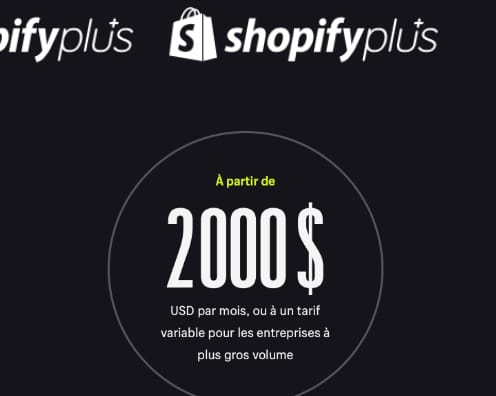
Shopify Plus s’adresse aux e-commerces solides, avec des besoins précis en automatisation, gestion d’image, API et accompagnement. L’offre démarre à 2000€ / mois, mais il faut discuter avec leur équipe pour obtenir un devis.
Si le tarif semble important, il vous faut savoir que cette formule propose de très nombreuses options et un accompagnement personnalisé. Ce qui nous amène à la suite des différences entre Shopify « classique » et Shopify Plus !
Un gestionnaire de compte dédié pour votre compte Shopify Plus
Avec Shopify, vous disposez d’une assistance par téléphone, email et livechat. Il est possible de faire ponctuellement appel à des experts Shopify pour vous aider à effectuer certaines tâches ou développer des fonctionnalités supplémentaires. Ces prestations ne sont pas comprises dans les abonnements Shopify et génèrent un coût supplémentaire.
En revanche, Shopify Plus offre une assistance personnalisée et dédiée pour votre site marchand. Dès que vous souscrivez à cette formule, un ingénieur de lancement vous accompagne tout au long du processus d’installation et de migration de votre boutique. Il vous aide à synchroniser vos outils tiers et à trouver des partenaires pour travailler sur des besoins spécifiques liés à votre e-commerce. Sa promesse est de vous aider à créer une boutique en ligne pleinement opérationnelle en 90 jours maximum !
Par ailleurs, un Merchant Success Manager vous conseille et forme, afin que vous sachiez utiliser le plein potentiel de Shopify Plus. Cet expert analyse également les tendances de votre secteur et vous livre un plan d’action pour animer et développer votre e-commerce.
Vous devenez également éligible au Merchant Success Program de Spotify. Un programme qui vous ouvre l’accès à des webinaires, des vidéos de formation et des checklists pour atteindre vos objectifs de croissance.
Plus d’options de personnalisation
Avec Shopify, vous pouvez vous servir de Liquid pour personnaliser des thèmes. Ce langage open-source, développé par la plateforme, vous permet de modifier le HTML ou le CSS de votre boutique en ligne. Liquid partage une syntaxe similaire aux autres langages de programmation. Donc si vous avez des connaissances dans le codage, vous devriez être à l’aise avec Liquid.
Cependant, sans compétence en développement web, vous aurez aussi la possibilité de personnaliser les thèmes. Vous serez simplement limité aux options offertes dans le back-office du template, ce qui peut être insuffisant pour les entreprises dont les besoins de personnalisation sont importants.
En souscrivant à Shopify Plus, vous accédez à des experts en webdesign pour vous accompagner dans la mise en place d’une interface cohérente avec votre charte graphique. Vous disposez d’une boutique unique qui porte parfaitement votre image de marque.
La personnalisation de la page de paiement
Shopify Plus permet de personnaliser l’expérience de paiement en fonction de conditions prédéfinies par vos soins (produits commandés, valeurs du panier…).
Vous pourrez personnaliser les méthodes d’expédition, les champs client et les options de paiement. Cela permet de :
- Modifier la remise pour des produits spécifiques.
- Proposer des prix basés sur le volume (pratique si vous gérez un e-commerce B2B ou de la vente en gros).
- Modifier, masquer, réorganiser les options d’expédition, les prix et les méthodes de paiement.
Les autres formules Shopify ne proposent pas ces options. Vous devrez acheter des add-ons supplémentaires.
Shopify Plus ouvre l’accès à des applications exclusives
Les utilisateurs de Shopify Plus ont accès à des applications et fonctionnalités exclusives :
- Le canal de vente en gros pour les entreprises B2B et les grossistes. Via une vitrine séparée, uniquement accessible par mot de passe, vous pourrez proposer vos produits à des tarifs dégressifs.
- Shopify Flow pour automatiser de nombreuses tâches comme marquer les clients fidèles ou envoyer des demandes de renouvellement de commande.
- Launchpad pour planifier et automatiser des ventes flash, des lancements de produits ou des campagnes de vente.
- L’application Transporter pour importer des enregistrements de clients, de produits et de commandes dans votre boutique Shopify.
- Bulk Account Inviter pour inviter vos clients importés d’une autre plateforme ou d’un magasin différent à activer leurs comptes en ligne sur votre boutique Shopify.
- Shopify Fulfillment Network pour pour gérer des stocks importants et l’exécution des expéditions avec des transporteurs comme UPS et DHL.
L’intégration avec des plateformes existantes
En tant que client de Shopify Plus, vous bénéficiez d’une API pour relier vos plateformes de :
- Gestion de l’information produits (PIM)
- Planification des ressources de l’entreprise (ERP)
- Gestion des stocks et des commandes (IMS)
- Gestion de la relation client (CRM)
- Logistique tierce partie (3PL)
- Gestion d’entrepôt (WMS)
L’accès exclusif à d’autres ressources
Le Merchant Success Program n’est pas le seul service disponible pour les utilisateurs de Shopify Plus. D’autres ressources sont à leur disposition, notamment :
- Une communauté Facebook où vous pouvez partager vos expériences avec d’autres utilisateurs de Shopify Plus.
- Un annuaire de partenaires vous donnant accès à des experts du web, des agences et des solutions pour satisfaire vos objectifs.
- L’accès à des programmes bêta exclusifs.
- L’accès à la Shopify Plus Academy pour disposer de conseils et formations sur l’utilisation de la plateforme.
Une fonction « multidevise »
Si vous êtes une entreprise internationale, Shopify Plus propose une fonction multidevise. Cette dernière définit automatiquement le pays et la devise de vos clients en fonction de leur adresse IP. Cela signifie que vos clients verront immédiatement les prix des produits dans leur propre monnaie. Cependant, ils pourront toujours choisir un autre pays s’ils le souhaitent.
De plus, si vous utilisez Shopify Payments comme solution de paiement, vous pouvez définir des prix de produits personnalisés selon le pays. Cette fonctionnalité est également disponible avec la formule Advanced de Shopify.
La répartition des stocks
Shopify propose de répartir vos stocks entre votre e-commerce et d’autres points de vente ou de stockage, afin d’éviter d’éventuels problèmes de rupture. Le nombre d’emplacements que vous pouvez définir dépend de la formule sélectionnée :
- Basic : jusqu’à 4 sites
- Shopify : 5 sites maximum
- Advanced : 8 emplacements maximum
- Shopify Plus : jusqu’à 20 emplacements
Avec ces plans, vous pouvez affecter votre stock à des magasins individuels, à des boutiques éphémères et à des entrepôts de stockage.
La Réalité Augmentée

La Réalité Augmentée est l’une des plus grandes tendances e-commerce de ces dernières années. Elle offre une expérience intuitive et immersive aux internautes. Grâce à elle, ils peuvent virtuellement essayer vos produits, ce qui augmente les chances de conversion.
Avec les formules Shopify, vous pourrez l’ajouter à votre boutique, à condition d’acheter une extension supplémentaire. Avec Shopify Plus, vous bénéficiez automatiquement de cette option.
Shopify ou Shopify Plus : laquelle choisir ?
Avec ses 4 formules évolutives, Shopify se destine aux TPE en phase de lancement ou PME en croissance. Les offres conviendront aux freelances et entreprises de moins de 10 salariés.
Si vous réalisez 1 million d’euros (ou plus) de revenus mensuels, Shopify Plus est une option plus pertinente. Elle rassemble toutes les fonctionnalités des différentes formules de Shopify, avec une dose de personnalisation, d’assistance, de rapidité et de technicité complémentaire. C’est l’offre la plus complète pour booster vos ventes et propulser votre notoriété !
Vous avez besoin d’aide pour choisir votre formule Shopify et créer votre boutique en ligne ? Quelle que soit la formule, faites appel à un développeur Shopify freelance. Pour cela, postez une annonce sur Codeur.com et trouvez un freelance pour vous accompagner !