Lancer son activité en freelance reste un rêve pour beaucoup de professionnels, pour gagner en indépendance et en liberté. Cette décision doit toutefois s’anticiper, car s’installer en freelance demande une vraie réflexion pour savoir quel statut d’entrepreneur choisir.
Les conséquences fiscales, sociales, juridiques et comptables vont en effet différer, d’où l’intérêt d’avoir recours à des connaisseurs de l’activité freelance comme Blank : découvrez pourquoi ?
Lancer son activité en freelance : quel statut et quelle forme juridique ?
Avant de s’installer en freelance, le choix du statut est essentiel, car il conditionne les obligations comptables, fiscales, financières et sociales.
L’ancien statut d’auto-entrepreneur, devenu micro-entreprise, est souvent privilégié, mais ce n’est pas la seule option : quel est le meilleur choix pour vous ?
Se lancer en freelance : la micro-entreprise, une solution simple et rapide
La micro-entreprise (ex auto-entreprise) reste sans conteste le régime le plus simple pour se lancer comme travailleur indépendant sans difficultés.
En échange de quelques contraintes (plafonnement du CA, activités réglementées…), ce statut permet de tenir une comptabilité simplifiée :
- Déclaration Urssaf mensuelle ou trimestrielle.
- Exonération de TVA selon les seuils.
- Possibilité de payer l’impôt sur le revenu en même temps que les déclarations Urssaf grâce au versement libératoire.
De manière générale, l’activité en freelancing demande d’être rigoureux sur le paiement des charges obligatoires, sous peine de placer son entreprise en difficulté. C’est pourquoi un compte pro comme Blank inclut dans son offre freelance la possibilité pour les micro-entrepreneurs d’effectuer les déclarations Urssaf automatiquement.
En revanche, le professionnel indépendant ne peut séparer son patrimoine personnel et professionnel, ni déduire ses frais réels. De plus, il est soumis à un seuil de chiffre d’affaires : si l’activité d’un freelance dépasse 77 700€ de CA annuel, sa micro-entreprise passe automatiquement en Entreprise Individuelle (EI).
Installation en freelancing : l’entreprise individuelle, une gestion simplifiée
Pour déduire des frais et récupérer la TVA, le freelance peut opter pour le régime de l’entreprise individuelle : les cotisations sociales sont plus élevées et il doit s’acquitter de l’IR, mais il n’est pas soumis à une limite de CA comme pour la micro-entreprise. Cette entreprise en nom propre se crée gratuitement.
Devenir freelance : l’EURL avec un salaire mensuel
L’entreprise unipersonnelle à responsabilité limitée (EURL) peut constituer un bon compromis entre taux de cotisations et niveau de protection sociale salariée.
Comme freelance, vous êtes le seul et unique gérant de cette variante de SARL, nécessitant de rédiger des statuts et de déposer un capital social d’au moins un euro.
Notez que le dépôt de capital en ligne est possible avec Blank, le compte pro des indépendants : le montant est de 69 € HT avec remise de l’attestation de dépôt de capital social en seulement 72 heures. Ces formalités permettent de protéger son patrimoine personnel, et de bénéficier des avantages de l’emploi salarié.
Cela suppose toutefois une comptabilité plus rigoureuse, assujettie ou pas à la TVA selon le régime fiscal proposé.
Installation en freelance : la SASU pour toucher des dividendes
La SASU, société par actions simplifiée unipersonnelle, correspond à la SAS, avec comme associé unique le freelance. Sa responsabilité est limitée aux apports, le capital social démarrant dès 1 €.
La rémunération est possible en dividendes, d’où un régime fiscal favorable, mais au détriment d’une protection sociale plus coûteuse, propre aux indépendants (près de 75% de la rémunération nette versée).
Le choix du régime et du statut juridique demande donc une vraie réflexion, sachant toutefois que ce choix n’est pas figé : les statuts juridiques de la SASU et de l’EURL peuvent évoluer en modifiant le capital social ou avec l’arrivée d’un nouvel associé.
En cas de doute, n’hésitez pas à consulter gratuitement les experts de Blank.
Le secret d’une activité freelance réussie : anticiper et se faire accompagner
Gagner de l’indépendance en choisissant le freelancing repose en réalité sur une contradiction, dont le futur indépendant doit être conscient : comme associé unique, il cumule le poste de PDG, celui censé avoir la vision de long-terme, et celui de CEO, censé avoir les mains dans le cambouis.
Comment avoir le recul du PDG quand on a les mains sur le guidon comme CEO ? La réponse est simple : il faut savoir se faire aider et conseiller par des professionnels ayant de l’expérience et le recul.
Se faire conseiller en amont de l’activité freelance
Pour savoir quel est le meilleur statut de freelance, le futur travailleur indépendant doit obtenir un conseil personnalisé, en fonction de son activité (conseil, commerce, prestations artisanales) et de ses objectifs (CA, croissance de développement).
Expert-comptable, chambre du commerce, ou Blank peuvent fournir des informations précieuses et personnalisées.
S’informer auprès d’organismes publics ou parapublics s’avère aussi profitable, pour bénéficier de certaines aides financières : les allocations chômage ou d’aide de retour à l’emploi (ARE) sont autorisées en micro-entreprise ou SASU. Il faut aussi se renseigner sur des dispositifs spécifiques, comme l’ARCE (Aide à la Reprise et Création d’Entreprise).
En dehors de ces aspects administratifs, le futur freelance doit enfin réfléchir à l’organisation pratique de sa future activité :
- Le lieu : pièce dédiée à domicile, espace de coworking, travail en extérieur…
- Le matériel et l’aménagement des locaux, pour concilier ergonomie et bien-être
- Les horaires, en mettant en place une routine pour éviter toute procrastination
Pour trouver des idées, n’hésitez pas à parcourir le blog ou le guide de la micro-entreprise de Blank.
Se faire conseiller durant son activité freelance
En devenant travailleur indépendant, le freelance néglige trop souvent un élément majeur, la comptabilité : c’est pourtant le fondement pour évaluer son chiffre d’affaires, son bénéfice, sa productivité, satisfaire à ses obligations comptables et fiscales…
Pour ne pas commettre d’erreurs, une activité en freelancing doit respecter 5 points :
- Avoir un compte bancaire professionnel indépendant
- Etablir un budget prévisionnel
- Tout facturer, au prix juste, et relancer les impayés, raison pour laquelle une banque pro en ligne qui propose aussi un outil de facturation et de devis
- Anticiper les variations de trésorerie
- Se renseigner en cas de doute
Comment choisir la meilleure banque pour une activité freelance ?
Bien souvent, les banques traditionnelles ne répondent pas parfaitement à l’activité en freelance, au moins dans la philosophie. Le professionnel indépendant est en recherche d’une solution bancaire réactive, agile, complète, simple, le tout à moindre coût.
Ce choix est d’autant plus important que légalement, tout freelance doit détenir un compte professionnel indépendant.
Un compte pro en ligne dédié aux indépendants
Né début 2021 de l’expertise reconnue du Crédit-Agricole, le compte pro Blank apporte à chaque professionnel une réponse fiable, simple et réactive :
- Fiable, car il est adossé à un grand groupe au savoir-faire international
- Simple car l’ouverture en ligne d’un compte pro prend 5 minutes
- Réactif car il offre un support clientèle 7j/7 par e-mail, complété, selon les formules, par l’accès à un conseiller expert ou un support 5j/7 par téléphone
Un compte pro complet pour freelance avec tous les services
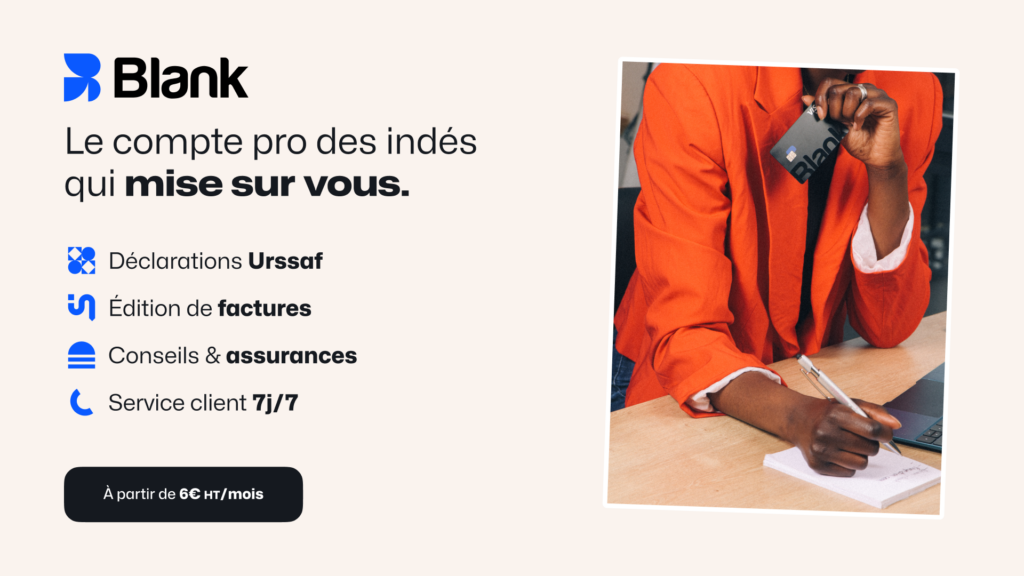
Pour offrir une solution sur-mesure à tout freelance ou travailleur indépendant, Blank a développé trois offres différentes adaptées aux besoins de tous, chaque offre associant une carte VISA BUSINESS paramétrable et un package différent (nombre de virements SEPA, quantité de chèques à encaisser, plafonds CB…).
Cette offre complète idéale en freelancing peut être renforcée par d’autres services, comme une garantie maintien de revenus, une assurance panne matériel ou le doublement de la garantie constructeur, particulièrement utiles pour limiter l’isolement propre à toute activité indépendante.
Pour simplifier la relation avec le travailleur indépendant, Blank propose aussi différents services selon l’offre souscrite, comme un outil de devis et de factures, une possibilité de déclaration / pré-calcul / paiement automatisé des cotisations Urssaf en micro-entrepreneur, ou encore la possibilité de scanner factures ou notes de frais…
Un compte pro en ligne pour indépendants au tarif pas cher
Pour se distinguer des autres comptes professionnels, Blank a fait le choix de tarifs transparents, compétitifs, à travers 3 offres de services financiers et assurantiels, allant de 6 € HT/mois pour l’offre simple, à 39 € HT/mois pour l’offre complète.
Cette solution professionnelle complète ne veut pas simplement faciliter la gestion financière du futur freelance : elle se voit aussi comme un atout pour tout travailleur indépendant et rigoureux, en l’accompagnant au plus près de sa nouvelle activité.