Google vient de publier un document d’aide dédiés à son nouveau Universal Commerce Protocol (UCP). Pour rappel, cette norme vise à unifier les échanges entre marchands, systèmes de paiement et agents d’intelligence artificielle. Le géant américain positionne clairement UCP comme une infrastructure centrale pour un futur commerce « agentique », c’est-à-dire automatisé par des IA capables d’acheter à la place des utilisateurs.
Ce qu’il faut retenir :
- UCP est une norme ouverte qui facilite la communication entre IA, sites marchands et services de paiement.
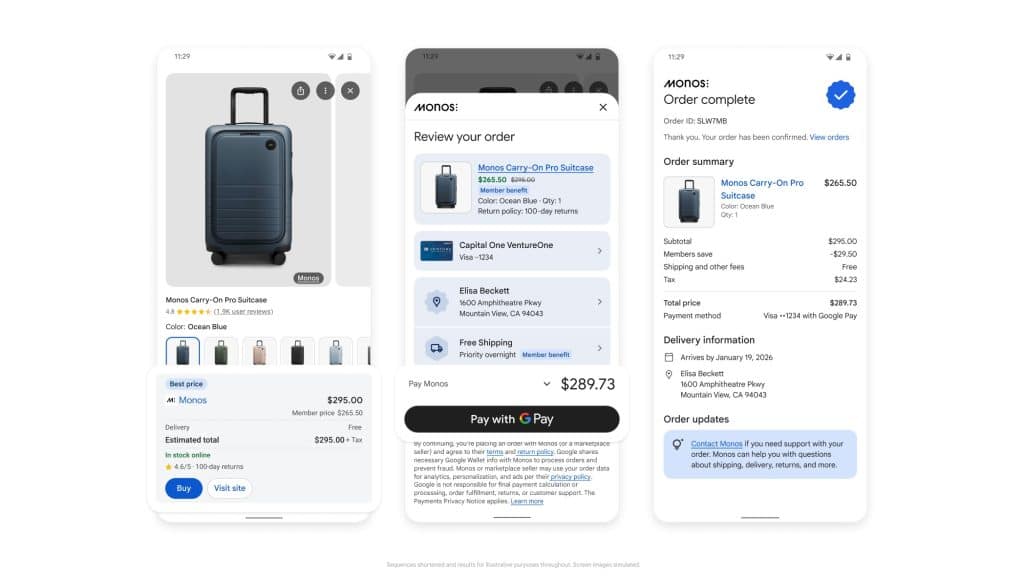
- Le checkout UCP permettra aux clients de finaliser un achat directement sur Google, tout en gardant le marchand comme vendeur officiel.
- L’objectif principal : réduire les frictions du parcours d’achat en s’appuyant sur Google Pay et les données déjà stockées dans Wallet.
- Phase de déploiement limitée : réservé pour l’instant à certains marchands basés aux États-Unis via un programme d’accès anticipé.
UCP, le nouveau langage du commerce en ligne
Annoncé en début d’année, Universal Commerce Protocol (UCP) est présenté comme un standard ouvert pour le commerce agentique, c’est-à-dire un ensemble de règles permettant aux agents intelligents (comme ceux de Google Gemini ou du mode IA dans Google Search) d’interagir sans friction avec les boutiques en ligne.
Concrètement, UCP sert de langage commun entre :
- Les sites marchands et leurs backends,
- Les agents IA qui agissent pour l’utilisateur (ex. : recommander, comparer, ou acheter),
- Les prestataires de paiement comme Google Pay ou d’autres PSP compatibles.
Le protocole est interopérable avec d’autres standards existants de l’écosystème, notamment Agent2Agent (A2A), Agent Payments Protocol (AP2) et Model Context Protocol (MCP).
Il permet donc aux différents systèmes d’agents de se comprendre, d’échanger des informations produits, de gérer des paiements et même d’assurer le suivi post-achat.
Un checkout simplifié dans l’écosystème Google
Grâce à l’intégration de UCP, Google introduit un nouveau bouton de paiement directement au sein du mode IA de Search et sur Gemini. Ce bouton permettra à un client d’acheter un produit sans quitter l’interface Google.
Contrairement au bouton d’achat existant, qui renvoie vers le site du marchand, le checkout UCP se passe intégralement sur Google, tout en maintenant le marchand comme vendeur de référence (seller of record). L’utilisateur effectuera son paiement via Google Pay, en utilisant les moyens de paiement et adresses déjà enregistrés dans son Google Wallet.
Résultat : moins d’étapes, plus de sécurité et un taux d’abandon de panier potentiellement réduit.
Une intégration maîtrisée pour les marchands
Les marchands souhaitant participer doivent :
- Remplir un formulaire d’intérêt via le Merchant Center d’après les critères publiés par Google.
- Structurer leurs fiches produits avec l’attribut native_commerce, nécessaire pour activer le bouton d’achat.
- S’assurer que leur prestataire de paiement (PSP) accepte les tokens de Google Pay. La majorité des processeurs déjà compatibles avec l’API Google Pay le permettent.
Google précise que la Merchant Center reste l’outil central de gestion des flux produits et des éléments de marque. Mieux la donnée produit est structurée, plus la compatibilité avec UCP et le checkout IA sera fluide.
Une étape vers l’e-commerce piloté par l’intelligence artificielle
Avec UCP, Google prépare clairement l’avenir d’un commerce piloté par des agents IA.
À terme, ces agents pourraient :
- Rechercher un produit selon vos contraintes (budget, délai, préférence de marque),
- Comparer automatiquement les meilleures offres,
- Et finaliser l’achat sans que vous quittiez l’interface Google.
UCP agit donc comme la colonne vertébrale technique de cette expérience, permettant aux systèmes d’échanger des données de manière standardisée, fiable et sécurisée.
L’article “Google en dit plus sur Universal Commerce Protocol (UCP), sa nouvelle norme pour un ecommerce agentique” a été publié sur le site Abondance.