Comment savoir si vous avez besoin d’une mise à jour ou d’une refonte de votre site Web ? C’est une question difficile, et il n’y a pas de réponse claire.
Parfois, vous savez que vous avez besoin d’une mise à jour simplement parce que vous voulez mettre à jour le design. Parfois, une update est attendue parce que le site actuel ne peut pas gérer les nouvelles fonctionnalités que vous souhaitez utiliser.
Dans tous les cas, voici 10 signes qui devraient vous alerter sur la nécessiter de refondre votre site internet !
1. Vous ne vendez pas en ligne
Les ventes par téléphone, c’est (quasi) terminé !
Les consommateurs veulent effectuer leurs achats en ligne, du début à la fin. Ils ne veulent pas attendre l’ouverture de votre entreprise pour prendre le téléphone et passer une commande. D’ailleurs, ils n’ont peut-être pas le temps, car ils sont – eux aussi – au travail au même moment.
Si vous continuez à utiliser le téléphone comme unique moyen d’enregistrer les commandes, alors il est temps de penser à une solution e-commerce pour votre site web.

2. Vos taux de conversion sont au ralenti
Il ne suffit pas d’être bien référencé par les moteurs de recherche. Si vous n’arrivez pas à convertir les leads qui atterrissent sur votre site, vous avez besoin d’une refonte en profondeur.
Ici, avoir un beau site web ne résout pas tout, vous devez revoir la conception du site en entier pour corriger les imperfections et en faire un temple des conversions.
Les visiteurs doivent naviguer dans le tunnel d’achat de manière simple et fluide, trouver des call-to-actions et landing pages performantes sur leur chemin.
3. La dernière refonte de votre site web remonte à…
Si vous en doutiez, sachez qu’Internet n’échappe pas à la mode et aux tendances.
En matière de technologie, tous les ans, il y a de nouvelles tendances qui affectent la conception et le développement d’un site web. Si vous ne vous mettez pas à jour en supprimant les fonctions désuètes et en ajoutant des nouveautés, c’est la renommée de votre entreprise qui est en jeu.
Pour réaliser à quelle point la toile a changé en quelques années, jetez donc un œil à cette ancienne version de Yahoo! :

Comparez-la maintenant au design actuel du site :
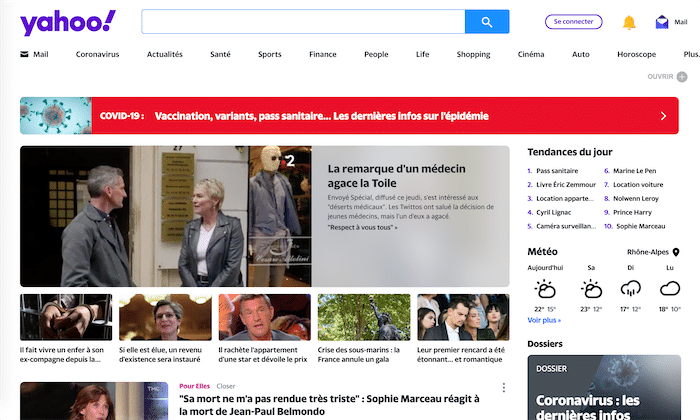
À moins que vous ne soyez un grand nostalgique du web tel qu’il était en 2009, vous conviendrez que le Yahoo! version 2021 est plus agréable pour les yeux que son ancêtre.
Imaginez maintenant que votre site équivaut au Yahoo! de 2009, tandis que ceux de vos concurrents ressemblent au Yahoo! de 2021. Inutile de vous dire qui choisiront vos clients potentiels (ou plutôt, qui ils ne choisiront pas).
Une refonte est donc l’occasion rêvée de dépoussiérer une bonne fois le design de votre site, une véritable nécessité pour ne pas être relégué au rang d’antiquité et être d’actualité sur votre marché.
Vous devez montrer que votre marque s’adapte aux tendances et qu’elle est en veille permanente sur son marché.
En plus, votre site finira par ne plus du tout être performant… Il vaut mieux le refondre légèrement chaque année, qu’avoir une mise à jour majeure qui va prendre du temps et avoir un coût important.
4. Votre site n’est pas mobile friendly
D’après StatCounter, en février 2019, 36% du trafic internet provenait des mobiles. De plus, selon la FEVAD, un achat sur 5 est réalisé depuis un smartphone ou une tablette.
Si votre site web n’est pas conçu spécifiquement pour les appareils mobiles, pensez à une reconstruction de fond en comble.
Les algorithmes d’aujourd’hui recherchent plusieurs facteurs favorables à la mobilité donc ajouter des plugins et add-ons mobile-compatibles ne résoudront pas le véritable problème. Vous devez penser votre site POUR le mobile.

5. Vous avez un taux de rebond élevé
Si les leads quittent votre site web sans s’engager davantage, c’est un signal clair qu’il y a quelque chose qui cloche. Cela peut venir du design, du contenu, du temps de chargement des pages, de l’ergonomie…
De manière générale, veillez à alléger un maximum vos pages pour qu’elles se chargent en moins de 3 secondes. Évitez les couleurs criardes, optez plutôt pour un design sobre. Ne vous laissez pas tenter par la folie des pop-ups ! Vous pouvez en mettre un qui se déclenchera au bout de quelques secondes, mais ne bombardez pas le visiteur immédiatement.
Enfin, repensez votre menu afin qu’il guide au mieux vos visiteurs.
6. Les moteurs de recherche ont changé leurs algorithmes
Le but ultime de tout site Web est d’obtenir du trafic et de convertir ses prospects en clients. Vous pouvez le faire en optimisant votre structure afin que les robots des moteurs de recherche puissent indexer et classer correctement votre site.
Mais, et si les moteurs de recherche changent les règles ?
C’est exactement ce qui se passe, chaque fois qu’il y a un changement d’algorithme pour Google ou d’autres moteurs de recherche. Vous devez vous tenir au courant de tout changement et tenir votre site Web à jour pour incorporer ces évolutions.
7. Votre site n’est pas responsive
C’est un fait : l’usage d’internet sur mobile et tablette a surpassé l’accès à internet sur ordinateur de bureau.

L’internet mobile a surpassé l’internet fixe en 2016.
Face à ce chiffre, le constat est sans appel : il est indispensable que votre site web soit responsive, c’est à dire adaptable aux smartphones, tablettes et autres supports.
Autant dire qu’un site qui ne dispose pas d’une navigation mobile optimale peut quasiment dire adieu à la moitié de son trafic. La refonte de votre site internet est donc l’occasion d’y remédier est de le rendre totalement mobile-friendly.
8. Le SEO de votre site fait grise mine
Le référencement naturel est l’un des enjeux principaux de n’importe quel site web. Et pour cause, l’existence même d’un site perd tout son sens si aucun internaute ne le trouve et ne le visite.
S’il est possible d’améliorer son SEO avec des techniques simples, la situation d’un site en matière de référencement requiert parfois de prendre des mesures plus lourdes, comme une refonte complète.
D’abord, le référencement naturel est en partie lié aux performances techniques du site : des pages trop lentes et trop lourdes peuvent coûter très cher, tout comme un site mal structuré. Un bon ménage de printemps sous la forme d’une refonte peut donc faire des miracles d’un point de vue SEO !
9. Votre site internet n’est pas ergonomique
Autre facteur à prendre en compte : l’expérience utilisateur. Parmi les quantités astronomiques d’informations que les moteurs de recherche prennent en compte pour effectuer leurs classements, l’expérience des visiteurs de votre site occupe une bonne place.
Comprenez par-là que si votre site est vieillot et peu ergonomique, les internautes qui atterrissent sur vos pages risquent fort de ne pas y rester très longtemps.
Un très mauvais signal pour Google qui ne se fera pas prier pour vous pénaliser. Ainsi, refondre un site internet est aussi une optimisation SEO à part entière.
10. Vous avez besoin de nouvelles fonctionnalités
La vie d’un site n’est pas un long fleuve tranquille. Il est amené à connaître des évolutions, au gré des opportunités et des changements au sein de votre entreprise.
Par exemple, il n’est pas rare qu’un site informatif (blog, magazine…) évolue vers un site de vente en ligne (même si cela ne représente qu’une fraction de l’activité). Mais ce type de mutation ne s’effectue pas en un claquement de doigt. De nouvelles fonctionnalités nécessitent souvent des changements profonds dans le site et son architecture.
Une refonte digne de ce nom est donc nécessaire pour emmener votre site internet vers de nouveaux horizons et développer votre activité en ligne.
Comment procéder à la refonte de votre site web ?
La mise en place de ce projet d’envergure commence par la recherche d’un prestataire compétent, qui correspond aux spécificités de votre site et de votre société.
Pour ce faire, déposez votre projet gratuitement et trouvez dès maintenant un spécialiste en refonte de site sur Codeur.com.
Afin d’appuyer votre choix et, par la suite, d’encadrer de A à Z le projet et les relations entre votre entreprise et le prestataire, la réalisation d’un cahier des charges est indispensable.
Vous pouvez d’ailleurs télécharger gratuitement notre modèle de cahier des charges pour refonte de site internet.
Conclusion
Vous avez reconnu certains de ces signes ? C’est qu’il est temps de revoir le design de votre site internet.
Déposez dès maintenant votre projet sur Codeur.com pour trouver un développeur freelance professionnel pour votre besoin.