Une étude inédite menée sur plus de 332 millions de requêtes Google vient de lever le voile sur les habitudes de recherche des internautes. Cette analyse approfondie, réalisée entre janvier 2023 et septembre 2024, révèle des données surprenantes sur la façon dont les américaines utilisent le moteur de recherche Google.
Ce qu’il faut retenir :
- Plus de 44 % des recherches Google concernent des marques, contrairement aux idées reçues qui suggéraient une proportion plus élevée.
- Un tiers des recherches sont purement navigationnelles, les utilisateurs se servant de Google comme d’une page d’accueil pour accéder à leurs sites favoris.
- Le divertissement domine largement les recherches avec 25% du volume total, loin devant les autres catégories.
- Entre 60 et 70% du volume total des recherches présente un potentiel de monétisation.
Une plongée sans précédent dans les données de Google
Cette étude, menée en partenariat avec Datos (une entreprise de Semrush), s’appuie sur un panel représentatif de 130 000 appareils américains sur une période de 21 mois. C’est la première fois qu’une analyse d’une telle envergure est réalisée sur les habitudes de recherche des utilisateurs de Google.
L’un des aspects les plus frappants de cette étude concerne la distribution des requêtes. Les données révèlent en effet une concentration massive du volume de recherches sur un nombre relativement restreint de termes. Les 10 000 termes les plus recherchés représentent à eux seuls 46% de toutes les recherches, dont 148 termes qui constituent près de 15% du volume total.
Parmi ces requêtes populaires, on trouve sans surprise des sites majeurs comme YouTube, Gmail, Amazon, Facebook ou encore ChatGPT. Cette concentration témoigne d’une tendance croissante : le trafic web se focalise de plus en plus sur un nombre limité de sites, et Google joue un rôle prépondérant dans cette centralisation.
Une méthodologie rigoureuse malgré certaines limites
Pour analyser et classifier plus de 320 000 termes de recherche différents, les chercheurs ont dû innover dans leur approche méthodologique. Ils ont fait appel aux modèles de langage (LLMs), et plus particulièrement à GPT 4o-mini via l’API de ChatGPT. Après de nombreux tests impliquant différents modèles (Claude, ChatGPT, Gemini et Mistral), GPT 4o-mini s’est révélé être le plus performant, atteignant un taux de précision remarquable de 96 %.
Le processus de classification s’est déroulé en plusieurs étapes. Dans un premier temps, 1 000 recherches ont été classées manuellement selon différents critères : marques contre termes génériques, intentions de recherche (navigationnelle, informationnelle, commerciale ou transactionnelle), et classification thématique en 24 catégories d’intérêt. Cette base a ensuite servi à affiner les prompts utilisés pour la classification automatisée. Une découverte majeure de ce processus fut l’importance d’utiliser des catégories de classification plus descriptives pour obtenir de meilleurs résultats.
Il est toutefois important de noter certaines limites dans la collecte des données.
En effet, l’étude n’inclut pas :
- Les recherches effectuées via l’application Google
- Les recherches spécialisées (Google Shopping, Google News, Google Hotels, Maps, Images, Vidéos, etc.)
- Les negative-click searches, c’est-à-dire les recherches où Google affiche des réponses instantanées dans la barre de recherche avant même que la requête ne soit terminée
- Les recherches réalisées via l’outil d’IA Gemini de Google
Bien qu’importantes à mentionner, ces limitations n’invalident pas les conclusions de l’étude. Elles permettent au contraire de mieux contextualiser les résultats et de comprendre leur portée réelle. Malgré ces restrictions, l’échantillon de plus de 331 millions de recherches reste suffisamment large et représentatif pour tirer des enseignements significatifs sur les comportements de recherche des utilisateurs.
Le mystère de la longue traîne enfin élucidé
L’analyse de la longue traîne des recherches dévoile des données très intéressantes. Pour le seul mois de septembre 2024, sur plus d’un million de termes de recherche utilisés, 59% n’ont été recherchés qu’une seule fois. Plus précisément, ces 612 981 recherches uniques ne représentaient que 2,2 % du volume total des recherches.
Cette distribution extrême met en lumière le phénomène suivant : en moyenne, chaque utilisateur du panel effectue 5 recherches que personne d’autre n’a réalisées. L’étude suggère qu’il pourrait s’agir soit de recherches uniques légitimes, soit de l’influence d’un petit nombre d’utilisateurs aux comportements de recherche particulièrement atypiques.
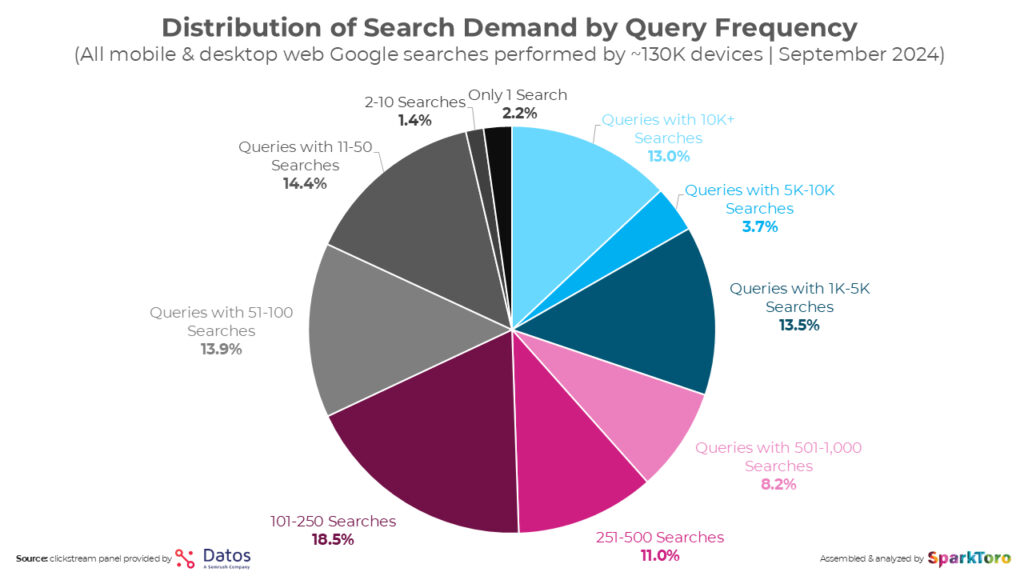
Cette découverte remet en perspective l’affirmation de Google selon laquelle « 15% des recherches quotidiennes sont nouvelles ». L’étude suggère aussi que ces nouvelles recherches ne proviennent pas tant de la longue traîne que de l’actualité quotidienne : nouveaux albums musicaux, lancements de jeux vidéo, catastrophes naturelles, nominations politiques inattendues et des milliers d’autres événements qui génèrent des recherches inédites chaque jour.
Si l’on exclut les requêtes ayant moins de 100 recherches sur la période de 21 mois, les utilisateurs effectuent en moyenne 121 recherches Google par mois. En incluant toutes les recherches de la longue traîne, ce chiffre atteindrait environ 200 recherches mensuelles par utilisateur.
Les intentions de recherche décryptées
Cette étude apporte également un éclairage précis sur les intentions réelles des utilisateurs de Google. La répartition des recherches révèle quatre grandes catégories d’intention :
- 51,8% des recherches sont informationnelles, c’est-à-dire que les utilisateurs cherchent simplement à obtenir des informations sur un sujet qui les intéresse ou dont ils ont besoin
- 33% sont navigationnelles : ces utilisateurs savent déjà où ils veulent aller et utilisent Google comme un moyen plus rapide, plus sûr ou plus efficace que la saisie directe d’une URL
- 14,5% sont commerciales, sans pour autant impliquer une intention d’achat immédiate. Cette catégorie englobe principalement les comparaisons de produits et la recherche d’informations sur des produits, tant en B2B qu’en B2C
- 0,69% sont transactionnelles, indiquant une volonté claire d’acheter quelque chose, de s’inscrire à un service ou de faire appel à un prestataire
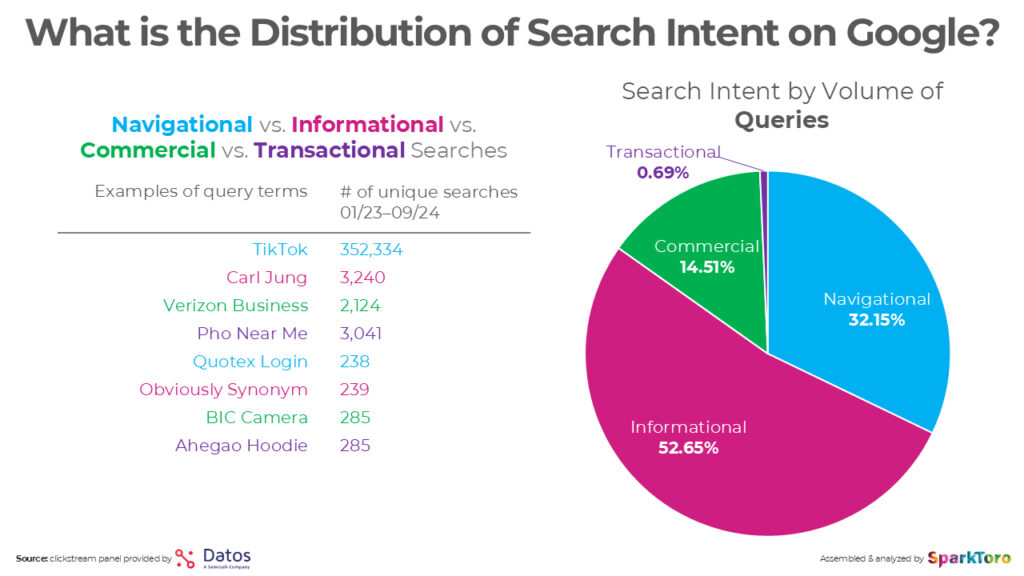
Notons que la distribution du volume de recherches diffère significativement de la distribution des mots-clés uniques. Les recherches navigationnelles, notamment, représentent une proportion beaucoup plus importante en termes de volume qu’en nombre de requêtes uniques. Cette différence s’explique par la répétition fréquente des mêmes recherches navigationnelles chez les utilisateurs qui veulent accéder à leurs sites favoris.
La domination du divertissement et des marques
Contrairement aux idées reçues, les catégories liées au divertissement dominent largement les recherches Google. Les acteurs, films, séries TV, artistes musicaux et jeux vidéo représentent environ 25% du volume total des recherches. Cette découverte expliquerait pourquoi Google investit autant dans l’expérience utilisateur pour ces types de contenus.
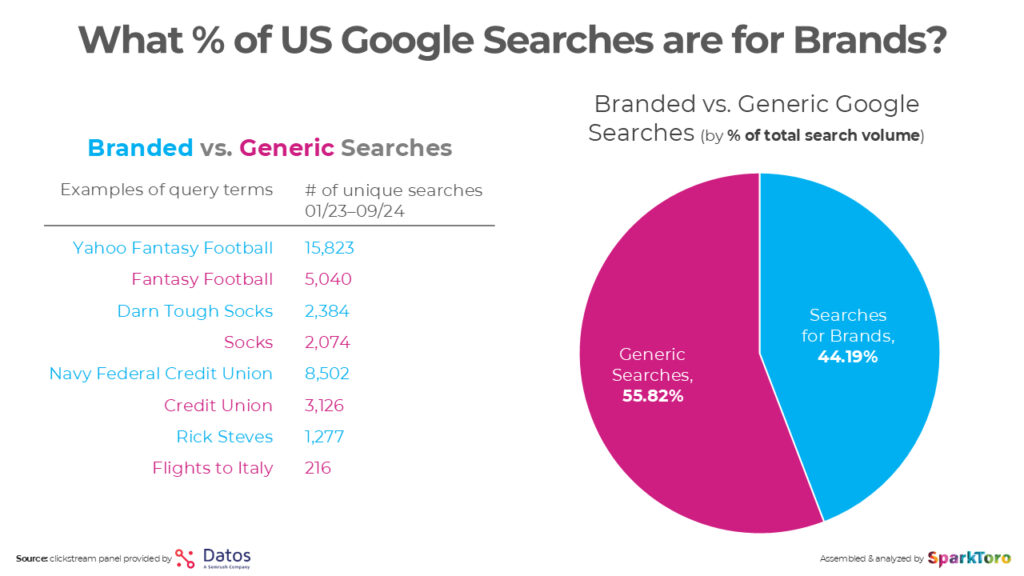
Par ailleurs, l’étude révèle que 44% des recherches concernent des marques, un chiffre inférieur aux estimations initiales, mais néanmoins significatif. Cette donnée suggère que Google est devenu la « page d’accueil » par défaut pour de nombreuses marques, soulignant l’importance cruciale de la gestion de la réputation en ligne.
Les implications pour le marketing digital
Ces différentes découvertes peuvent avoir des implications majeures pour les stratégies marketing. En substance, l’étude suggère qu’il est désormais plus avantageux d’être la marque recherchée que de tenter de se positionner sur des millions de variations de requêtes. Google est devenu un lieu où les utilisateurs se rendent après avoir identifié un besoin, plutôt qu’un espace de découverte de nouvelles marques ou services.
Par ailleurs, entre 60 et 70 % du volume total des recherches présente un potentiel de monétisation. Cependant, les domaines comme les arts et le divertissement, les jeux, l’éducation ou le contenu pour adultes, bien que représentant une part importante des recherches, restent difficiles à monétiser pour la majorité des éditeurs de sites et des entreprises. Par exemple, il est compliqué de vendre des produits dérivés à des personnes recherchant simplement des informations sur leur jeu vidéo favori ou leur célébrité préférée.
L’analyse met également en lumière l’évolution de l’écosystème de recherche. Les réponses directes de Google, y compris les aperçus IA, dominent déjà plusieurs des plus grandes catégories de recherche, notamment dans les domaines des arts et du divertissement, des jeux, du sport, de la finance et des contenus de référence. Cette tendance pourrait s’accentuer, poussant les entreprises à diversifier leurs stratégies de visibilité en ligne au-delà du référencement naturel traditionnel.
Autrefois, la recherche était considérée comme un excellent point de départ pour le marketing. Aujourd’hui, elle apparaît davantage comme la récompense d’un marketing efficace mené sur d’autres canaux. Les parcours de découverte se sont déplacés vers les réseaux sociaux, YouTube, les podcasts, les newsletters et les événements, suggérant la nécessité d’une approche marketing plus diversifiée et moins dépendante du SEO.
L’article “Étude exclusive : ce que révèlent 332 millions de recherches Google” a été publié sur le site Abondance.