Elle aura duré 23 jours et 13 heures… Ainsi se termine la Google Core Update de Novembre de l’année 2024 ! Chers amis SEO, il est temps de faire le bilan (même si, selon Google, il faudrait attendre encore 1 semaine). Alors, qu’est ce qu’on fait maintenant ?
Ce qu’il faut retenir :
- La Core Update a débuté le 11 novembre 2024 et s’est terminée le 6 décembre 2024.
- Si vous êtes patient, Google vous recommande d’attendre d’avoir 1 semaine de “données post-update” pour vous lancer dans des analyses.
- Priorisez les plus fortes chutes, sur les mots-clés avec le plus de volume de recherche.
- Repérez les patterns potentiellement “spammy” ou sur-optimisés sur vos pages et dans vos contenus.
Google met fin à sa Core Update de Novembre 2024
Clap de fin du roll-out ce 5 décembre ! L’annonce a été donnée par le biais du compte X (Twitter) de Google Search Central :
This roll-out is now complete.
— Google Search Central (@googlesearchc) December 5, 2024
Retrouvez toutes les dernières updates de Google sur notre page dédiée.
Analyser son SEO après une update : les recos de Google (et d’Abondance)
Comme évoqué dans notre dernier à l’article à l’annonce de la sortie de la Core Update de Novembre, Google a enrichi sa documentation quant à ce qu’il recommande de faire une fois la Core Update terminée. Nous avons complété ces recommandations :
Attendre pour avoir 1 semaine de “données post-update”
Google vous recommande d’attendre encore 1 semaine ! Si vous êtes de nature patiente, alors optez pour cette stratégie : attendez 1 semaine complète pour comparer la semaine qui viendra de s’écouler à la semaine qui précède le déploiement.
Pas clair ? Attendez le lundi 16 décembre pour comparer la semaine du 6 au 13 décembre à la semaine du 1er au 8 novembre 2024. C’est mieux ?  Ainsi, vous analysez le SEO de 2 semaines complètes, du vendredi au vendredi, juste avant et juste après la mise à jour du coeur de l’algo de Google.
Vous êtes impatient comme nous ? Keep reading 
Trier les données de positionnement pour identifier les plus fortes chutes
On vous souhaite de n’avoir connu que des hausses de positionnement… Mais dans le cas contraire :
- RDV dans votre outil de positionnement préféré (coucou Monitorank) ou dans le rapport “Performance” de la Google Search Console,
- Triez vos mots-clés par volumes de recherche (pour les outils de positionnement) ou par impressions (pour la Search Console) afin de commencer vos analyse par les mots-clés les plus générateurs de trafic,
- Concentrez-vous sur les variations de positionnement les plus conséquentes : Google indique, par exemple, qu’une baisse de la 2ème position à la 4ème position ne doit pas entraîner de mise à jour de votre stratégie, au contraire, un contenu bien positionné doit être protégé. Selon nous, vous devez prioriser les mots-clés qui ont chuté de plus de 10 positions.
Analyser les changements SEO majeurs chez les concurrents
On ne le répétera jamais assez : une baisse de positionnement ne veut pas forcément dire que vous avez fait quelque chose de mauvais… Parfois ce sont les concurrents qui ont fait quelque chose de très bien ! Vous avez donc deux hypothèses : soit vous avez fait quelque chose de mauvais, soit les concurrents ont fait quelque chose de bien.
En analysant les changements effectués par vos concurrents sur les 6 derniers mois, vous pourrez repérer des bonnes pratiques à côté desquelles vous êtes peut-être passé. Si vous êtes utilisateur de Ahrefs, accédez au rapport “Meilleures pages” de vos concurrents : vous y trouverez une indication des modifications “majeures” ou “mineures” sur les URL :
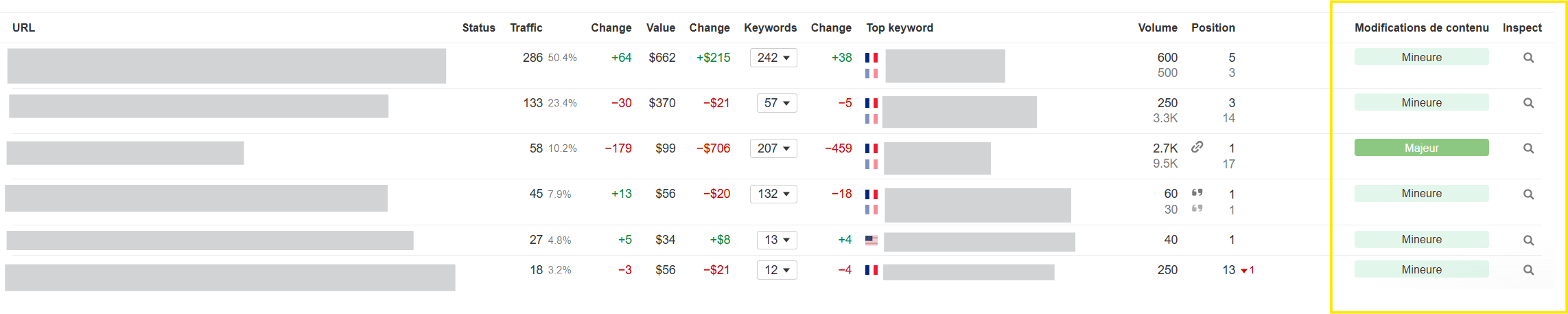
Utilisez la Wayback Machine, en complément, pour comparer les changements sur les pages de vos concurrents (attention, WM ne sauvegarde pas toutes les pages, vous n’aurez peut-être pas la donnée).
Enfin, n’oubliez pas le netlinking ! Analysez vos liens et ceux des concurrents, afin d’identifier des actions significatives dans les derniers mois.
Faire un audit honnête de la qualité de vos pages
Les Core update traitent principalement de la pertinence et de la légitimité d’un résultat vs un mot-clé. Faites un audit honnête et lucide de l’état de votre contenu : est-il vraiment utile ? apporte-t-il quelque chose de différent que celui de votre concurrent ? est-il sourcé ? adresse-t-il bien l’intention de recherche ?
Pour vous aider, nous avons compilé la liste des “questions relatives à la qualité des contenus” de Google dans un Notion. Vous pourrez évaluer la qualité globale des contenus de votre site (dupliquez le modèle dans votre propre Notion pour pouvoir l’utiliser, icône de copie en haut à droite de la page) :
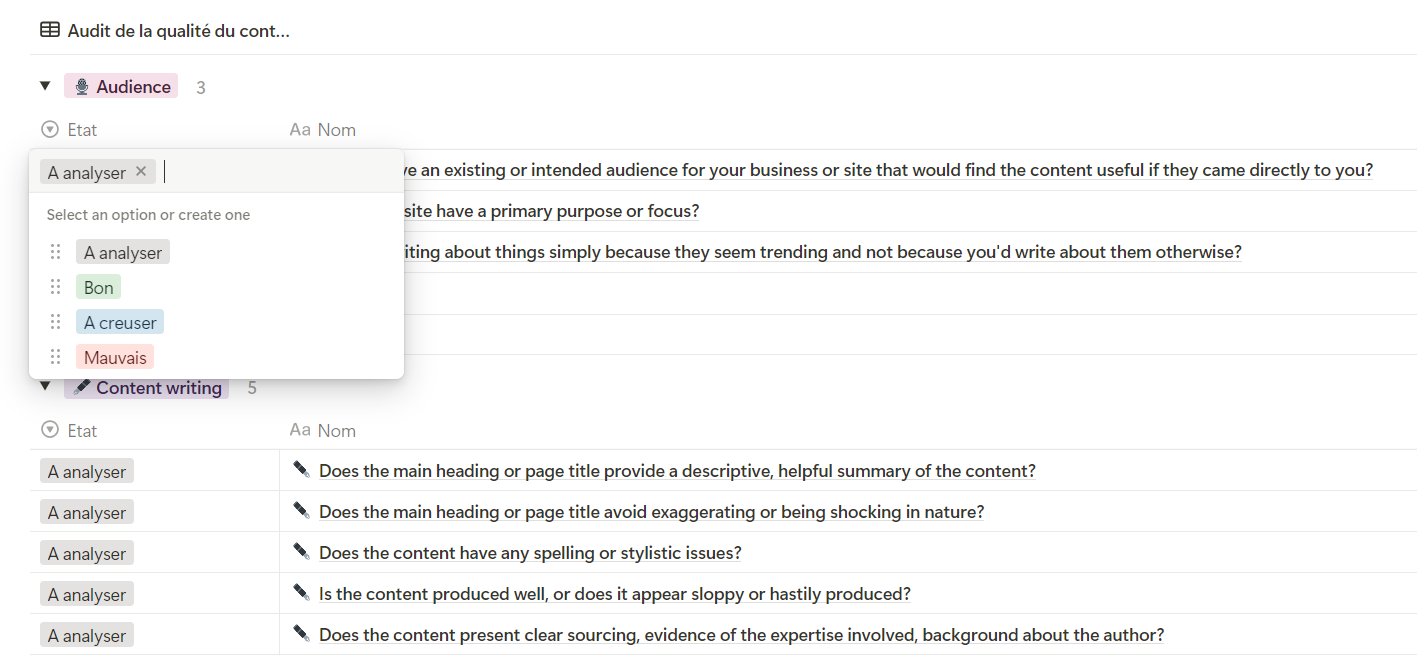
Une fois l’analyse terminée, priorisez vos chantiers d’améliorations SEO en fonction des problématiques identifiées : content gap, niveau d’expertise, contenu “people-first”, etc.
Repérer les patterns qui pourraient poser problème
L’analyse est parfois complexe car elle demande de prendre du recul sur votre site web, un oeil externe peut aider à repérer les problèmes au travers d’un audit SEO, mais elle est indispensable si vous constatez des fortes baisses de positionnement.
Avez-vous un énorme bloc de contenu informationnel sur une page transactionnelle comme une page catégorie e-commerce ? Manque-t-il des infos de contact sur la page locale d’un de vos magasins ? Y’a-t-il une duplication sur l’ensemble de vos pages ? Vos pratiques peuvent-elles paraitre spammy aux yeux du moteur de recherche ?
Explorez toutes les possibilités et essayez de trouver ces fameux patterns : des pratiques communes aux pages qui ont été impactées par l’Update.
[Rappel] Ce qu’on vous déconseille :
- Supprimer des contenus : une mise à jour du contenu est parfois plus efficace, pas de décisions radicales !
- Appliquer les stratégies des autres SEO impactés. Chaque site est unique ! Après la mise à jour, analysez ce qui a du sens pour vos utilisateur plutôt que d’appliquer ce qu’appliquent les autres SEO sur leurs propres sites, ce qui marche pour eux pourrait ne pas marcher pour vous.
Besoin d’aide ? Nos experts SEO seniors se tiennent à votre dispo pour un audit SEO

L’article “Core Update de Novembre, c’est fini ! On fait quoi maintenant ?” a été publié sur le site Abondance.