Avec l’émergence des agents IA capables de réaliser des recherches approfondies, le paysage de la recherche en ligne adopte une nouvelle forme. Ces outils promettent des analyses détaillées en quelques minutes, remettant en question la suprématie des moteurs de recherche traditionnels comme Google. Quel sera l’impact potentiel de ces innovations sur le secteur de la recherche en ligne ?
Ce qu’il faut retenir :
- Les agents de recherche approfondie, comme Deep Search d’OpenAI, réalisent des analyses détaillées en quelques minutes, réduisant le besoin de multiples recherches manuelles.
- Google a lancé en version bêta son mode IA, une réponse directe à ces nouveaux agents, mais son impact sur le trafic des sites web traditionnels suscite des inquiétudes.
- La personnalisation et l’interaction conversationnelle offertes par ces agents pourraient redéfinir la manière dont les utilisateurs accèdent à l’information en ligne.
Depuis l’avènement des moteurs de recherche, notre manière d’accéder à l’information a été transformée. Google, en particulier, s’est imposé comme le leader incontesté, répondant à des milliards de requêtes quotidiennes. Cependant, l’émergence récente d’agents de recherche basés sur l’intelligence artificielle, capables de fournir des rapports détaillés en un temps record, pourrait bien bouleverser cet équilibre. Ces innovations technologiques posent la question de l’avenir des moteurs de recherche traditionnels et de leur capacité à s’adapter à ces nouveaux défis.
Les agents de recherche approfondie : une révolution en marche
Les agents de recherche approfondie, à l’image de Deep Search développé par OpenAI, sont conçus pour synthétiser une vaste quantité d’informations en ligne et accomplir des tâches de recherche complexes pour l’utilisateur. Que ce soit pour une étude de marché, l’achat d’une voiture, la planification d’un voyage ou l’obtention d’un crédit, ces agents offrent des analyses détaillées en quelques minutes, économisant ainsi des heures de recherche manuelle.
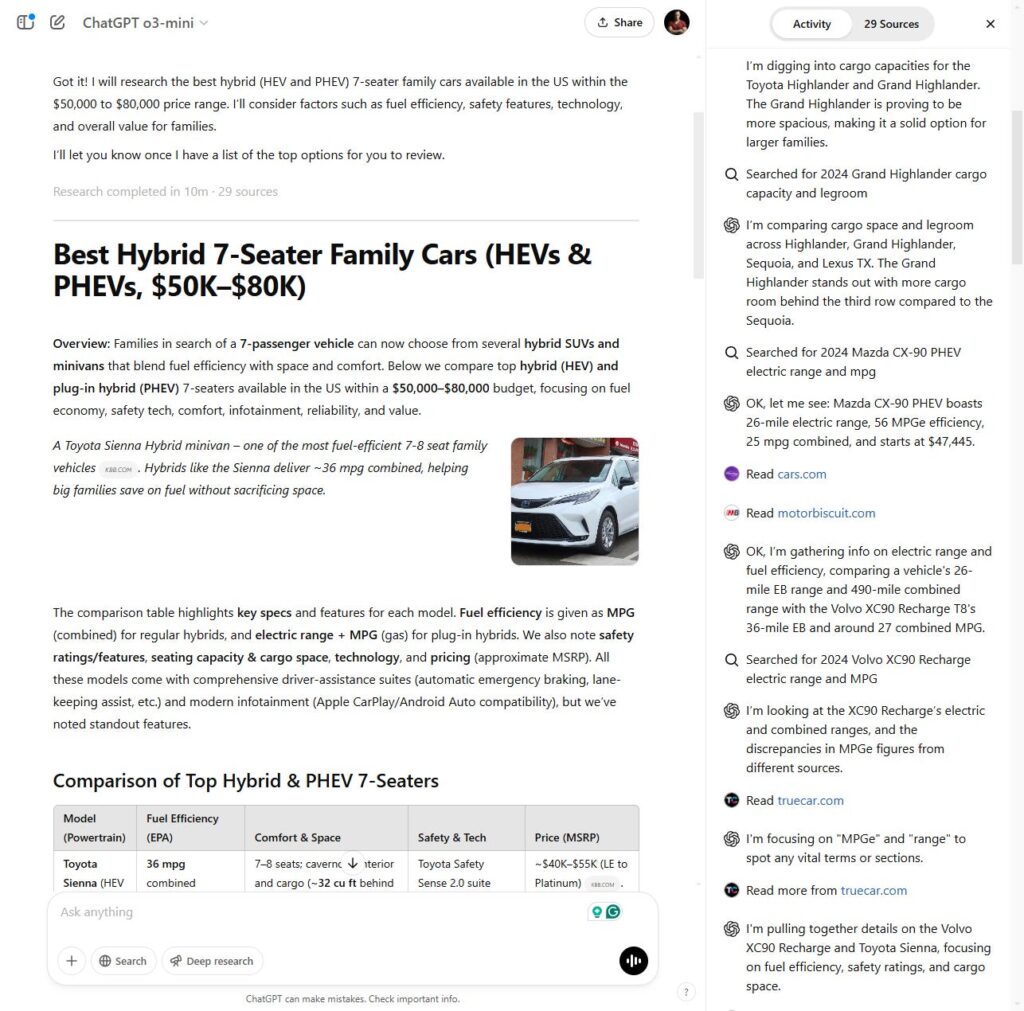
Par exemple, une requête sur « la meilleure voiture familiale hybride à 7 places dans une fourchette de prix de 50 000 à 80 000 dollars » a conduit Deep Search à consulter 41 résultats en ligne, à analyser des articles spécialisés et à comparer les capacités de chargement de différents modèles. Le rapport généré en 10 minutes a fourni une synthèse exhaustive, réduisant ainsi le besoin pour l’utilisateur de parcourir individuellement chaque source.
Les avantages des agents de recherche approfondie
Plusieurs facteurs expliquent pourquoi les agents de recherche approfondie pourraient redéfinir le paysage de la recherche en ligne :
- Efficacité et gain de temps : Ces agents fournissent des réponses complètes en quelques minutes, éliminant le besoin de réaliser de multiples recherches manuelles.
- Personnalisation : Ils offrent la possibilité de personnaliser les sources consultées et les critères de recherche, offrant une expérience adaptée aux besoins spécifiques de chaque utilisateur.
- Interaction conversationnelle : Similaire à une interaction avec un vendeur en magasin, ces agents permettent un échange interactif, où l’utilisateur peut approfondir certains aspects selon ses besoins.
- Adoption par d’autres moteurs de recherche : Des moteurs comme Bing ont déjà intégré des fonctionnalités similaires, indiquant une tendance forte vers l’adoption généralisée de ces agents pour les requêtes complexes.
L’impact potentiel sur Google et les moteurs de recherche traditionnels
L’efficacité et la rapidité des agents de recherche approfondie constituent une menace potentielle pour les moteurs de recherche traditionnels. Ces agents réduisent le nombre de clics nécessaires pour obtenir une réponse complète, ce qui pourrait considérablement diminuer le trafic vers les sites web et, par conséquent, les revenus publicitaires des moteurs de recherche.
En réponse, Google a lancé en version bêta son « mode IA », une version améliorée de ses aperçus d’intelligence artificielle. Cependant, des études ont montré que ces aperçus d’IA détournent davantage de clics des résultats de recherche classiques qu’ils n’en redirigent vers les sources citées. Cela suggère que le mode IA pourrait accentuer la diminution du trafic vers les sites web traditionnels, exacerbant ainsi les défis déjà posés par les agents de recherche approfondie.
Bing : un nouvel acte dans l’évolution des agents de recherche approfondie
En décembre 2023, Bing a introduit une fonctionnalité nommée « Deep Search », visant à fournir des analyses détaillées et rapides aux utilisateurs. Cette initiative positionne aujourd’hui Bing comme un acteur majeur dans l’évolution des agents de recherche approfondie, offrant une alternative aux outils développés par des entreprises concurrentes.
La technologie Deep Search de Bing est conçue pour effectuer des recherches complexes en un temps réduit, bien que sa profondeur d’analyse soit légèrement inférieure à celle de l’agent de recherche de ChatGPT. A noter que Grok possède également sa propre fonctionnalité Deep Search. De leur côté, Gemini et Perplexity disposent d’une fonctionnalité « Deep Research ». Difficile de nier ce changement de paradigme que rien ne semble désormais pouvoir arrêter !
L’article “Deep Search, Gemini, Perplexity… Les nouveaux géants de la recherche en ligne arrivent” a été publié sur le site Abondance.