Le développement du numérique dans notre société et le « booste » que lui a donné la crise de la COVID-19 fait qu’un certain nombre de personnessouhaitent se lancer dans le e-commerce. Pour beaucoup, c’est une solution pour arrondir ses fins de mois, pour d’autres le « nirvana » pour faire rapidement de l’argent Un moyen de se faire de l’argent rapidement.
Cependant, créer une boutique en ligne n’est pas si simple. Cela demande des compétences en webmarketing, en relations clients et communication. Il faut être un peu « community manager » et maitriser la création de site Internet et le référencement naturel.
Gérer un site d’e-commerce est un métier qui demande d’être en capacité de se multiplier… Mais si la motivation est là, vous trouverez dans cette activité professionnelle une réelle satisfaction.
Dans cet article, Codeur.com vous donne quelques clefs pour réussir votre mise en route. Si vous avez besoin d’aide pour le développement de votre site e-commerce, faites appel à un développeur spécialisé dans le e-commerce !
Qu’est-ce que le e-commerce ?
Le e-commerce porte plusieurs noms… commerce électronique, vente en ligne, ou même boutique en ligne. C’est une manière de vendre en passant par l’intermédiaire du Web. La transaction entre le vendeur et l’acheteur est exclusivement digitale.
De la commande à la livraison, vous ne rencontrez jamais personne de manière physique à l’exception (peut-être) du livreur !
La vente en ligne se pratique de différentes manières. Soit directement à partir d’un site Internet d’e-commerce, ou d’un site vitrine avec extension vers une page e-commerce ou à travers des Marketplace, et les médias sociaux.
Les différentes formes d’e-commerce
On y retrouve les mêmes formes que dans le commerce physique à commencer par la vente en B2B. Le Business to Business est une forme de commerce qui se fait vers des clients professionnels. Des entreprises font appel à des prestataires de livraison par exemple, nous sommes dans le B2B. Le B2C est un échange commercial entre des particuliers et des professionnels.
Le Business to Consumer est une forme de commerce que nous retrouvons dans la plupart des cas. Supermarché, magasins de vêtements et bien sûr tous les commerces en ligne qui proposent des services ou biens à des particuliers.
Le C2C est une forme de commerce qui se fait entre particuliers. On retrouve ce type de transaction dans les services à domiciles, mais aussi avec Airbnb, et les plateformes de vente de produits d’occasions comme le boncoin.
Les différents schémas de commerces
Il y a plusieurs manières d’envisager son développement commercial. Différents schémas de vente sont possibles. En voici quelques-uns :
Vendre les produits que l’on fabrique
Plutôt réservé à ceux qui ont un talent, une compétence dans un domaine artistique ou artisanal. C’est aussi une possibilité pour ceux qui s’installent dans un domaine industriel.
Vendre avec le dropshipping
C’est une tendance qui se développe depuis quelques années. C’est de la vente sans stock. Vous servez d’intermédiaire en quelque sorte entre le fournisseur et le client. Au passage, vous prenez une marge qui paye votre travail de vendeur.
Vendre grâce à l’affiliation
Par exemple, avec Amazon. Un site d’affiliation est e-commerce qui donne la possibilité de vendre des produits Amazon pour gagner de l’argent sous forme de commissions. Comme le dropshipping, il n’y a pas de stock.
Vendre sur une marketplace
Amazon, Cdiscount sont des marketplaces. Vous positionnez vos produits sur leur site, et vous profitez de l’impact de ces géants pour développer votre commerce. Il faut cependant laisser un % de votre marge à la structure choisie.
Vendre vos services en ligne
Vous avez un talent, une compétence, un diplôme qui vous le permet, vous pouvez proposer vos services en ligne (cours particuliers, séance de coaching, cours de yoga…)
Les avantages du e-commerce
Une boutique en ligne sera parfois compliquée à gérer, ne remplira pas toujours tous les critères que l’on pensait, mais se lancer dans un e-commerce, vous permettra d’une part de vous installer comme entrepreneur et surtout vous donnera la possibilité de pousser les lignes géographiques au-delà du local.
Vous allez pouvoir proposer vos produits et services sur le territoire national et plus encore.
Pour un certain nombre d’entre vous, les supports physiques est les locaux ne seront pas utiles. C’est donc un gain de coût non négligeable.
Les outils marketing ainsi que le numérique vous donnent la possibilité de traiter la promotion de votre business de manière rapide, précise et moins chèrequ’avec les méthodes traditionnelles.
Les outils technologiques vous donnent des moyens de « veilles » très poussés et vous permettent de rester au plus près de votre cible. C’est un avantage considérable en termes de développement.
Autre plus à considérer, votre commerce est ouvert 24 h sur 24 et toute la semaine. Vos clients ont ainsi la possibilité d’acheter de n’importe où et à n’importe quelle heure.
12 conseils vous développer votre e-commerce
1. Déterminez votre offre
Il est important de définir quelle sera votre offre. Sachez qu’il n’est pas positif de s’éparpiller… En effet, si vous proposez des services de coaching sportif, vous pouvez aussi compléter par des produits naturels destinés à l’entretien de vos muscles ou pour maigrir par exemple.
Mais on fera certainement moins confiance à une esthéticienne qui propose en parallèle de vous vendre des pots de confiture. Il faut rester « logique » et proposer une activité ou un service qui se trouve dans un secteur précis. Pensez à étudier votre marché afin de mettre en relief les concurrents, analyser leurs offres et tenter de vous démarquer soit par le prix, soit par le service…
2. Faire le choix de votre nom de domaine
Vous allez vous lancer dans le e-commerce. Vous devez alors très probablement créer un site Internet. Votre nom de domaine sera votre identifiant sur internet. La manière dont vous allez vous déterminer sera très importante. Exemple de nom de domaine : Codeur.com
Pour vous aider à choisir le vôtre, voici quelques conseils :
- Choisir un nom court afin qu’il soit facile à lire.
- De préférence, votre nom de domaine doit indiquer votre marque ou avoir un lien avec votre offre de produit ou services. Par exemple : nike.fr, mcdonald.fr ou même gerermesfinances.fr
- Bien sûr votre nom doit-être unique. Vous pouvez le vérifier sur les moteurs de recherche.
3. Étudier la concurrence
Evaluer vos concurrents sera un premier pas pour trouver comment vous démarquer et aborder la croissance de votre e-commerce. Face à 157 300 sites marchands français, vous devez analyser vos forces et vos faiblesses, pour mettre en place une stratégie différente et performante. C’est votre meilleure chance de réussir !
4. Choisir la solution e-commerce adaptée à vos besoins
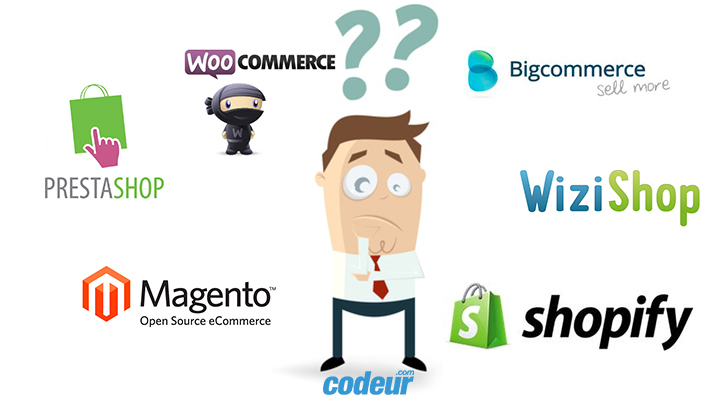
WordPress, Magento, Prestashop, Wizishop, ZenCart…
Les plateformes pour créer votre boutique en ligne ne manquent pas ! Étudiez bien tous les outils qui sont à votre disposition, leurs avantages et leurs inconvénients, pour sélectionner celui qui correspond le mieux à vos besoins et à vos compétences en développement web.
5. Choisissez ou créez le design de votre site Internet
Votre site sera le reflet de votre commerce. Le design doit-être adapté et choisi en lien avec vos produits ou services. Vous pouvez choisir un cadre très tendance, ou plus rétro. Mettre en avant le côté « luxe » ou choisir une ambiance plus nature… Pour réussir à coller parfaitement à la tendance de votre business, vous devez commencer par créer une charte graphique en lien avec votre cible et la stratégie marketing que vous aurez établi pour développer votre e-commerce. Pensez aux couleurs, aux polices de caractères…
6. Mettez vos produits en valeur
Il y a une vraie différence entre l’achat en magasin où l’on peut toucher et voir le produit et l’achat en ligne ou les seuls repères sont les photos et les descriptifs. Il est dont primordial de bien choisir ses visuels et de donner le maximum de détails dans vos descriptifs. Présentez votre catalogue ainsi que vos produits de manière à faciliter le processus d’achat. C’est dans cet objectif que vos produits doivent comprendre ces 4 éléments :
- Le nom
- Une ou plusieurs photos
- Son prix
- Une description détaillée du produit.
7. Organiser votre stratégie SEO et marketing
Dès le départ, vous devez trouver l’axe de communication adapté à votre activité.
Selon votre cible et les produits vendus, vous devez réfléchir à une ligne éditoriale qui intègre des notions de référencement et un aspect commercial.
La définition de votre stratégie éditoriale passe tout d’abord par l’analyse des mots-clés utilisés par vos consommateurs.
Vous devez trouver les termes qu’ils vont entrer dans les moteurs de recherche, pour trouver des expressions ciblées, qui vont amener du trafic qualifié sur votre e-commerce. Pensez aussi aux mots-clés de longue traîne (expression de plus de trois mots), car ils sont souvent moins concurrentiels et drainent des visiteurs de plus grande qualité.
Quand vous avez défini les termes sur lesquels vous souhaitez positionner votre boutique, vous devez rédiger les pages et les fiches produits de votre e-commerce. Pensez à intégrer les mots-clés aux endroits stratégiques comme le titre, les sous-titres, les images, etc.

Enfin, les expressions sélectionnées devront aussi se retrouver dans les différents contenus de votre blog. C’est d’ailleurs ce dernier qui va vous apporter le plus de trafic et vous aider à booster votre visibilité dans les moteurs de recherche.
8. Développer votre communauté
Pourquoi attendre que votre e-commerce soit en ligne pour communiquer sur les réseaux sociaux ?
Plus tôt vous assurerez la communication de votre projet, plus vite vous ferez du chiffre d’affaires. Commencez dès maintenant à créer les profils sur les réseaux sociaux et à publier des articles sur des blogs collaboratifs pour faire connaître votre nom et vos futurs produits.
Au moment de l’ouverture de votre site marchand, vous aurez déjà acquis quelques consommateurs.
9. Créer un blog pour parler de votre projet
Voyez avec votre développeur web pour qu’il ouvre rapidement votre partie blog.
Vous pourrez publier régulièrement des billets intéressants sur le démarrage de votre aventure.
Cela va vous aider à accroître votre communauté, mais aussi à faire monter votre site dans les résultats des moteurs de recherche. En effet, le blog va influencer votre référencement naturel et, au moment de l’ouverture officielle de votre boutique en ligne, vous serez déjà positionné sur des mots-clés stratégiques.
10. Récolter des adresses mail
Préparez déjà un fichier de prospection en offrant à vos lecteurs la possibilité de s’inscrire à votre newsletter.
Pour assurer le succès de votre ouverture officielle, vous pourrez envoyer à tous vos fidèles abonnés un email qui annonce le lancement du site et, pourquoi pas, donner un code de réduction pour les remercier de leur soutien durant la mise en œuvre de votre projet.
11. Vérifier les 50 points de notre checklist

Dans un autre article, nous vous proposions 50 points à vérifier avant d’ouvrir votre e-commerce aux internautes. C’est donc le moment de consulter cette super checklist !
12. Trouver un prestataire pour la création de votre e-commerce
Pour être certain que votre site marchand soit opérationnel et vous rapporte rapidement des bénéfices, confiez sa réalisation à un spécialiste.
Sur Codeur, vous trouverez de nombreux développeurs e-commerce disposés à réaliser la boutique de vos rêves. Postez vite votre annonce avec les grandes lignes de votre cahier des charges et dénichez le freelance idéal !
Notre astuce pour lancer votre e-commerce
Grâce à ces 12 conseils, vous savez comment aborder votre projet e-commerce dans les grandes lignes.
Après avoir trouvé un partenaire web pour vous aider dans cette incroyable aventure, comme une agence ou un développeur spécialisé e-commerce, vous pourrez commencer à communiquer sur votre futur bébé et lancer alors votre entreprise avec succès !
Si vous avez d’autres conseils à partager avec les futurs web entrepreneurs, les commentaires vous tendent les bras !