The development of digital technology in our society and the 'boost' that the ... crisis gave it COVID-19 means that a certain number of people want to launch into e-commerce. For many, it's a way to supplement their income; for others, the 'nirvana' to make money quickly. A way to earn money fast.
However, creating an online store is not that simple. It requires skills in web marketing, customer relations, and communication. You have to be something of a 'community manager' and master website creation and SEO.
Managing a site e-commerce is a profession that requires being able to multiply yourself… But if the motivation is there, you will find real satisfaction in this professional activity.
In this article, Codeur.com gives you some keys to successfully get started. If you need help developing your e-commerce site, call on a developer specialized in e-commerce !
What is e-commerce?
E-commerce goes by several names… electronic commerce, online selling, or even online store. It's a way of selling via the Web. The transaction between the seller and the buyer is exclusively digital.
From ordering to delivery, you never meet anyone in person except (perhaps) the delivery driver!
Online selling is practiced in different ways. Either directly from a website e-commerce, or from a showcase site with a link to an e-commerce page or through marketplaces, and social media.
Different forms e-commerce
You find the same forms as in physical commerce, starting with B2B sales. Business to Business is a form of commerce aimed at professional clients. Companies use delivery service providers, for example — that's B2B. B2C is a commercial exchange between individuals and businesses.
Business to Consumer is a form of commerce that we find in most cases. Supermarkets, clothing stores and of course all online businesses that offer services or goods to individuals.
C2C is a form of commerce that takes place between individuals. We find this type of transaction in home services, but also with Airbnb, and platforms for selling second-hand products like leboncoin.
Different commerce models
There are several ways to consider your commercial development. Different sales models are possible. Here are a few:
Selling the products you make
Rather reserved for those who have a talent or a skill in an artistic or craft field. It's also an option for those who set up in an industrial sector.
Sell with dropshipping
It's a trend that has been developing for a few years. It's selling without stock. You act as an intermediary of sorts between the supplier and the customer. In the process, you take a margin that pays for your work as a seller.
Sell through affiliate marketing
For example, with Amazon. An affiliate site is an e-commerce site that allows you to sell Amazon products to earn money in the form of commissions. Like dropshipping, there is no inventory.
Sell on a marketplace
Amazon and Cdiscount are marketplaces. You list your products on their sites and benefit from the reach of these giants to grow your business. However, you must give a percentage of your margin to the chosen platform.
Sell your services online
If you have a talent, skill, or a diploma that allows it, you can offer your services online (private lessons, coaching sessions, yoga classes, etc.).
The advantages of e-commerce
An online store can sometimes be difficult to manage and won’t always meet every expectation, but launching an e-commerce business will allow you to establish yourself as an entrepreneur and, above all, give you the opportunity to expand geographically beyond the local area.
You will be able to offer your products and services nationwide and even further.
For some of you, physical assets and premises will not be necessary. That represents a significant cost saving.
Marketing tools as well as Digital tools give you the ability to to process promote your business quickly, more precisely and at lower costmore effectively than with traditional methods.
Technological tools provide you with very advanced monitoring capabilities pushed and allow you to stay as close as possible to your target audience. This is a considerable advantage for growth.
Another advantage to consider is that your business is open 24 h 24 hours a day, all week. Your customers have thus the possibility to buy any wherever and at any time.
Checklist before launching an e-commerce site
SEO
- Have a keyword in the URL (not mandatory but useful),
- Optimize title tags,
- Optimize meta descriptions,
- Install an SEO plugin if necessary,
- Create and submit a sitemap,
- Find long-tail keywords to attract qualified traffic,
- Optimize your product pages for search engines and users: at least 100 words, no supplier descriptions or duplicated content,
- Optimize images for SEO,
- Simplify URLs,
- Optimize internal links,
- Optimize category descriptions.
Avoid friction
- Avoid the homepage slider (makes scrolling difficult),
- Clearly display the price on your products,
- Avoid surprises (hidden shipping fees, etc.),
- Display your products properly: image/video (be original),
- Keep the shopping cart visible and always accessible,
- Make your information visible,
- Display accepted payment methods,
- Highlight your guarantees,
- Showcase your well-known clients,
- Create very strong guarantees (double your money back if not satisfied),
- Simplify and test your checkout funnel so it has the “right number of steps”,
- Allow purchases without creating an account,
- Optimize the site's loading speed.
Site promotion
- Have a blog with articles (use Redacteur.com),
- Have a "Partners" page,
- Have a popup or a space for the newsletter,
- Have Facebook, Twitter and Google+ pages,
- Have a presence on price comparison sites,
- Have a presence on marketplaces,
- Be present on forums frequented by your target audience.
Navigation
- Be compatible with mobile phones and tablets,
- Offer complementary items on your product pages,
- Invite users to follow you on the thank-you page (after purchase),
- Provide quick access to top-selling items,
- Provide an easy-to-understand menu (e.g., illustrate product types),
- Make CTAs visible (call-to-action buttons),
- Inform visitors that they may be tracked via cookies.
Site analysis and monitoring
- Monitor pages that generate traffic loss,
- Find and highlight the most searched-for products that generate the most sales,
- Set up, monitor and optimize conversion rates,
- Set up, monitor and optimize your purchase funnels,
- Find popular and frequently used pages to boost the rest,
- Have a available providers for your e-commerce
Web Marketing
- Send a summary email after purchase (use it to promote),
- Follow up on abandoned shopping carts,
- Reward loyalty with discounts,
- Use e-commerce marketing tools to prompt your visitors to take action,
- Use Codeur.com to improve your site and your marketing,
- Remember to re-engage dormant customers,
- Make offers on social networks,
- Use retargeting.
These 50 points can help you deepen your research and preparation before diving in. However, you will also need to think about the ongoing development of your sales, with adapted marketing strategies and constant evaluation of their impact on your turnover, stock management, etc.
Feel free to check this blog regularly for additional information on managing and growing your online store.
12 tips to grow your e-commerce
1. Define your offer
It is important to define what your offering will be. Know that it is not good to spread yourself too thin… Indeed, if you offer sports coaching services, you can also complement them with natural products intended for muscle care or weight loss, for example.
But people will likely trust a beautician less if she also tries to sell you jars of jam. You need to stay “logical” and offer an activity or service within a specific sector. Consider studying your market to highlight competitors, analyze their offers and try to differentiate yourself either by price or by service…
2. Choose your domain name
You are going to start in e-commerce. You must then very likely create a website. Your domain name will be your identifier on the internet. The way you choose it will be very important. Example of a domain name: Codeur.com
To help you choose yours, here are some tips:
- Choose a short name so that it is easy to read.
- Preferably, your domain name should indicate your brand or be linked to your product or service offering. For example: nike.fr, mcdonald.fr or even gerermesfinances.fr
- Good of course Your name must be unique. You can check it on search engines.
3. Study the competition
Evaluating your competitors will be a first step to finding how to stand out and approach the growth of your e-commerce. Facing 157,300 French online stores, you must analyze your strengths and weaknesses to put in place a different and effective strategy. It's your best chance to succeed!
4. Choose the e-commerce solution that fits your needs
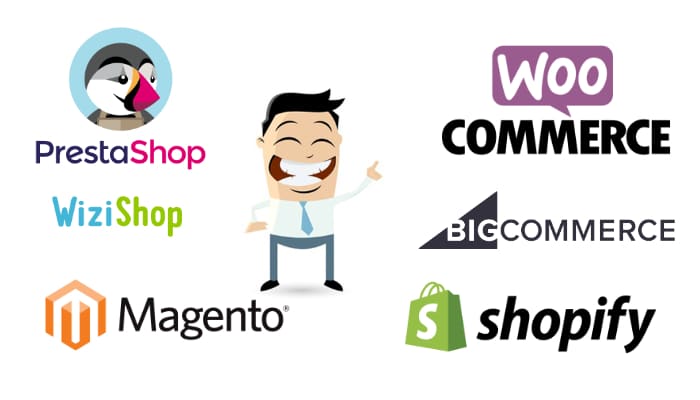
WordPress, Magento, Prestashop, Wizishop, ZenCart…
Platforms for create your online shop are plentiful! Study carefully all the tools available to you, their advantages and disadvantages, to select the one that best matches your needs and your web development skills.
5. Choose or create your website design
Your site will reflect your business. The design must be adapted and chosen in connection with your products or services. You can choose a very trendy layout, or a more retro one. Highlight the “luxury” side or opt for a more natural atmosphere… To succeed in perfectly matching your business’s trend, you should start by creating a visual identity that aligns with your target audience and the marketing strategy you will have established established to develop your e-commerce. Think about colors, fonts…
6. Showcase your products
There is a real difference between shopping in a store where where you can touch and see the product and shopping online where the only reference points are photos and descriptions. It is therefore essential to choose your visuals carefully and provide as many details as possible in your descriptions. Present your catalog as well as your products in a way that makes the purchasing process easier. To that end, your products should include these 4 elements:
- The name
- One or more photos
- Its price
- A detailed description of the product.
7. Organize your SEO and marketing strategy
From the start, you must find the communication angle suited to your business.
Depending on your target audience and the products sold, you should develop an editorial line that incorporates SEO concepts and a commercial aspect.
Defining your editorial strategy begins with keyword analysis used by your consumers.
You need to find the terms they will enter into search engines to identify targeted phrases that will bring qualified traffic to your e-commerce site. Also consider long-tail keywords (phrases of more than three words), as they are often less competitive and attract higher-quality visitors.
Once you have defined the terms you want your store to rank for, you must write the pages and the product pages of your e-commerce. Remember to integrate keywords in strategic places such as the title, subtitles, images, etc.

Finally, the selected phrases should also appear in the various contents of your blog. In fact, the blog will bring you the most traffic and help boost your visibility in search engines.
Also read: Faceted navigation: best practices for SEO
8. Grow your community
Why wait for your e-commerce site to be online before communicating on social networks?
The sooner you promote your project, the sooner you'll generate revenue. Start now by creating social media profiles and publishing articles on collaborative blogs to make your name and future products known.
By the time your online store opens, you'll already have acquired some customers.
9. Create a blog to talk about your project
Talk with your web developer so they can quickly enable your blog section.
You can regularly publish interesting posts about the launch of your venture.
This will help you grow your community and also improve your site's position in search engine results. Indeed, the blog will influence your organic search ranking and, by the time your online shop officially opens, you'll already be positioned for strategic keywords.
Also read: How to create an e-commerce site?
10. Collect email addresses
Prepare a prospecting list in advance by offering your readers the option to subscribe to your newsletter.
To ensure the success of your official launch, you can send all your loyal subscribers an email announcing the site's launch and, why not, give a discount code to thank them for their support during the implementation of your project.
11. Find a service provider to create your e-commerce site
To be certain that your online store is operational and quickly profitable, entrust its creation to a specialist.
On Codeur.com, you will find many e-commerce developers are ready to build the shop of your dreams. Post your ad quickly with the main points of your brief and find the ideal freelancer!
Our tip for launching your e-commerce
Thanks to these 61 tips, you now know how to approach your e-commerce project at a high level.
After finding a web partner to help you on this incredible journey, such as an agency or an e-commerce specialist developer, you can start promoting your upcoming project and successfully launch your business!