Google a récemment introduit une nouvelle fonctionnalité dans la Search Console : les recommandations SEO. Cette innovation offre aux webmasters des conseils personnalisés pour optimiser leurs sites web directement depuis leur tableau de bord.
Cependant, bien que cette nouvelle approche soit prometteuse, elle présente également certaines limites à prendre en compte…
Recommandations dans la Search Console : une fonctionnalité pratique
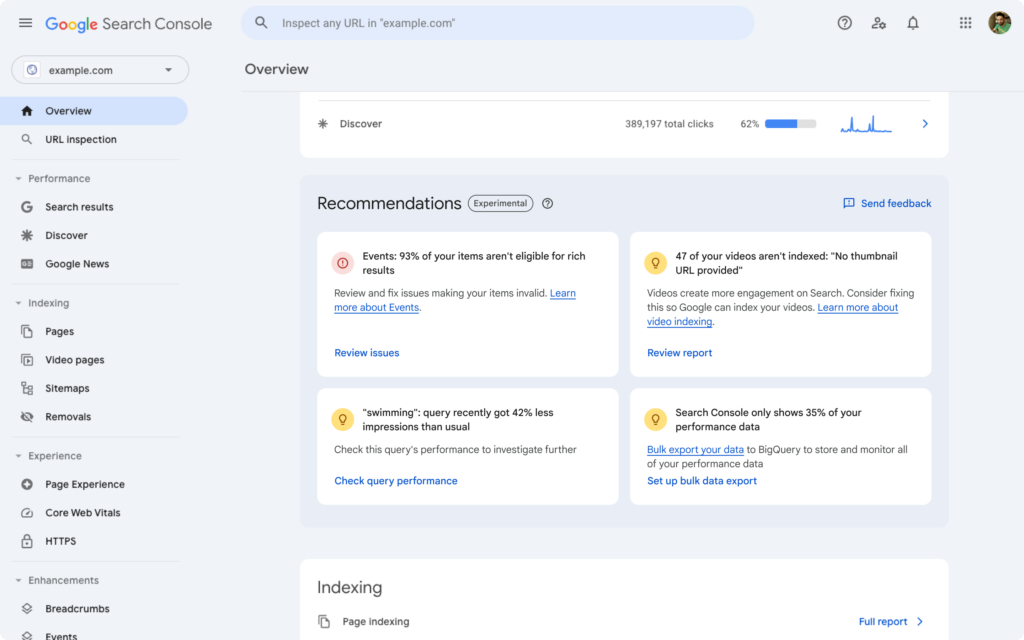
L’ajout de recommandations SEO à la Google Search Console marque une évolution significative dans l’accompagnement des propriétaires de site web. En effet, ce nouvel outil fournit des suggestions concrètes, directement applicables, afin d’améliorer la visibilité de vos pages dans les résultats de recherche.
Google propose ainsi trois types de recommandations :
- Problèmes : les éléments nécessitant une correction rapide, tels que des erreurs de serveur ou des contenus dupliqués.
- Opportunités : des recommandations pour améliorer le trafic organique, comme l’optimisation du contenu ou le SEO on-page.
- Configuration : les ajustements visant à faciliter la gestion du site dans la Search Console.
Chaque catégorie permet de prioriser les actions à entreprendre selon leur importance : vous vous concentrez ainsi sur les aspects les plus critiques de votre site.
Un déploiement progressif et limité dans la Search Console
Notez que cette fonctionnalité est encore en phase expérimentale. Google prévoit un déploiement progressif au cours des prochains mois. Cependant, toutes les propriétés du site ne bénéficieront pas immédiatement de ces recommandations. De plus, même après un déploiement complet, Google offrira des conseils uniquement lorsqu’ils seront jugés pertinents.
Les avantages et limites des recommandations dans la Search Console
Les recommandations SEO de la Search Console apportent une valeur ajoutée indéniable pour les webmasters en simplifiant l’identification des problèmes techniques. Cette fonctionnalité permet de gagner du temps et de recevoir des conseils personnalisés, de Google himself, pour améliorer sa visibilité dans les SERPs. Une nouveauté qui favorise une approche plus stratégique du référencement.
Néanmoins, ces recommandations ne couvrent pas l’ensemble des aspects du SEO et ne doivent pas être considérées comme une solution miracle. Les suggestions sont automatisées et peuvent parfois manquer de précision ou de pertinence dans des contextes spécifiques. Par exemple, la Search Console pourrait suggérer de corriger une erreur technique mineure qui, bien que valide, n’aura qu’un faible impact sur la performance globale du site.
Par ailleurs, il est essentiel de prendre du recul sur les actions proposées, en fonction des objectifs spécifiques de votre site. En effet, ce qui est pertinent pour un e-commerce ne l’est pas forcément pour un blog de tourisme. Les webmasters doivent donc combiner ces recommandations avec une analyse plus approfondie de leur site et de leur activité.
Un outil complémentaire à l’expertise humaine
Si ces recommandations sont un ajout précieux à la Search Console, elles ne remplacent pas l’expertise humaine. L’intervention d’un expert SEO reste essentielle pour interpréter correctement ces suggestions et les adapter de manière optimale à vos pages. Ces conseils restent un support à la prise de décision, mais ils ne se substituent pas à une stratégie de référencement complète et personnalisée.
De plus, l’optimisation SEO est un travail continu, qui nécessite sans cesse votre attention. L’idéal n’est pas d’attendre les recommandations de la Search Console : vous devez constamment intégrer les bonnes pratiques de Google, surveiller les KPI de votre activité et corriger les erreurs en temps réel.
Notre dernier conseil pour utiliser les recommandations SEO de la Search Console
Les recommandations de la Search Console faciliteront l’optimisation des sites web, en particulier pour les utilisateurs novices. Cependant, pour maximiser leur impact, intégrez ces suggestions dans un cycle régulier d’audits SEO.
Ces évaluations, à planifier périodiquement, vous permettent d’aller au-delà des simples alertes automatiques. Prenez les recommandations de la Search Console comme indicateurs de base, puis associez-les à des données provenant d’autres outils comme Google Analytics, pour obtenir une vision complète de l’évolution de votre positionnement.
Cette méthode proactive transforme les suggestions en un outil dynamique qui soutient efficacement votre stratégie SEO globale.
Enfin, si vous souhaitez aller plus loin dans l’optimisation de votre référencement, pensez à faire appel à des professionnels sur notre plateforme de rédaction, Redacteur.com. Nos spécialistes de la plume vous aident à créer des textes véritablement optimisés pour les moteurs de recherche.
L’article La Search Console vous propose désormais des recommandations est apparu en premier sur Redacteur.com.