Le content marketing n’a, de nos jours, plus ses preuves à faire : de nombreuses entreprises l’utilisent, démontrent sa rentabilité et il apparaît presque archaïque de parler d’inbound marketing comme d’une approche particulièrement innovante ou atypique. Reste qu’un sujet apparaît encore délicat à attaquer pour les entreprises : le contenu vidéo.
Trop complexe, trop cher et donc forcément pas assez rentable : les peurs sont nombreuses et forment autant d’excuses pour ne pas s’y investir, même pour les structures les plus matures en termes de marketing de contenu. Mais faire de la vidéo est-il aussi complexe que cela ? Comment mettre en place une stratégie efficace… et qui, surtout, dure sur le long terme ? À travers ce petit guide, tentons de poser les premières pierres de votre future stratégie.
Pourquoi faire de la vidéo ?
Sur le papier, c’est la question à laquelle il est le plus simple de répondre, pourtant les réponses sont plus complexes qu’il n’y paraît. Surtout : en lisant entre les lignes, vous allez comprendre en quoi la vidéo se différencie d’autres contenus et comment cela devrait conditionner votre stratégie en la matière.
Des plateformes porteuses d’audience
Non, le SEO ne va pas mourir comme le veut ce marronnier circulant dans n’importe quel média marketing depuis désormais plus d’une décennie. Non, les réseaux sociaux non plus ne vont pas disparaître et ne sont pas qu’un effet de mode : les géants du secteur sont installés depuis bien longtemps et sont désormais indispensables dans les stratégies marketing de nombreux groupes. Reste que nier le fait qu’une partie du public s’informe désormais plus sur TikTok et YouTube que sur Google ou Facebook est autant une erreur que de jouer les oiseaux de mauvaise augure.
TikTok a été régulièrement décrit, au cours des derniers mois, comme le nouveau moteur de recherche de référence pour la Gen Z. Des titres bien grandiloquents, qui sont néanmoins représentatifs d’une tendance de fond : le public n’est désormais plus exclusivement à aller chercher sur des sites de façon classique.
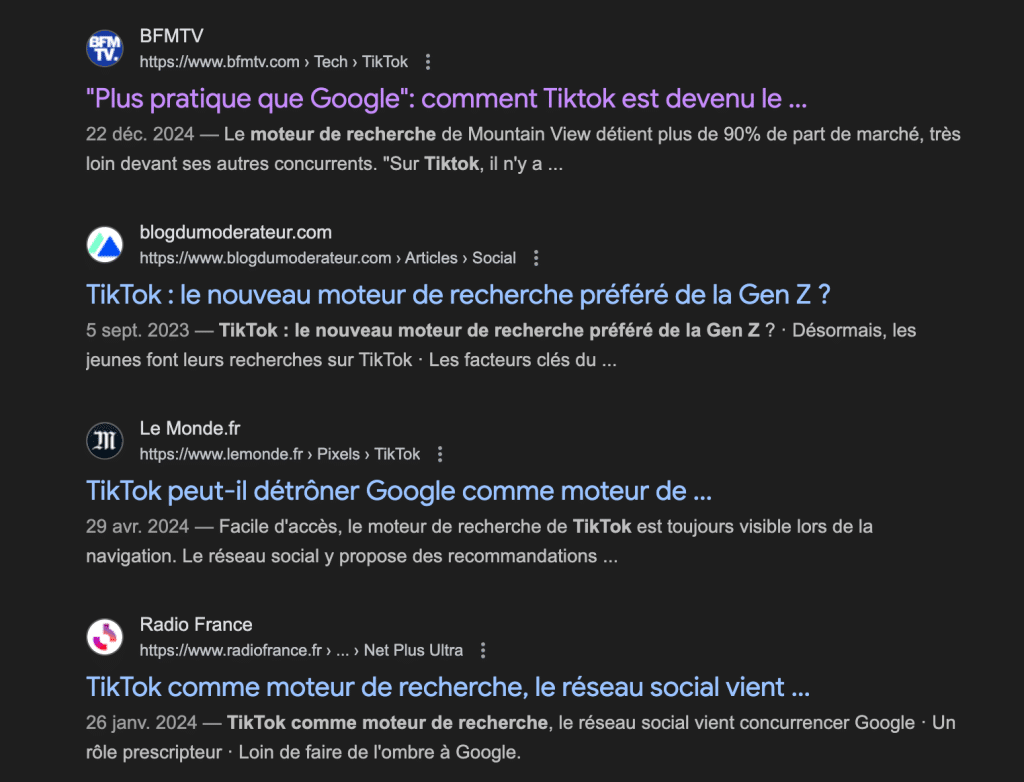
Si TikTok est encore aujourd’hui très assimilé à un public jeune, cela évolue très fortement et le développement de médias de référence comme Les Échos ou Le Monde sur la plateforme, à travers des contenus très qualitatifs, le montre bien. Se développer sur TikTok, c’est toucher une audience à un endroit où vos concurrents ne sont pas. À terme, cela pourrait également vous permettre de toucher une audience difficilement atteignable ailleurs.
Bien évidemment, la logique avec YouTube est la même. La plateforme, appartenant à Google, est néanmoins plus mature, touche un public relativement universel et les stratégies de contenu y sont plus abouties chez les annonceurs. Cela ne la rend pas moins pertinente pour toucher une audience de plus en plus complexe à atteindre sur d’autres plateformes. La généralisation de l’intelligence artificielle, qui résumera et anonymisera vos contenus textuels, ne fera qu’accroître la tendance.
Le lien unique que cela crée
L’attachement à une marque est important, c’est souvent ce qui va vous faire choisir un produit ou un service par rapport à un autre. C’est quelque chose que la plupart des entreprises cherchent à développer en mettant en avant leurs valeurs, leur histoire et, finalement, tout élément différenciant par rapport à la concurrence. Certains acteurs choisissent même l’incarnation de la marque par une mascotte pour lui donner un côté sympathique, rapidement identifiable. Reste qu’en la matière, rien ne vaut la vidéo.
Vous aurez beau lire 40 articles d’un rédacteur, il est assez rare que vous développiez pour cette plume un affect particulier. Alors, bien évidemment, votre sensibilité à son style d’écriture fera peut-être que vous apprécierez retrouver des articles portant sa signature, mais c’est sans commune mesure avec le lien créé par une équipe ou une personne que vous voyez chaque jour en vidéo.
L’exemple le plus parlant est sans doute le présentateur télé. Prenons, par exemple, Jean-Pierre Pernaut, connu pour avoir présenté le journal de 13 heures de TF1 pendant plus de 30 ans. Il était devenu, pour de nombreux Français, une figure connue ; on pourrait presque pousser la chose en disant que c’était quasiment un « membre de la famille » pour des foyers l’ayant regardé tous les midis pendant des années.
Selon vos choix en termes de contenu vidéo, vous aurez ainsi la possibilité d’instaurer une figure récurrente qui vous permettra d’incarner votre marque, d’identifier humainement cette dernière et donc de développer un lien privilégié avec vos clients et prospects.

Répondre aux nouvelles manières de consommer
Qu’on s’en attriste ou qu’on l’observe de façon neutre, force est de constater que les articles longs semblent de plus en plus être réservés à une niche pouvant investir l’énergie nécessaire à leur lecture… d’autant plus lorsque l’on se trouve sur des supports numériques. Produire un contenu vidéo, au-delà de la plateforme sur laquelle vous allez le diffuser, vous permet de transmettre un contenu facilement consommable, même quand il est extrêmement riche en informations.
Tentez de retranscrire un podcast en format écrit et vous allez rapidement comprendre pourquoi certaines prises de parole se prêtent mieux aux formats audio et/ou visuels. Même au-delà de cet exemple extrême, des formats courts d’une minute sauront bien souvent capter l’attention de façon bien plus efficace qu’un équivalent textuel. Toucher votre cible est une chose, réussir à accrocher son attention une fois qu’elle arrive sur votre contenu en est encore une autre. Sur ce point, la vidéo est généralement un facilitateur.
Des contraintes réelles, mais mal évaluées
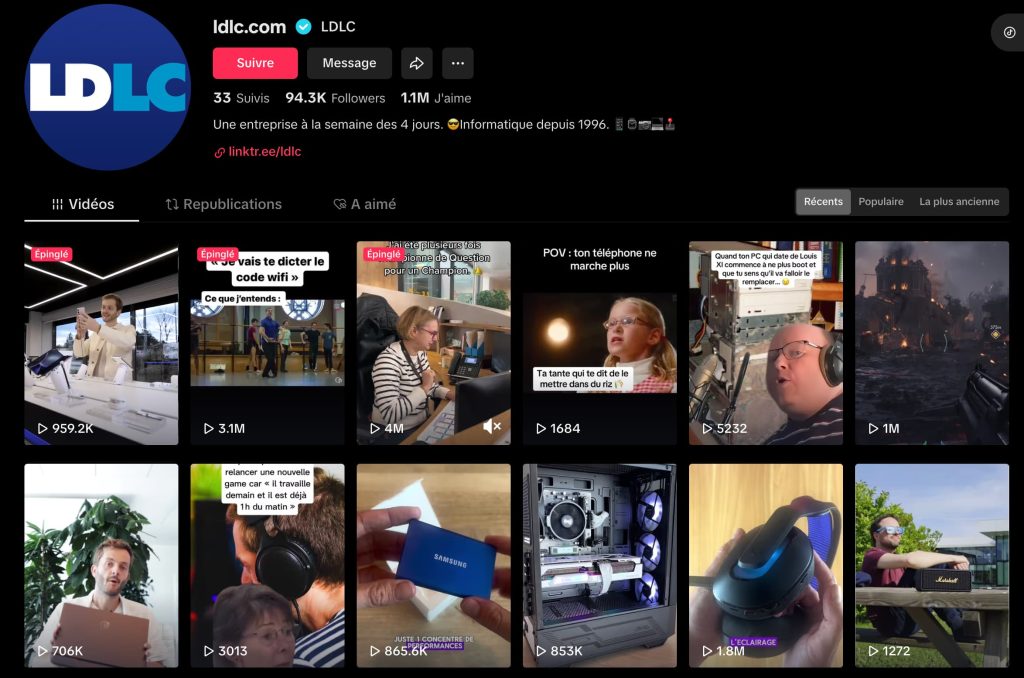
Dans l’immense majorité des cas, ce qui pousse les entreprises à ne pas se lancer dans la création vidéo, c’est souvent le manque de moyens. Ce n’est pour autant pas insurmontable et, plus intéressant encore : la créativité peut parfois émerger de ces contraintes.
Les contraintes techniques, souvent sur-estimées
La vidéo, c’est forcément plus complexe à produire qu’un article écrit. Pour autant, nous y reviendrons dans un article dédié aux contraintes techniques, ces dernières sont souvent surestimées.
Pour filmer, n’importe quelle caméra d’entrée de gamme fera d’excellents résultats tant que vous n’ambitionnez pas de devenir le prochain Spielberg. Mieux encore : les smartphones font aujourd’hui d’excellents appareils de captation. 28 jours plus tard, film de Danny Boyle sorti au cinéma en 2025, a d’ailleurs été tourné en partie avec un iPhone. Si cela peut convenir pour du cinéma, cela devrait convenir pour vos vidéos d’entreprise.
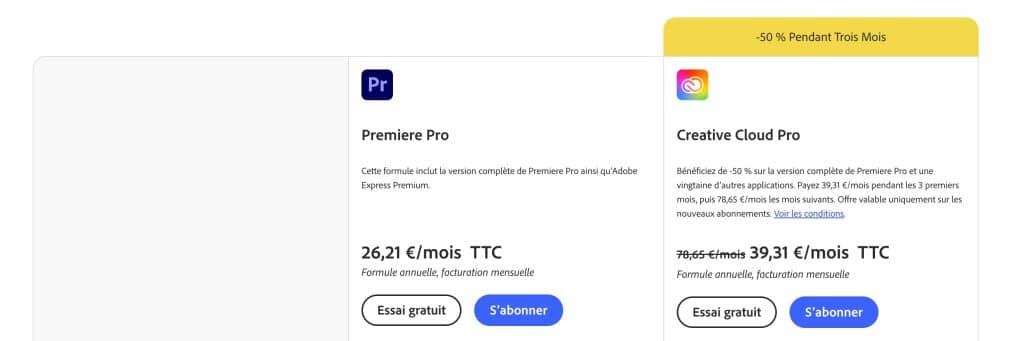
Le logiciel de montage est également un sujet mais, là encore, ce n’est pas forcément une question pure de coût. CapCut est une solution très abordable, facile d’accès et qui ne mettra pas le tarif du logiciel comme point bloquant. Adobe Premiere Pro pourra convenir à toutes sortes de projets, même les plus ambitieux. La solution d’Adobe est certes plus onéreuse, mais reste accessible et est parfois même déjà possédée par des entreprises ayant souscrit à la suite de la marque américaine.
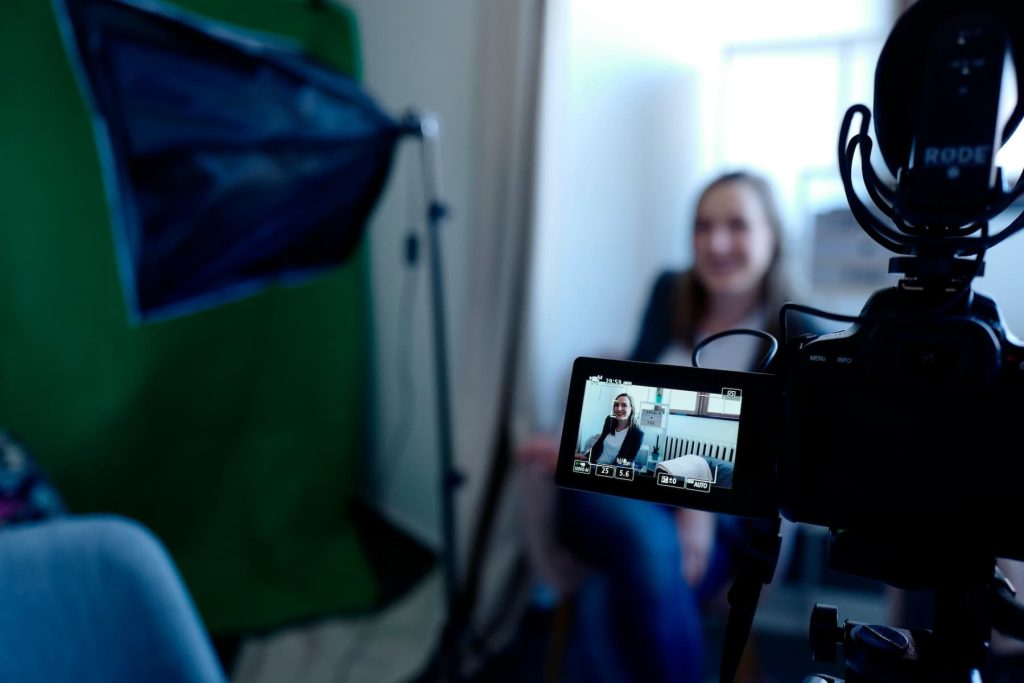
Les points de vigilance devront finalement se faire sur des éléments où l’économie peut coûter cher en qualité perçue : le son et la lumière. Bonne nouvelle néanmoins, ce ne sont pas les plus grands postes de dépense. Un excellent micro se trouve neuf aux alentours de 100 €. Pour l’éclairage, cela dépendra en grande partie des conditions dans lesquelles vous tournez.
Les contraintes humaines, les plus déterminantes
Le plus gros problème, quand on veut se lancer dans la création de contenu vidéo, reste les moyens humains que l’on peut aligner en face. Que ce soit pour la réalisation des vidéos comme pour l’incarnation, si importante et citée précédemment.
Produire de la vidéo demande du temps et se révèle donc coûteux en ressources humaines. Là-dessus, pas de magie : difficile d’y échapper et cela demandera une équipe marketing suffisamment fournie pour permettre cela. Les compétences peuvent s’acquérir sur le terrain, d’autant plus avec la myriade de tutoriels disponibles aujourd’hui, mais rien ne pourra combler le temps nécessaire à l’écriture, au tournage et au montage. Le vrai investissement se situe ici.
Vous l’aurez également compris à la lecture des avantages de la vidéo, vous aurez besoin d’une personne ou de plusieurs pour incarner votre société. C’est ici un point particulièrement sensible puisque vous allez avoir besoin d’un élément fiable qui ne risque pas de quitter la société dans deux mois, sinon cela perd un peu de son intérêt. Cette personne devra également avoir une certaine légitimité pour s’exprimer sur des sujets nécessitant une expertise. Enfin, tout le monde n’est pas à l’aise devant une caméra. Si cela se travaille, comme n’importe quel autre sujet, on ne peut pas attendre d’un collaborateur qu’il se prête avec autant de facilité à l’exercice vidéo qu’à celui de la rédaction d’un article de blog.
Sur ce dernier point, la réponse demandera une étude au cas par cas. Selon la taille de votre structure et la composition de votre équipe, les réponses seront différentes. L’incarnation peut aussi bien venir d’un cadre dirigeant que d’une ou plusieurs personnes salariées. Il n’y a pas de bonne ou de mauvaise approche, simplement des solutions plus ou moins adaptées à vos ambitions et contraintes.

Tout sous-traiter, une option viable ?
La sous-traitance peut être une option de facilitation pour s’éviter bon nombre de contraintes, qu’elles soient techniques ou humaines. Vous aurez alors plusieurs possibilités concernant les choses à sous-traiter :
- La stratégie de contenu
- La construction/location du lieu de tournage
- Le tournage en lui-même
- L’incarnation en vidéo
- Le montage
- Etc.
Chaque élément présente des avantages et des inconvénients et aucune solution n’est parfaite. Il est cependant intéressant de garder en tête qu’à l’instar d’un rédacteur professionnel externe alimentant votre blog, votre stratégie de contenu peut reposer sur une personne tierce réalisant vos vidéos avec votre collaboration.
C’est d’ailleurs une manière encore peu courante, mais très pertinente de collaborer avec des créateurs de contenu. Plutôt que de voir une créatrice que vous jugez pertinente comme une simple opportunité d’espace publicitaire, il est parfois bien plus pertinent de développer avec cette dernière un format spécifique à votre entreprise, sur vos propres médias. Son image vous sera alors utile, mais cela sera également le cas de son expertise au sens large.

Une stratégie pour du long terme
Quels que soient vos moyens et vos choix, il faudra éviter de tomber dans l’écueil que l’on retrouve bien trop souvent en matière de création de contenu : les belles intentions qui ne durent que six mois. Aucun projet n’est parfait au départ et les ambitions sont généralement plus sages lorsqu’elles sont modestes. Que ce soit sur le rythme de publication comme sur les moyens mobilisés pour produire chaque vidéo : gardez en tête que vous devez construire une stratégie qui sera tenable sur le long terme.
Une chaîne YouTube d’interviews reposant sur un contenu par mois durant un an aura plus de chance de trouver son public qu’un même média avec six contenus en autant de semaines mais s’arrêtant après ce début en fanfare. De la même manière, un podcast d’interviews tourné avec une caméra d’ensemble sera peut-être moins satisfaisant au départ qu’un équivalent avec cinq caméras pour autant d’angles. Reste que si cela vous permet de diminuer drastiquement le temps de montage et donc de tenir sur la durée : le choix le moins ambitieux est pourtant sûrement celui qui vous apportera le plus sur la durée.
Quel contenu y produire ?
Au-delà des moyens, le frein principal qui revient concernant la création de contenu vidéo est souvent la fameuse phrase « je n’ai rien à raconter ». Pourtant, si votre structure existe, c’est que d’une manière ou d’une autre elle a pour mission d’apporter des choses à des clients, patients, partenaires. Il y a donc forcément des choses à développer en matière de contenu vidéo.
SEO & Contenu vidéo, des synergies évidentes
Pour une entreprise mature sur le référencement naturel, la tentation peut être de se servir de ses connaissances concernant les recherches des internautes pour produire du contenu vidéo lié. Pour cause, comme on l’a vu au tout début de l’article, les plateformes vidéos sont désormais des moteurs de recherche et l’expression de besoin directe existe même sur YouTube ou TikTok.
Dans de nombreux cas, cela peut représenter une première stratégie parfaitement viable. Au-delà de la visibilité que vous aurez sur ces requêtes lorsqu’elles seront formulées sur les plateformes vidéos, vous aurez également des chances de ressortir dans les SERP Google grâce à vos créations YouTube. Une stratégie qui permet de faire d’une pierre deux coups et qui rassure au cas où l’expression de besoin serait présente sur Google et non YouTube.
Attention néanmoins à ne pas agir en mimétisme complet entre votre stratégie de contenus textuels pour le SEO et votre stratégie de contenus vidéo. L’expression de besoin ne s’y formule pas toujours de la même manière. Exemple concret : si je suis très content de trouver rapidement sur Google un article avec tableau concernant le barème d’imposition, je n’ai pas forcément envie ou besoin qu’on m’y réponde à travers un format vidéo.

Comme pour tout contenu, priorité à l’apport de valeur
L’algorithme des plateformes vidéos va suggérer des contenus aux utilisateurs, ainsi on peut se retrouver plus proche d’une stratégie Google Discover que d’une pure stratégie SEO. En découle alors une autre approche stratégique ne visant pas à répondre à des interrogations directes des internautes mais à susciter leur intérêt à travers un contenu leur apportant de la valeur. C’est là que le travail de persona marketing prend tout son sens.
Si je vends une solution CRM à des entreprises, il sera difficile de me placer sur les expressions de besoin directes de mes cibles. Elles ne seront pas toujours formulées de façon aussi massive que ce qu’est en réalité le marché, et en réponse je me retrouverai vite face à une très grande concurrence en SEA comme en SEO. Par contre, si je produis une série de vidéos à destination du persona décisionnaire sur le choix de CRM et traitant de divers sujets ayant son intérêt : j’ai de grandes chances de créer des points de contact.
Mieux encore, grâce à ces contenus, je pourrais non seulement créer un premier canal d’acquisition, mais je pourrais également développer une image d’expertise si mes vidéos sont perçues comme utiles et qualitatives. Par effet de halo, ma solution CRM profitera également de cette image. Et je ne parle même pas du bénéfice de l’incarnation précédemment cité, qui sera parfait pour la mise en confiance.
La réutilisation du contenu, un enjeu crucial
Pour la production de contenu vidéo, il faut également penser à sa réutilisation. C’est la même logique qu’un livre blanc, qui peut être décomposé en articles de blog pour ensuite alimenter une newsletter. Le but est de rentabiliser au maximum la production d’une matière première coûteuse et, bien évidemment, la vidéo entre parfaitement dans ce cadre.
Si j’ai beaucoup parlé de podcasts jusqu’à présent, c’est par intime conviction qu’il s’agit d’un exemple parfait. Un format vidéo d’interview pourra se décliner en podcast sur les plateformes d’écoute. Il pourra également être découpé en séquences thématiques, remonté, dynamisé pour produire d’autres vidéos. Des extraits pourront également être produits pour des YouTube Shorts, des TikTok, des vidéos Instagram ou même Facebook. En bref : avec seulement une vidéo à la base, vous pourrez en réalité en produire plusieurs et surtout développer la présence de votre marque sur de nombreuses plateformes.
Le podcast est un exemple, mais cela peut valoir sur des formats différents. Reste que cela mérite d’être pensé en amont, notamment si vous souhaitez calculer les coûts et les productions réelles qu’induisent le tournage d’un contenu vidéo.

Comment mesurer son retour sur investissement ?
Qui dit investissements marketing importants dit, bien évidemment, volonté de calculer son retour sur investissement. Selon les stratégies, cela peut se rechercher de manière plus ou moins directe, mais il ne faut jamais perdre de vue que la vidéo est soumise aux mêmes contraintes et limites que d’autres stratégies de contenu.
Peut-on rechercher la rentabilité directe ?
Rien de plus rassurant que Google Ads. Un coût par clic, un taux de conversion, éventuellement des paramètres supplémentaires à ajouter comme le taux de signature ou la fidélisation, mais le calcul de rentabilité se fait de façon relativement simple. Pour la création vidéo, c’est relativement différent.
Si vous pensez votre création vidéo comme une stratégie d’acquisition directe de clients, vous faites probablement déjà une première erreur. La vidéo doit être pensée comme une brique d’une stratégie d’inbound marketing. Elle sera réassurance et fidélisation pour certains, vecteur de notoriété pour d’autres, voire simplement enjeu d’image. Un discours commercial franc et direct au sein d’un contenu lui fait souvent perdre toute sa valeur : inutile donc d’attendre un calcul de rentabilité aussi direct qu’avec une campagne de publicité sur les moteurs de recherche.
Alors, bien évidemment, votre création de vidéos, en cas de succès, va permettre une acquisition directe, mais cela devrait davantage être vu comme un objectif à long terme qu’une préoccupation immédiate. Qui plus est, cela ne sera qu’une retombée parmi de nombreuses.
Ce qui peut être mis en place
Concernant la rentabilité directe, Google Analytics sera votre meilleur allié pour détecter les sources de trafic venant de vos vidéos YouTube. Vous pouvez évidemment coupler ça à des liens traqués ou même à des codes promos exclusivement diffusés dans vos contenus vidéos si votre activité et votre contenu vous le permettent. Toujours dans le calcul de rentabilité directe, un formulaire demandant à l’internaute où il vous a connu peut être utile, ou la systématisation de la question de la part de vos équipes commerciales.
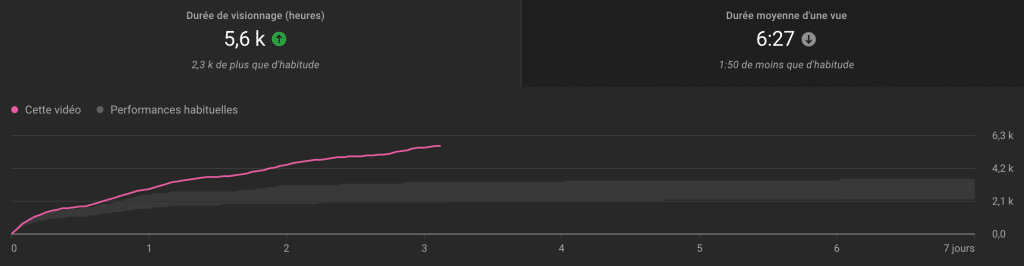
Le plus pertinent reste néanmoins de vous fier aux indicateurs de notoriété directement présents sur les plateformes. Le nombre d’abonnés sur votre compte n’a, au final, que peu d’importance : focalisez-vous sur les vues et leur évolution. Surveillez également le watch yime réel de votre contenu et cela vous donnera une indication sur la pertinence de votre contenu. Finalement, on est assez proche des indicateurs présents sur n’importe quels autres réseaux sociaux classiques.
Les exemples qui devraient vous inspirer
Puisqu’il est parfois complexe de se projeter, présentation de deux stratégies pour trois acteurs. Des approches relativement simples à analyser mais dont l’efficacité est redoutable.
Runwise et Finary, deux exemples sur l’expertise
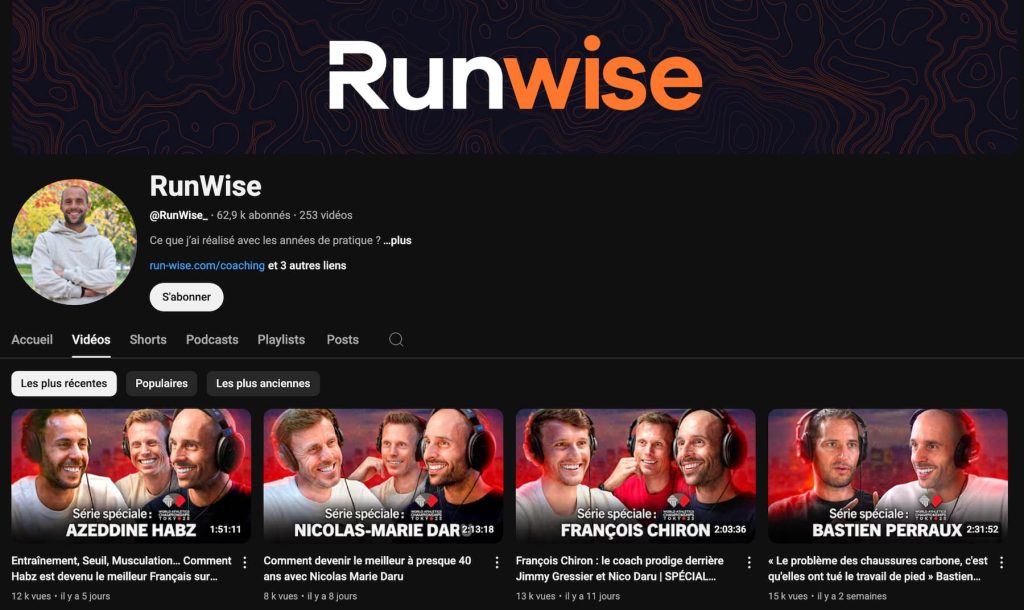
Runwise est une société proposant du coaching en course à pied, une activité en plein développement mais où la concurrence est féroce. D’autant plus qu’ici le coaching est réalisé par un professionnel humain et qu’il fait face à la concurrence plus abordable des applications.
Finary est une application ayant pour but de simplifier la gestion de son patrimoine et de ses investissements. Un secteur tout aussi concurrentiel où Finary a développé une base de plus de 500 000 utilisateurs.
Ces deux sociétés, si elles n’ont sur le papier pas grand-chose à voir sur le papier, ont construit leur stratégie YouTube de la même manière : l’éducation. Runwise va vulgariser la physiologie et les méthodes d’entraînement pour permettre à chacun de développer ses compétences en la matière. Finary propose énormément de contenus d’éducation financière pour mieux gérer ses investissements. Les deux chaînes YouTube publient également des formats longs, des podcasts vidéos, donnant la parole à des références dans leur secteur respectif. Des sportifs et entraîneurs inspirants pour Runwise, des entrepreneurs et financiers couronnés de succès pour Finary.
Dans les deux cas, la logique est la même : fournir de nombreuses compétences gratuites et à haute valeur ajoutée aux internautes sans pour autant chercher à forcer sur le discours commercial. Cela pourrait même être presque perçu comme l’inverse. Des coureurs pourront parfaitement se construire un premier entraînement cohérent grâce aux contenus de Runwise sans avoir à faire appel à un coach. Pour Finary, la concurrence entre les connaissances transmises et leur plateforme apparaît comme moins directe, mais la logique peut se prolonger.
Reste que pour Runwise comme pour Finary, cela permet aux sociétés de développer plusieurs choses : de la confiance, de l’affect et une reconnaissance de leurs compétences. Ainsi, de nombreux coureurs font appel à la société Runwise lorsqu’ils décident de passer le pas du coaching, car il apparaît logique de travailler avec un coach aux méthodes similaires à celles qui nous ont poussés à apprécier la chaîne YouTube. Cela exclut d’office la concurrence, pourtant féroce dans ce secteur. Concernant Finary, fort de connaissances nouvelles, l’habitué de leur chaîne YouTube se tournera logiquement vers cette plateforme et non une autre lorsqu’il souhaitera gérer les investissements qu’il vient de réaliser.
On retiendra dans les deux cas une réelle générosité dans le contenu produit et une approche qui n’use d’aucun argument direct pour prouver le sérieux des sociétés, mais dont les vidéos le démontrent par elles-mêmes.
Leroy Merlin, la réponse à l’expression de besoin
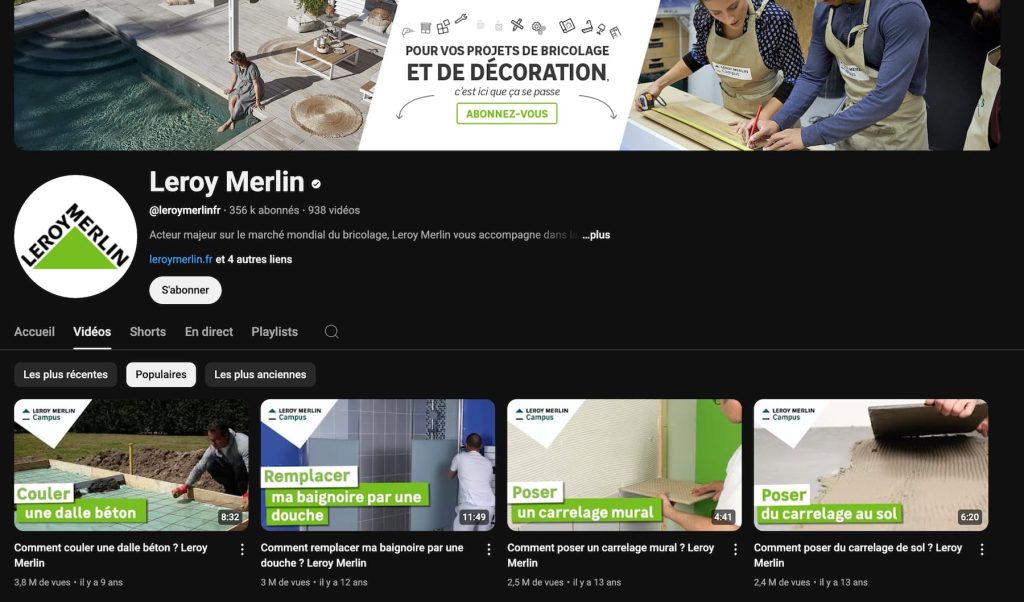
Avec quasiment 1000 vidéos en 14 ans d’existence, la chaîne de Leroy Merlin peut sembler difficile à analyser de prime abord. Pourtant, les plus gros succès de la chaîne sont relativement parlants et datent des tous premiers mois du média vidéo.
Il s’agit de vidéos tuto pour aider les internautes à réaliser une terrasse carrelée, installer un circuit électrique apparent ou encore ragréer un sol. Nous évoquions plus tôt dans l’article que l’expression de besoin n’était pas forcément la même concernant le contenu textuel et vidéo, et Leroy Merlin semble l’avoir compris avant tout le monde. Les tutoriaux pour les travaux prennent tout leur sens en vidéo et les contenus de la marque sont incroyablement utiles pour le persona : la personne souhaitant réaliser ses travaux.
C’est diablement efficace : si je constate des fissures sur un mur en plâtre chez moi, je vais chercher un tuto pour résoudre le problème. Leroy Merlin va me fournir une explication claire et c’est donc tout logiquement chez eux que je vais prendre les produits nécessaires à la réalisation de l’opération. Après tout, je sais déjà qu’ils vont convenir : ce sont ceux qui étaient présents dans le tuto que j’ai visionné !
La stratégie est donc ici différente de ce que l’on a vu pour les deux entreprises précédentes. L’approche est concrète et utile, et cela montre que selon le secteur d’activité, la réponse à l’expression de besoin directe peut être tout aussi pertinente.
L’article “Comment définir une stratégie de contenus vidéo pour son entreprise ?” a été publié sur le site Abondance.