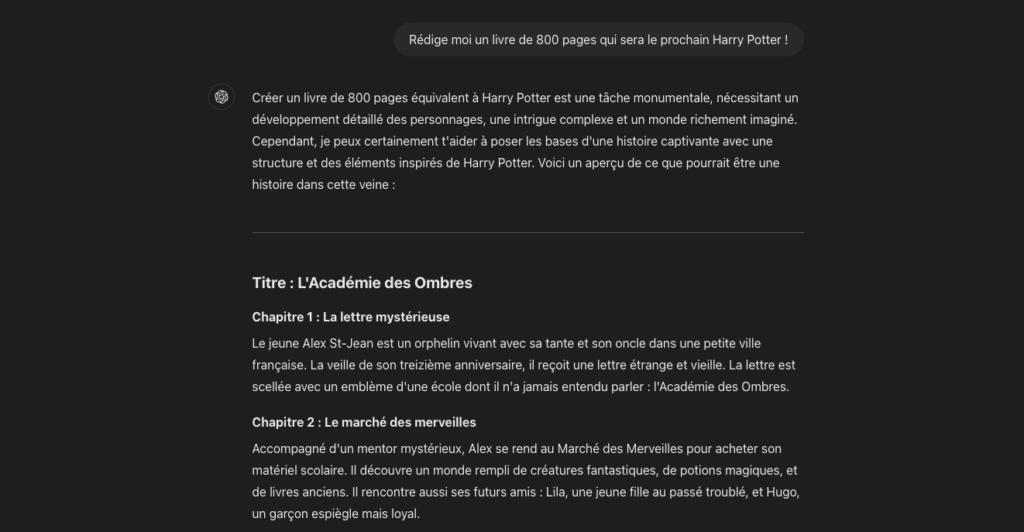
L’intelligence artificielle, et en particulier ChatGPT, offre des possibilités fascinantes pour l’écriture de livres. Cependant, cette approche moderne soulève aussi des débats passionnés quant à son efficacité et son éthique, car, répondons de suite à la question : oui, il est possible d’écrire un livre à l’aide de ChatGPT.
Néanmoins, comme toujours avec l’IA, cela reste un outil à intégrer dans le processus créatif. Il ne faut pas diluer l’authenticité de l’œuvre, votre « patte » d’artiste, au profit d’un écrit robotique.
Alors, comment écrire et publier un livre avec ChatGPT, tout en conservant une qualité humaine dans la rédaction ? On vous explique tout dans cet article !
Comment utiliser ChatGPT pour écrire un livre ?
ChatGPT ne peut totalement remplacer l’humain, mais elle transforme le rôle traditionnel de l’auteur. L’intelligence artificielle dispose d’avantages et d’inconvénients sur la rédaction. Il est important de les connaître pour tirer le meilleur parti de cette technologie lors de l’écriture de votre prochain livre.
Définir les rôles : ChatGPT comme outil, pas comme auteur
La première étape consiste à définir clairement le rôle de ChatGPT dans votre projet. Utilisez-le comme un assistant pour surmonter les blocages, générer des idées, étoffer le profil de vos personnages ou développer des dialogues.
Cependant, l’IA reste guidée par l’écrivain. ChatGPT, ou toute autre IA rédactionnelle, doit s’adapter à la vision et les objectifs spécifiques du livre.
Maintenir la cohérence narrative
Un des plus grands défis lors de l’utilisation de ChatGPT est de maintenir une cohérence dans la narration et le style. Pour y parvenir, établissez un cadre détaillé avant de commencer à utiliser l’IA.
Dans le prompt fourni, intégrez un maximum d’informations sur les descriptions de personnages et les directives stylistiques. Rappelez-les à chaque paragraphe ou chapitre que vous lui demandez de formuler.
D’ailleurs, au fur et à mesure que vous avancez dans l’écriture de votre livre, fournissez vos textes à ChatGPT pour qu’il effectue des propositions unifiées et cohérentes.
Conseil bonus : pensez à repérer les répétitions et tics de langage de l’intelligence artificielle, pour bannir certains termes de vos contenus.
Utiliser ChatGPT de manière sélective et stratégique
Plutôt que de dépendre entièrement de ChatGPT pour écrire de grands pans de texte, considérez son utilisation pour des tâches spécifiques.
Par exemple, l’IA d’OpenAI excelle dans la génération de descriptions créatives, la suggestion de répliques pour les dialogues, ou même dans l’aide à la résolution de problèmes narratifs complexes.
L’outil est aussi capable de reformuler des paragraphes qui vous semblent manquer d’originalité ou de fluidité. C’est un gain de temps précieux lorsque vous bloquez sur la rédaction d’un concept imaginaire ou, au contraire, pour ajouter de la véracité dans une scène au cadre réel et connu (comme un musée, une ville, un monument, une place, un paysage…).
Enrichir son livre ChatGPT avec des faits avérés
Écrire un livre avec ChatGPT offre la possibilité d’enrichir votre récit avec des informations précises et des données contextuelles. Si votre livre nécessite des détails historiques, scientifiques ou culturels, vous pouvez gagner du temps sur les recherches. L’intelligence artificielle les effectue ! Ces détails rendent votre histoire plus immersive et éducative.
Toutefois, il est sage de croiser les informations fournies par ChatGPT avec des sources fiables, surtout pour des sujets complexes ou controversés. Cette diligence évite les incohérences qui pourraient nuire à la crédibilité de votre ouvrage.
Expérimenter la rédaction avec différents genres et voix
Un avantage significatif de l’utilisation de ChatGPT pour écrire un livre est sa flexibilité. L’IA peut endosser plusieurs profils au moment de générer du texte. Vous pourrez expérimenter différents styles d’écriture et de voix narrative pour trouver le ton qui correspond à votre objectif, mais aussi à chaque personnage.
Si c’est votre premier roman, ChatGPT vous aide à améliorer votre compréhension des nuances stylistiques et tonales requises pour chaque genre… et donc à ajouter une touche professionnelle à votre œuvre.
Comment publier son livre rédigé à l’aide de ChatGPT ?
Une fois le manuscrit achevé, la publication est la prochaine étape. L’autoédition, notamment sur des plateformes comme Amazon KDP (Kindle Direct Publishing), offre une solution rapide, gratuitement et relativement simple pour tous les auteurs.
Peu importe qu’il s’agisse d’un roman, d’un livre de recettes ou d’un guide sur le marketing digital : l’auto-publication sur Amazon est possible, avec un processus mené entièrement en ligne.
Pour savoir, en détail, comment faire, consultez notre article « Les 6 étapes pour publier un livre sur Amazon ».
Quant à ChatGPT, il accompagne de nouveau votre rédaction pour augmenter vos chances de vente. Étant donné que l’intelligence artificielle a travaillé sur votre livre, elle peut vous aider à :
- Écrire le résumé du livre de manière captivante.
- Rédiger votre biographie d’auteur pour qu’elle attire l’attention des lecteurs potentiels.
- Préparer les métadonnées, telles que les mots-clés et les catégories pour optimiser le référencement et la visibilité du livre.
Les implications légales de l’utilisation de l’IA en écriture
Bien que pertinent à l’ère numérique, le débat sur les droits d’auteur concernant les œuvres générées par intelligence artificielle est complexe.
Il suffit de prendre l’exemple de la bande dessinée « Zaria of the Dawn ». Kristina Kashtanova, son auteure, a utilisé l’IA Midjourney pour créer les images, fournissant seulement les paramètres nécessaires à la génération des illustrations.
Initialement, l’ensemble de l’ouvrage (textes et images) avait été reconnu sous copyright par l’Office américain du Copyright. Cependant, quelques semaines plus tard, une rectification a été faite : finalement, comme les images ne sont pas issues d’une création humaine directe, elles ne peuvent pas bénéficier de cette protection.
Cette distinction reflète une tension entre les notions économiques et spirituelles du droit d’auteur. Le copyright protège l’œuvre en tant que telle, tandis que le droit d’auteur, surtout dans les pays de droit civil comme la France, inclut également un aspect “moral”, lié à la personnalité de l’écrivain.
En France, l’article L111-1 du Code de la propriété intellectuelle stipule que :
L’auteur jouit, du seul fait de sa création, d’un droit de propriété incorporelle exclusif et opposable à tous, incluant des attributs intellectuels et moraux, ainsi que patrimoniaux.
Néanmoins, dans le cadre d’un livre généré (même en partie) avec ChatGPT, est-ce que la propriété pourrait être entravée ou minimisée ? Pour le moment, cela ne semble pas être le cas, mais à l’avenir, il se peut que des lois changent…
En effet, face à ces enjeux, le Conseil Supérieur de la Propriété Littéraire et Artistique (CSPLA) en France a discuté de la nécessité éventuelle d’adapter le droit d’auteur pour intégrer les œuvres créées par IA.
Cependant, une telle intégration semble complexe et nécessiterait une coordination au niveau international, étant donné les divergences entre les systèmes juridiques et les décisions récentes aux États-Unis.
Notre dernier conseil pour écrire un livre avec ChatGPT
En résumé, écrire et publier un livre avec l’aide de ChatGPT est possible, mais dans une certaine limite. Les IA rédactionnelles arrivent à structurer des idées, rechercher des faits ou détails, peaufiner le style ou simplifier la publication. Cependant, la réussite de ce projet repose sur un partenariat judicieux entre l’humain et la machine, garantissant que l’œuvre finale reste personnelle, authentique et d’une grande qualité.
Vous avez besoin d’aide pour écrire un livre ? Laissez les plumes aguerries de Redacteur.com rédiger un livre blanc, un roman ou le script d’une bande dessinée pour vous !
L’article Peut-on écrire un livre avec ChatGPT et le publier ? est apparu en premier sur Redacteur.com.